Is your LinkedIn reach in a tailspin? If you’ve noticed your once-reliable engagement numbers dipping, you aren’t alone. LinkedIn has quietly executed one of the most significant overhauls in its history, transitioning from a patchwork of five disparate systems into a single, unified, AI-driven powerhouse.
For creators, marketers, and business leaders, this isn’t just a minor update—it is a fundamental shift in the rules of engagement. To decode this new landscape, we spoke with LinkedIn Ads expert AJ Wilcox to understand how the platform’s new "brain" determines who sees your content and how you can reclaim your visibility.
1. The Architectural Shift: Moving from Relationships to Relevance
Historically, LinkedIn’s feed operated on a fairly predictable logic: if you were connected to someone, you were likely to see their posts. This "social graph" model favored your network above all else.
The new LinkedIn algorithm has pivoted toward an interest-based distribution model. Much like the evolution seen on YouTube, Facebook, and TikTok, the platform now prioritizes "professional journeys" over simple connection counts. The algorithm tracks your behavior to build an ongoing, evolving profile of your professional interests, rather than reacting solely to the last item you clicked.
The Rise of the Specialist
The most profound implication of this shift is the "specialist’s advantage." The algorithm now understands semantic meaning, not just keywords. A post discussing "reducing churn" can now reach a user searching for "customer retention," even if the exact phrase is absent from the post.
By consistently producing content within a specific niche, you "train" the AI to associate your profile with that topic. This creates a compounding effect: the more you post about a core subject, the more reliably the algorithm surfaces your content to the right audience. Conversely, generalists who oscillate between disparate topics—such as AI, pet photos, and career fairs—dilute their authority, causing the algorithm to view each post as an isolated, unrelated signal.
2. The Era of "Invisible Engagement"
For years, marketers have been obsessed with vanity metrics: likes, shares, and public comments. However, data analysis of over 600,000 posts from 63,000 accounts indicates that these visible signals are declining in importance.
The new algorithm is increasingly governed by invisible engagement signals. These are the behaviors that leave no public trace but speak volumes about user intent:

- Dwell time: How long a user lingers on your post.
- Document swipes: Tapping through a carousel or PDF.
- "See more" clicks: Expanding a truncated post.
- Video completion rates: Watching a clip to the end.
Combined, these invisible interactions drive overall engagement up by nearly 14%. To succeed, you must move beyond the "like" and engineer content that invites deeper, non-public interaction.
3. Engineering Your Content Strategy
If the algorithm is now an AI curator, how do you feed it the right data? The answer lies in structural shifts to your content creation process.
The Power of Carousels and Documents
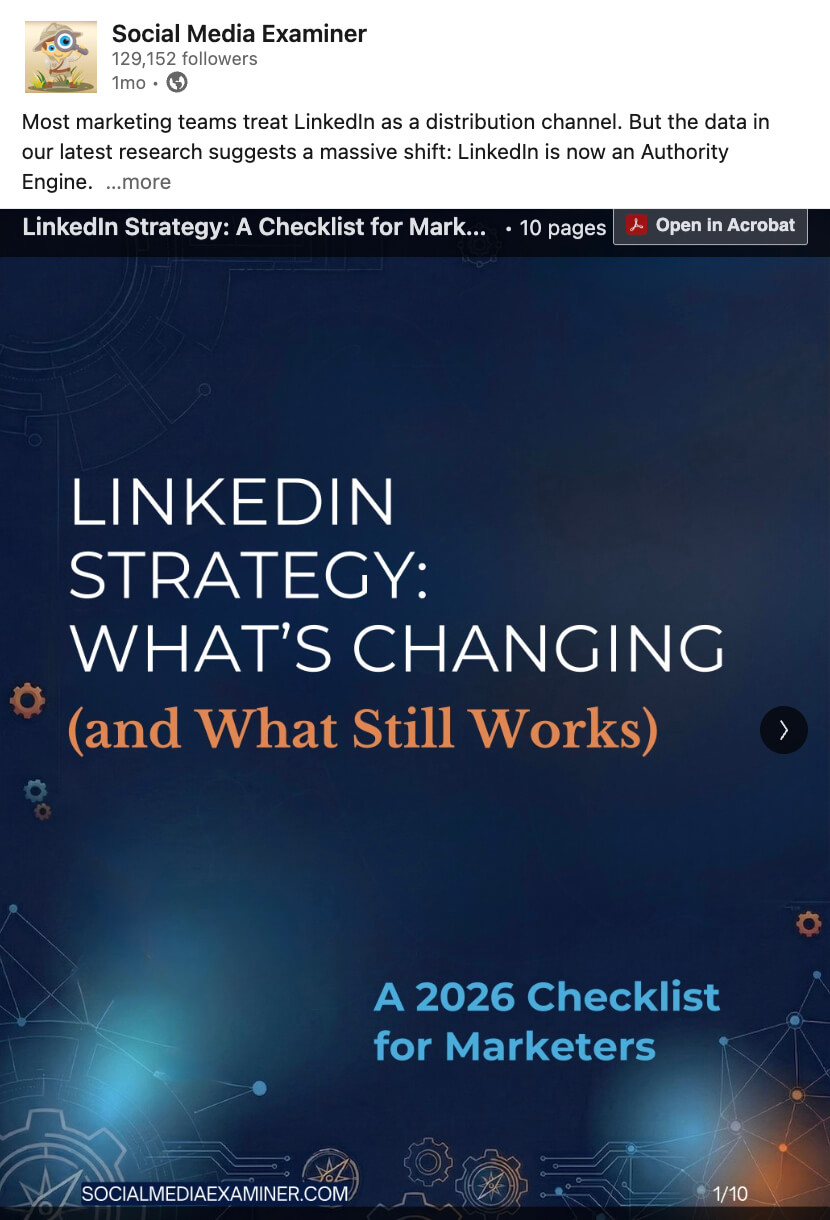
Document posts and carousels are currently the highest-performing formats on the platform. Because they require the user to physically swipe through slides, they generate high-intent invisible signals.
- Strategy: Transform your long-form insights into step-by-step guides, tip lists, or condensed slide decks. By forcing a "swipe" action, you are effectively signaling to the algorithm that your content is high-value and worthy of wider distribution.
The "See More" Hook
Impressions are fleeting; half of all post impressions occur within the first 48 hours. If your post fails to generate early interaction, it effectively dies in the feed. The "See more" click is a critical metric.
- Tactical Advice: Craft openings that create curiosity without giving the entire value proposition away in the first two lines. A strong hook is not clickbait; it is a promise of value that forces the user to expand the post to get the answer.
The Depth of Dialogue
The algorithm no longer counts the quantity of comments; it evaluates the density of the conversation. A back-and-forth exchange in the comments section is a massive signal of quality.
- Best Practice: Avoid generic calls-to-action like "Drop your thoughts below." Instead, ask specific, nuanced questions tied to the content. Furthermore, respond to comments within the first hour of publication. This "early burst" of activity acts as a signal to the platform that the post is active, prompting the AI to push it to a larger segment of your audience.
4. Fighting Content Fatigue
A common struggle for creators is the feeling that they are repeating themselves. AJ Wilcox notes that marketers often suffer from "creator fatigue," fearing they have run out of original ideas. However, the data suggests two vital reframes:
- Your Audience is Always New: The person reading your post today is likely encountering your ideas for the first time. You do not need to invent the wheel every day; you need to refine your message for a rotating audience.
- Vary the Angle, Not the Subject: The algorithm evaluates whether content represents original thought or simple repurposing. Use tools like AI to brainstorm new metaphors, fresh formats, or contrarian perspectives on your core topic. A creator who approaches the same subject from ten unique angles signals authority; one who posts the same template over and over signals fatigue.
5. Implications for the Future
The shift toward an AI-driven, interest-based feed means that LinkedIn is becoming a discovery engine rather than a static networking list.
Why This Matters
For B2B companies and individual professionals, the implications are clear:
- Authority Building: If you are not known for a specific pillar of expertise, you are effectively invisible to the new algorithm. You must commit to a niche.
- The Death of Spam: The algorithm is becoming increasingly sophisticated at identifying low-effort, AI-generated, or "engagement-farm" comments. Avoid automated engagement tools, as they are likely to penalize your reach rather than boost it.
- Community First: The most effective "hack" for the new algorithm is human connection. By answering questions, engaging in substantive dialogue, and listening to the specific challenges of your audience (often found in DMs), you gather the raw material for your next piece of high-performing content.
A Final Note on Strategic Consistency
As LinkedIn continues to refine its "AI brain," the platforms that survive will be those that prioritize high-quality, original, and deeply relevant content. The algorithm is no longer a hurdle to overcome; it is an echo chamber of your own consistency. If you provide genuine value and foster real conversations, the algorithm will reward you by placing your content in front of the people who are actually looking for your expertise.
By moving away from vanity metrics and toward structural engagement—specifically carousels, depth-oriented conversations, and specific, curiosity-driven hooks—you align your strategy with the platform’s long-term goals. The "new" LinkedIn is not a place for noise; it is a place for the signal.
For those looking to stay ahead, remember: the most important metric is no longer what the public sees, but what the AI detects.