In the rapidly evolving landscape of digital advertising, a profound tension persists between traditional methodologies and the relentless march of artificial intelligence. For marketing professionals, the central question has shifted from "How can I better manage my search campaigns?" to "Why am I still manually steering a vehicle that is designed to drive itself?"
The Google Ads platform, much like its counterpart at Meta, has fundamentally transformed from a granular, human-controlled interface into an AI-powered engine. Despite this, a significant portion of the industry remains tethered to legacy practices—the digital equivalent of insisting on riding a horse in an era of fuel-efficient motorcycles. As we navigate this transition, the distinction between those who embrace AI and those who resist it is no longer just a matter of preference; it is a defining factor in corporate profitability and career longevity.
The Chronology of Control: From Manual Manipulation to Algorithmic Autonomy
To understand where we are, one must look at the evolution of search marketing over the past two decades. In the early days of Google AdWords, success was defined by the marketer’s ability to manipulate the environment. Agencies and in-house teams spent countless hours obsessing over match types, bid modifiers for devices, time-of-day scheduling, and hyper-segmented audience targeting. This era was defined by "control-first" management—the belief that a human being could, through sheer force of will and spreadsheet dexterity, outperform an automated auction system.
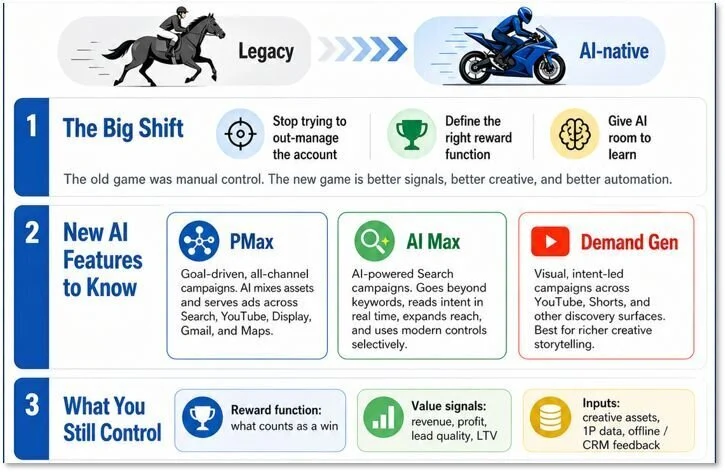
However, the reality of the current landscape is starkly different. Today, Google’s "AIfying" of its platform is complete. With the introduction of Performance Max (PMax), AI Max, and Demand Gen, the mechanism of value delivery has migrated from manual keyword selection to real-time intent analysis.
- Performance Max (PMax): By feeding the system specific goals, budgets, and creative assets (text, imagery, video), the AI autonomously orchestrates ad placement across the entirety of the Google ecosystem, including Search, YouTube, Display, Gmail, and Maps.
- AI Max: A specialized search-only campaign model that abandons the rigid hierarchies of brand/non-brand and match types, instead analyzing search intent in real-time to capture relevant audiences regardless of the specific keywords typed.
- Demand Gen: A visual-centric evolution of Discovery ads that utilizes deep learning to place video and static assets in front of users based on intent signals that far exceed human analytical capabilities.
The shift is clear: the industry has moved from a "management" model to an "architectural" model. The marketer’s role is no longer to steer the ship, but to design the compass.
Supporting Data: The Case for Algorithmic Maturity
The resistance to this transition often stems from a lack of trust in the "black box." However, industry veterans, including former Google insiders, argue that the "doozy" decisions made by AI are statistical anomalies, often explainable by Hanlon’s Razor—they are rarely malicious, merely the result of a learning system that improves daily.
When evaluating an organization’s readiness for this new era, maturity models provide a necessary, objective lens. A robust maturity assessment hinges on two primary axes: Capability Scoring (how sophisticated is the internal team?) and Depth Scoring (how widespread is that sophistication across the organization?).
The Maturity Framework
A true "AI-native" organization (scoring a 4 on a scale of 0–4) is characterized by:
- Measurement & Value Architecture (30% weight): Shifting from vanity metrics like sessions or clicks to "reward functions"—optimizing for revenue, profit, or long-term customer lifetime value (LTV).
- Search Operating Model (20% weight): Abandoning the "SKAG" (Single Keyword Ad Group) structure in favor of Smart Bidding and AI-led broad matching.
- Data & Audience Intelligence: Leveraging first-party data to fuel the machine’s learning.
- Creative Adaptability: Allowing the system to mix and match assets based on real-time performance.
- Operating Cadence: Moving from daily manual adjustments to governance-based monitoring.
The objective is a composite score of 85 or higher. Organizations scoring below 30 are categorized as "Legacy AdWords Operators," essentially functioning as tourists in a modern digital environment.
The Implications of Professional Stagnation
The cost of refusing to modernize is not merely theoretical; it is financial and professional. "Profit pulverizing" is the inevitable result of manual micromanagement in an AI-optimized auction. When agencies or internal teams spend their day adjusting bid modifiers or slicing campaigns by device, they are failing to utilize the very signals that the AI is optimized to capture.
The Human-AI Collaboration
The modern search professional must embrace an "embrace and extend" strategy. This involves:
- Defining the Reward Function: The machine is excellent at finding conversions, but it needs to know what a "good" conversion looks like. Providing CRM data, offline conversion imports, and lead quality scores allows the machine to optimize for the business outcome that actually matters: profit.
- Creative Stewardship: If the AI is the engine, creative assets are the fuel. Professionals must pivot their time away from keyword management and toward developing high-quality, diverse creative assets that the AI can deploy across various channels.
- Governance over Micromanagement: Rather than manually tweaking campaigns, the modern marketer acts as a guardrail. They set the boundaries—brand safety, budget limits, and audience exclusions—and let the AI iterate within those parameters.
Addressing the Resistance: The "Horse vs. Motorcycle" Analogy
The persistent framing of search marketing as a "Brand vs. Non-Brand" conflict is perhaps the most significant indicator of institutional immaturity. In an AI-native world, this distinction is increasingly irrelevant. The machine is concerned with intent, not the semantic categorization of a user’s query.
When marketers insist on manual control, they are limiting the machine’s ability to learn. Every time a human overrides an automated bid, they are effectively telling the algorithm to ignore millions of data points it has processed regarding that user’s intent. To stop "monkeying" with settings is not to surrender control; it is to shift control to a level of intelligence that can process signals across Search, YouTube, and Maps simultaneously—a task impossible for any human team.
The Path Forward: A Call to Action
For serious marketing and analytics professionals, the mandate is clear: abandon the "AdWords-era" mindset. The transition is culturally painful because it requires admitting that the "soul-sucking" work of the past is no longer valuable. However, the payoff is significant. Companies that successfully transition to an AI-first operating model report 3x to 20x improvements in revenue and profit efficiency.
Steps to Achieve Maturity:
- Audit the top 80% of spend: Identify where your budget is being wasted on manual interventions that yield no statistical benefit.
- Standardize Measurement: Ensure your primary conversion actions are tied to business value (revenue/LTV) rather than volume.
- Implement Enhanced Conversions: Leverage Google’s data-handling capabilities to improve signal accuracy.
- Test AI Max: Transition core campaigns to automated matching to see the performance ceiling for yourself.
- Score Your Maturity: Perform an honest, ego-free audit of your current operations. If the score is low, use it as a roadmap for transformation.
The choice to stay in the past is, in a pragmatic business context, no longer an option. The competition is already feeding the machine, optimizing their creative, and scaling their reach through automation. Those who persist in "riding the horse" will find themselves left behind, while those who master the "motorcycle" will define the future of digital performance.
The era of the "Search Marketer" as a button-pusher is over. The era of the "Performance Architect" has begun. Carpe diem.