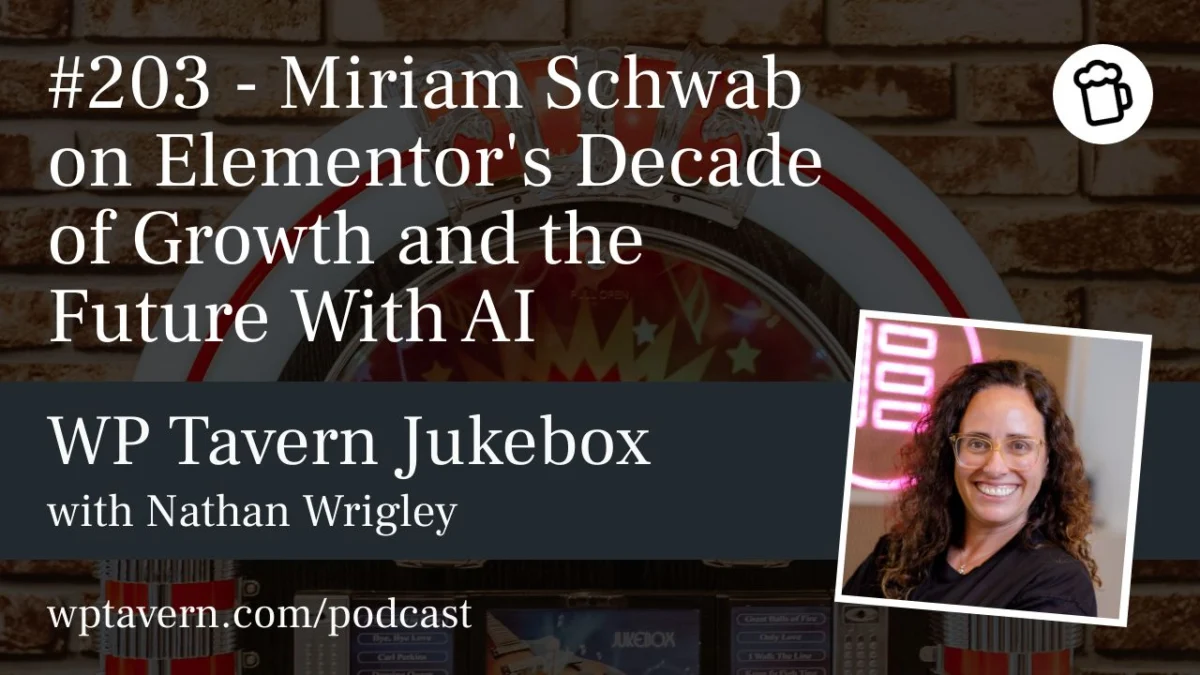
As the WordPress ecosystem stands on the precipice of its next great transformation, few figures are as uniquely positioned to navigate the turbulence as Miriam Schwab. Having spent two decades in the WordPress trenches—transitioning from service provider to agency lead, founder of the pioneering static-WordPress startup Strattic, and now the "Head of WordPress" at Elementor—Schwab has witnessed the platform’s journey from a humble blogging tool to the backbone of the modern web.
In a recent, in-depth discussion on the WP Tavern Jukebox podcast, Schwab reflected on the meteoric rise of Elementor, the necessity of evolving legacy architecture, and the urgent, industry-wide race to integrate agentic AI.
The State of the Ecosystem: A Decade of Growth
Elementor, which celebrates its tenth anniversary this year, has evolved from a niche page builder into a global juggernaut. According to data cited by Schwab, Elementor now powers over 13% of the entire web. This growth trajectory is not merely a reflection of legacy installations; the platform added approximately 3.5 million new sites over the course of 2025 alone.
This rapid expansion has earned Elementor the title of "Top Content Management System" by W3Techs for three consecutive years—a metric that reflects the sheer volume of new websites launched on the platform, outpacing industry rivals like Wix and Shopify. For a 10-year-old product, maintaining this momentum is a feat of engineering and market strategy, but it also carries significant weight. With such a vast user base, every update—including the recent overhaul to Version 4—requires a rigorous, almost surgical approach to backward compatibility.
Chronology: From Static Sites to AI Agents
Schwab’s career mirrors the maturation of the WordPress ecosystem itself. Her early days focused on custom agency work, providing a firsthand view of the complexities inherent in scaling WordPress for major tech firms and nonprofits. This culminated in the founding of Strattic, which solved the "WordPress trilemma" of speed, security, and scalability by introducing static architecture to dynamic sites.
When Elementor acquired Strattic in 2022, it was more than a business transaction; it was a strategic integration of high-performance architecture into the most popular page-building experience on the market. Now, in her role as Head of WordPress, Schwab acts as the bridge between Elementor’s internal development teams and the broader open-source community, navigating a landscape where the "old guard" of web development is being rapidly disrupted by artificial intelligence.
The AI Mandate: Building the Future
The defining narrative of 2025 and 2026 for the WordPress community has been the pivot toward AI. Schwab emphasizes that Elementor’s strategy is not just about adding "check-box" AI features like text generation or image creation; it is about building a cohesive, agentic infrastructure that secures WordPress’s relevance for the next two decades.
The Three-Pronged AI Strategy
Elementor’s approach to AI is currently divided into three distinct operational layers:
- In-Editor Assistance: This includes the standard generative tools—text and image creation—that users now expect. While "de rigueur" today, these tools are foundational to maintaining a competitive user experience.
- Angie and Agentic Capability: Perhaps the most significant development is "Angie," a standalone plugin that brings agentic AI to the WordPress backend. Unlike simple text-to-content tools, Angie acts as a site administrator, capable of managing categories, WooCommerce products, and user permissions. By exposing over 200 WordPress "tools" to an AI agent, Elementor is effectively teaching the CMS how to self-manage.
- Site Planner: Designed to solve the "blank canvas" problem, Site Planner uses conversational AI to guide users through the initial stages of web development. By asking targeted, clarifying questions, it generates a comprehensive site brief and a structured wireframe, effectively carrying a project from inception to 80% completion.
Official Perspectives: The Abilities API and Standardization
A critical point of discussion is the "Abilities API," a project developed by the WordPress core team to standardize how AI interfaces with the CMS. Schwab highlights a fascinating moment of parallel development: while the WordPress core team was working on the Abilities API, Elementor’s team was independently building their own toolset for Angie.
"The team built their own tools to expose WordPress capabilities because they didn’t wait for the core solution," Schwab notes. "Now, the goal is to sync up with the Abilities API and leverage it."
This standardization is vital. By creating a unified language for AI to interact with WordPress, the ecosystem is future-proofing itself. It ensures that regardless of how LLMs (Large Language Models) evolve—whether they become more autonomous or integrate into new interfaces like neural links—WordPress will remain a compatible, programmable environment.
Implications for the Industry
The shift toward AI-driven workflows presents a profound challenge to traditional web developers and designers. As tasks that once required hours of manual "tinkering"—such as padding adjustments, image cropping, and CSS styling—become instantaneous, the role of the professional is forced to pivot.
The Human in the Loop
Schwab argues that the value of the human professional is not disappearing; it is shifting. The developer is no longer just the "hammer and nail" technician; they are the director and strategist. "The quality of the results will be dependent on the skillset of the user—not in terms of ‘how do I get AI to do stuff,’ but the skillset of knowing what an excellent website should be," she says.
This "Director" model suggests that the future of web design lies in oversight. Professionals will manage AI agents to ensure that output meets high design standards, accessibility requirements, and business goals.
The Support Conundrum
As AI takes on more administrative tasks, the nature of support is also set to change. With tools like Angie, users may inadvertently "break" their sites in novel ways—such as accidentally deleting their own administrative access. Elementor is responding by embedding "guardrails" directly into the AI logic, requiring human confirmation for critical actions. Simultaneously, AI is expected to revolutionize support by analyzing vast knowledge bases to provide real-time, context-aware solutions to common issues.
Accessibility and the Future
One of the most pressing questions is whether AI-generated sites can adhere to WCAG (Web Content Accessibility Guidelines). Schwab acknowledges that AI is not a magic bullet for accessibility; it requires tools and specific direction. To address this, Elementor has championed the "Ally" plugin, which doesn’t just scan for accessibility issues but proactively suggests and implements fixes. This highlights a recurring theme: AI is a tool that requires a "human in the loop" to ensure that efficiency does not come at the cost of inclusivity.
Looking Toward 2026: A New Era
As the interview concluded, Schwab expressed a palpable sense of optimism for the coming year. She views the current AI-driven turbulence not as a threat, but as a "reignited spark for innovation."
"WordPress has been amazing for over 20 years," she concluded. "But AI takes it to a whole other level and makes innovation more accessible. We’re going to see some amazing things released over the course of 2026—not just by Elementor, but by the entire ecosystem—that will make WordPress shine."
For the millions of creators who call WordPress home, the message is clear: the platform is not merely surviving the AI revolution; it is actively building the tools to lead it. As we look toward 2026, the question is no longer whether AI will change WordPress, but how effectively the community can leverage these new, powerful capabilities to push the boundaries of what a website can be.