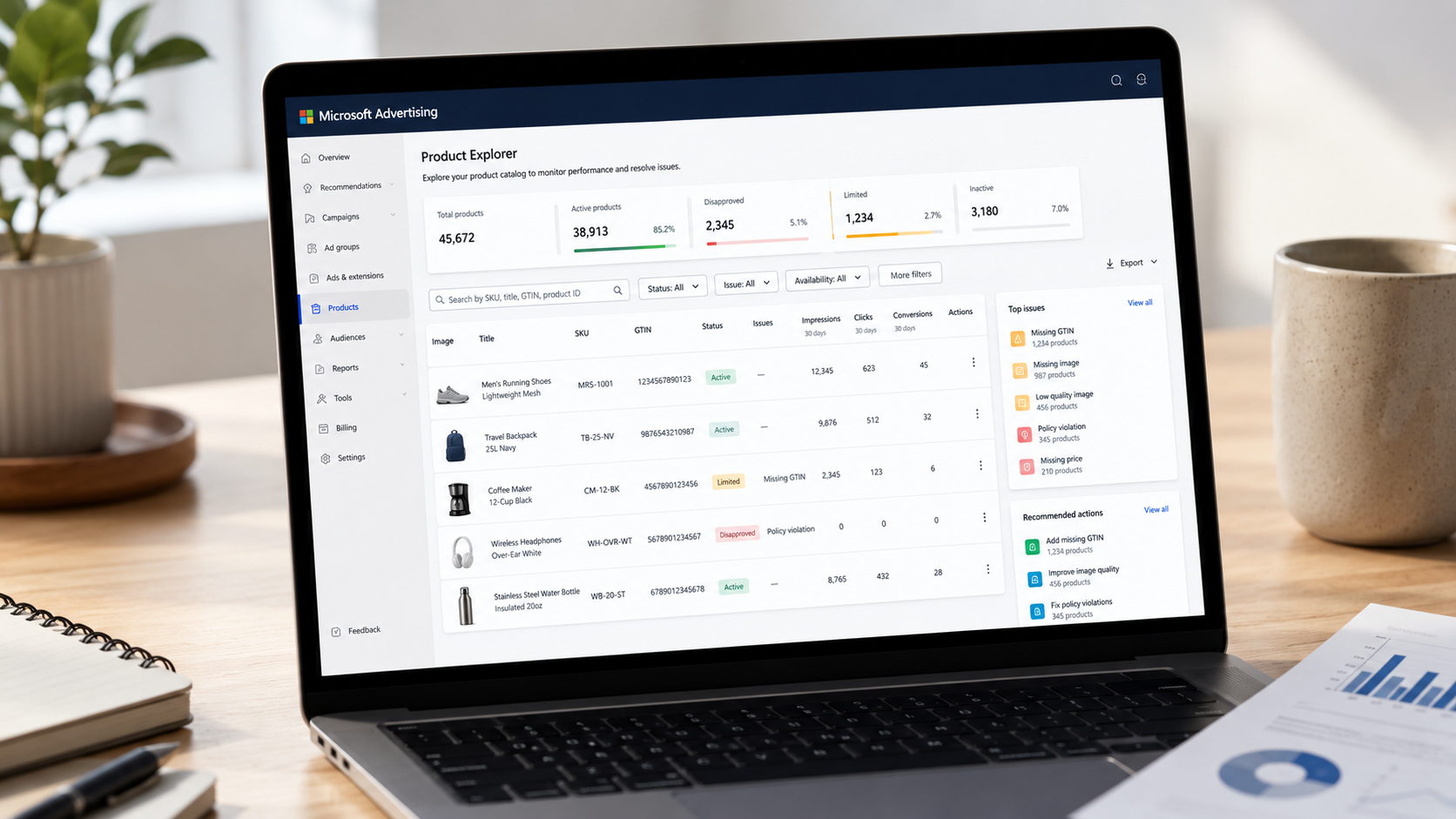
In an era where automated bidding and machine learning dictate the success of retail advertising, data feed health has emerged as the ultimate differentiator for e-commerce brands. Recognizing the critical need for deeper visibility into product inventory, Microsoft Advertising has officially launched Product Explorer.
This centralized reporting and diagnostic tool is designed to give search marketers, retail brands, and agency media buyers unprecedented clarity into their product catalog’s operational health and performance.
Announced by Microsoft Advertising Product Liaison Navah Hopkins, Product Explorer addresses a long-standing pain point for digital storefronts: the "black box" of product feed eligibility. By merging granular feed diagnostics with real-time performance metrics, Microsoft aims to streamline how advertisers manage, troubleshoot, and optimize their retail campaigns.
Main Facts: Inside the Product Explorer Feature Set
For years, digital marketers managing extensive product catalogs have faced a persistent challenge: identifying why certain products fail to serve impressions despite being active in their merchant feeds. Product Explorer is built to solve this issue by serving as a unified, searchable dashboard that bridges the gap between catalog logistics and advertising performance.
+---------------------------------------------------------------------------------+
|                           MICROSOFT PRODUCT EXPLORER                            |
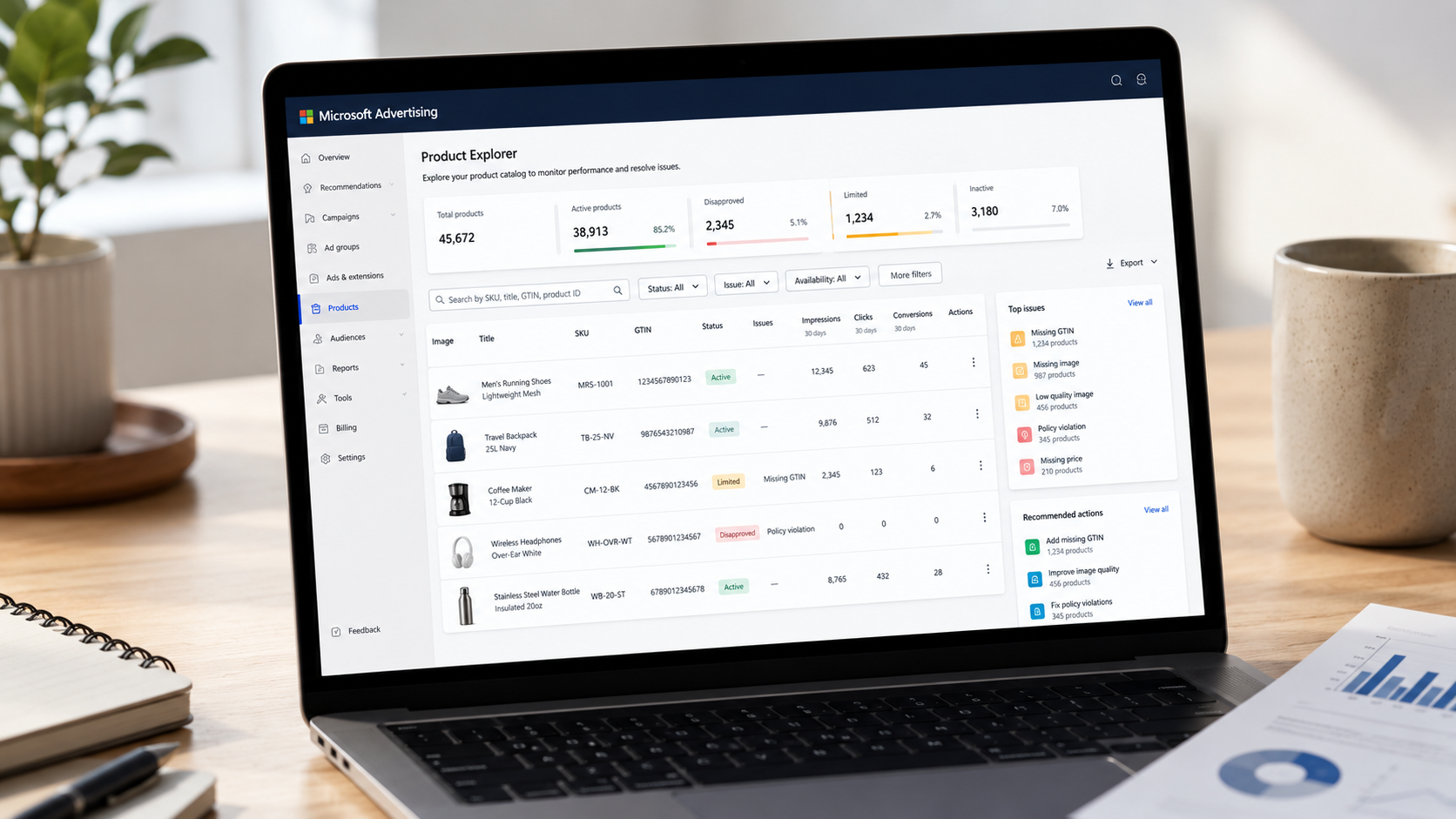
+---------------------------------------------------------------------------------+
|  [ Search Bar: SKU, GTIN, Title, Product ID ]                                   |
+---------------------------------------------------------------------------------+
|  Active Status   |   Ad Serving State   |   30-Day Performance (Clicks/Impr)    |
|  [ Approved ]    |   [ Serving ]        |   1,240 Impr / 42 Clicks             |
+---------------------------------------------------------------------------------+
|  Diagnostics & Actionable Recommendations:                                      |
|  - Missing GTIN (Impact: High) -> [Resolve Now]                                 |
|  - Low-Quality Image (Impact: Medium) -> [Update Asset]                         |
+---------------------------------------------------------------------------------+
The tool introduces several key capabilities directly into the Microsoft Advertising user interface:
1. Granular Search and Filtering
Advertisers can now bypass tedious, multi-step spreadsheet downloads to audit their catalog. Product Explorer provides a fully searchable interface where users can instantly filter their entire product database by core attributes, including:
- SKU (Stock Keeping Unit)
- Product Title
- GTIN (Global Trade Item Number)
- Product ID
2. Live Eligibility and Ad-Serving Diagnostics
Rather than guessing why a high-priority product is underperforming, advertisers can immediately see the exact status of any item. The dashboard highlights whether a product is active, currently serving ads, or blocked by policy or technical issues.
3. Integrated 30-Day Performance Metrics
Product Explorer brings performance data directly into the diagnostic view. Advertisers can review product-level metrics covering the previous 30 days. This integration makes it easy to spot "zombie products"—items that are technically eligible to serve but are generating zero impressions or clicks—as well as top-performing products that may be capped by budget constraints or minor feed errors.
4. Proactive, Actionable Recommendations
When the system identifies metadata gaps (such as missing Google Product Categories, low-resolution images, or absent GTINs), it does not merely flag the error. Product Explorer surfaces specific, prioritized recommendations to guide advertisers on how to fix the issue, maximize their eligible inventory, and boost campaign reach.
5. Seamless Data Portability
For enterprise accounts and agencies managing tens of thousands of SKUs, manual troubleshooting in an interface is not always practical. Product Explorer allows users to export filtered product lists, complete with their diagnostic statuses and performance data, for bulk editing in external feed management tools or spreadsheet software.
Chronology: The Evolution of Microsoft’s E-Commerce Advertising Suite
The release of Product Explorer is the latest milestone in Microsoft’s multi-year effort to build a robust, competitive e-commerce ecosystem. To understand the significance of this launch, it is helpful to look at the timeline of how Microsoft Ads has evolved its retail capabilities:
[Early Era] ----------------> [Import Era] --------------> [Automation Era] ----------> [Diagnostic Era]
Basic Bing Product Ads        Google Merchant Import       Smart Shopping & PMax        Product Explorer Launch
(Manual feed uploads)         (Frictionless migration)     (AI-driven bidding)          (Granular feed transparency)
The Early Era: Bing Product Ads (2013–2018)
In the early days of Bing Ads, e-commerce functionality was basic. Advertisers uploaded manual text-based feeds into the Microsoft Merchant Center. Troubleshooting was notoriously difficult, often requiring support tickets or decoding complex XML error logs to understand why a product was rejected.
The Import Era: Google Merchant Center Integration (2019–2021)
To capture market share from Google, Microsoft introduced the Google Merchant Center Import tool. This allowed retail advertisers to mirror their Google Shopping feeds directly into Microsoft Merchant Center with a few clicks. While this drastically lowered the barrier to entry, it created a dependency: if a feed broke during the import process, finding the root cause on the Microsoft side remained a highly manual, frustrating task.
The Automation Era: Smart Shopping and Performance Max (2022–2023)
As automated campaign types became the industry standard, Microsoft expanded its support for Smart Shopping and eventually introduced its own version of Performance Max (PMax) campaigns. These campaigns relied heavily on algorithm-driven placements. However, the automated nature of these campaigns created a "black box" effect, leaving advertisers with very little visibility into which specific products from their catalog were actually driving results.
The Diagnostic Era: The Launch of Product Explorer (Present)
Recognizing that automated bidding is only as good as the data feeding it, Microsoft shifted its focus to transparency. Product Explorer represents the culmination of this shift, giving advertisers the precise tools they need to audit, optimize, and scale their product feeds directly within the Microsoft Ads ecosystem.
Supporting Data: The High Stakes of Product Feed Health in Modern Retail Media
The launch of Product Explorer comes at a time when retail media and product-based search advertising are experiencing unprecedented growth. Industry data underscores why feed quality has become a top priority for digital marketers.
The Cost of Poor Feed Quality
According to industry studies by feed management platforms, up to 40% of product feeds contain critical errors—such as missing GTINs, poorly formatted titles, or broken image URLs—that prevent items from showing up in search results.
| Feed Error Type | Average Occurrence Rate | Impact on Campaign Performance |
|---|---|---|
| Missing GTINs | 22% | Severe reduction in ad impressions and match relevancy |
| Poor Title Optimization | 35% | Lower Click-Through Rates (CTR) and higher Cost-Per-Click (CPC) |
| Missing Product Category | 18% | Misaligned automated bidding and poor audience targeting |
| Broken/Low-Res Images | 12% | High bounce rates and immediate ad disapproval |
Furthermore, research indicates that optimizing product titles with key attributes (such as brand, size, and color) can increase click-through rates (CTR) by 18% to 115%. By highlighting these metadata gaps directly, Product Explorer helps advertisers unlock this latent revenue potential.
Microsoft’s Expanding Footprint
While Google remains the dominant player in search, Microsoft Advertising has quietly expanded its reach. With the integration of generative AI features via Copilot and the expansion of the Microsoft Audience Network, Microsoft now reaches over 1.2 billion unique monthly users globally.
Additionally, Microsoft’s strong hold on desktop search—which often boasts higher average order values (AOV) and conversion rates than mobile search—makes it a highly profitable channel for retail brands. For these brands, even a minor increase in feed eligibility on Microsoft Ads can translate to a substantial lift in overall e-commerce revenue.
Official Responses and Industry Reception
The introduction of Product Explorer has been met with widespread enthusiasm from the search engine marketing (SEM) community.
In her announcement, Microsoft Advertising Product Liaison Navah Hopkins emphasized that the tool is designed to save advertisers time and reduce the friction of catalog management. According to Hopkins, the feature should already be live across most global accounts, allowing advertisers to immediately begin auditing their catalogs ahead of key retail seasons.

Professional media buyers and agency executives have highlighted the practical benefits of the tool:
"In the past, troubleshooting a Microsoft merchant feed felt like looking for a needle in a haystack," says one PPC agency director. "We would see that our total approved products dropped, but we had to download massive CSV files and run VLOOKUPs against our Google feed to find the discrepancies. Having a searchable, filterable dashboard with 30-day performance data right in the UI is a massive workflow improvement."
Other industry experts note that the tool’s focus on actionable recommendations aligns perfectly with the broader trend toward AI-driven advertising. By telling advertisers exactly how to fix an issue, Microsoft is lowering the technical barrier to feed optimization, allowing small-to-medium-sized businesses (SMBs) to compete more effectively with retail giants.
Strategic Implications: Empowering Advertisers in an Automated Landscape
The launch of Product Explorer is more than just a convenient UI update; it has deep strategic implications for the digital marketing landscape.
       +---------------------------------------------+
       |   Product Explorer Identifies Feed Errors   |
       +---------------------------------------------+
                              |
                              v
       +---------------------------------------------+
       |  Advertiser Fixes Metadata & Missing GTINs  |
       +---------------------------------------------+
                              |
                              v
       +---------------------------------------------+
       |   Algorithms Receive High-Quality Signals   |
       +---------------------------------------------+
                              |
                              v
+-----------------------------------------------------------+
|  RESULT: Improved Ad Relevancy, Lower CPCs, Higher ROAS   |
+-----------------------------------------------------------+
1. Feeding the Algorithm High-Quality Data
Modern retail campaigns rely heavily on machine learning to determine when and where to show an ad. However, these algorithms are entirely dependent on the quality of the data they receive. If a product feed lacks clear titles, detailed descriptions, or accurate attributes, the algorithm struggles to match the product with relevant search queries.
Product Explorer acts as a quality-control filter. By helping advertisers resolve data gaps, it ensures that Microsoft’s automated bidding algorithms have the clean, structured data they need to maximize Return on Ad Spend (ROAS).
2. Leveling the Playing Field with Google Merchant Center
For years, Google Merchant Center (GMC) has set the gold standard for feed diagnostics, offering robust tools like the "Diagnostics" tab and "Merchant Center Next." By introducing Product Explorer, Microsoft is closing this feature gap. This makes the Microsoft Advertising platform more appealing to search marketers who may have previously avoided the platform due to clunky feed troubleshooting workflows.
3. Streamlining Agency Workflows and Client Reporting
For agency account managers, Product Explorer is a powerful tool for client communication. When a client asks why a specific flagship product is not generating sales, the manager no longer has to dig through complex logs. They can simply search for the product in Product Explorer, take a screenshot of the specific eligibility issue, and present a clear, actionable solution to the client.
Conclusion: Maximizing E-Commerce ROI with Product Explorer
As e-commerce advertising continues to grow more automated, the battle for digital shelf space is won or lost in the product feed. Microsoft Ads’ launch of Product Explorer represents a significant step forward in giving advertisers the transparency, diagnostic depth, and performance insights they need to succeed.
By centralizing catalog health and performance metrics into a single, intuitive dashboard, Microsoft is helping brands of all sizes eliminate silent errors, recover lost impressions, and drive higher efficiency from their ad spend.
With the tool now live in accounts, advertisers are highly encouraged to log in, run a quick audit of their core SKUs, and leverage Product Explorer’s actionable recommendations to ensure their catalogs are fully optimized and ready to convert high-intent shoppers.