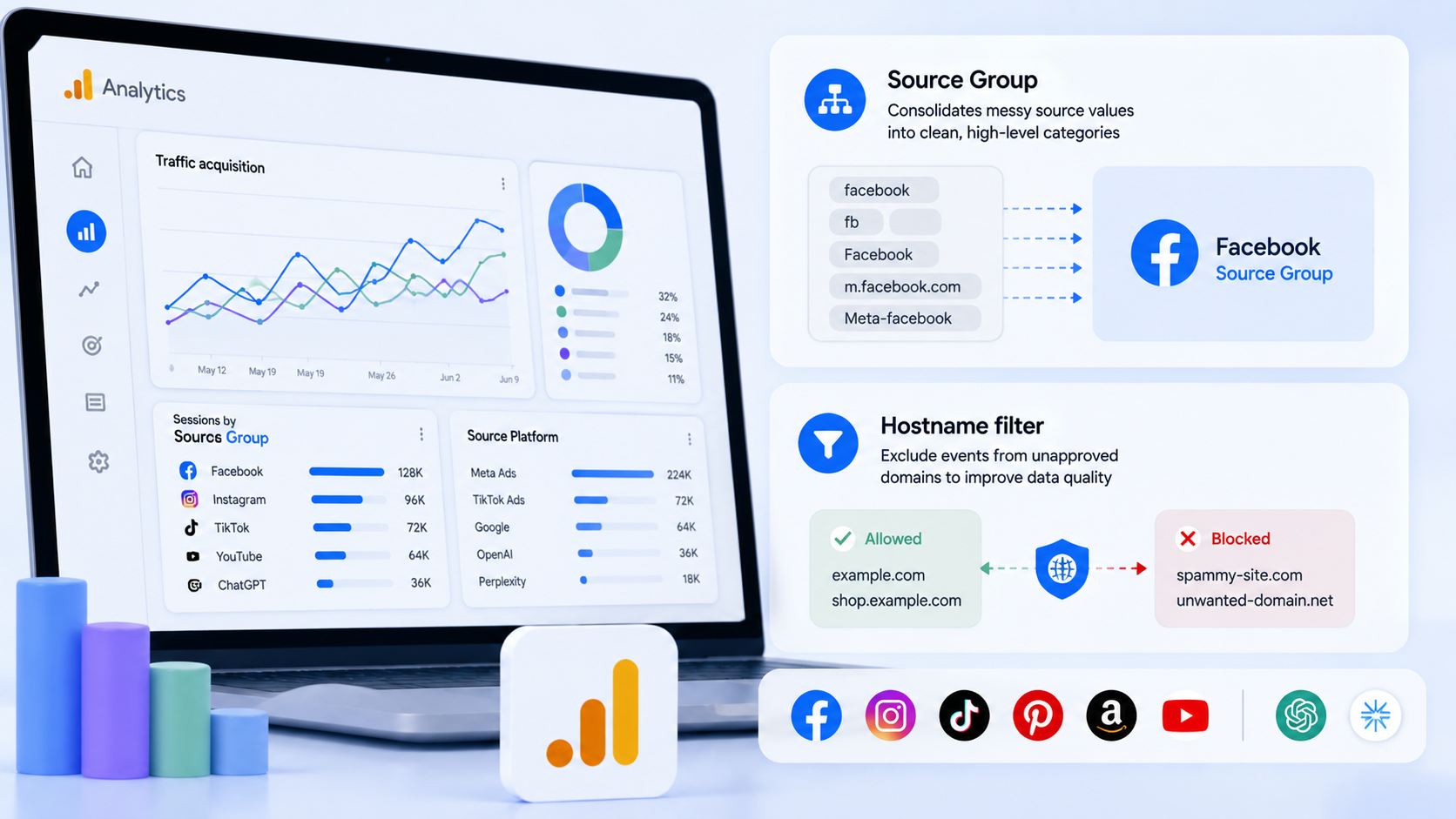
Google has announced a major update to Google Analytics 4 (GA4) designed to address two of the most persistent pain points for modern digital marketers: fragmented traffic source reporting and data quality degradation. By introducing a new Source Group reporting dimension and robust hostname filtering controls, the tech giant aims to streamline cross-channel attribution, simplify performance analysis, and give advertisers cleaner, more reliable datasets.
As the digital advertising ecosystem grows increasingly complex—spanning traditional search, programmatic display, emerging retail media networks, social commerce, and conversational AI engines—maintaining a single, accurate source of truth has become a monumental challenge. These new features represent a concerted effort by Google to standardize incoming data streams, making it easier for brands to understand where their marketing dollars are driving the greatest return on investment (ROI).
1. Main Facts: Understanding the New GA4 Capabilities
The latest update introduces two primary features to the Google Analytics interface, alongside an overhaul of existing traffic source classifications.
┌────────────────────────────────────────────────────────────────────────┐
│                      GOOGLE ANALYTICS 4 UPDATE                         │
├───────────────────────────────────┬────────────────────────────────────┤
│           SOURCE GROUP            │         HOSTNAME FILTERING         │
│            DIMENSION              │              CONTROLS              │
├───────────────────────────────────┼────────────────────────────────────┤
│ • Consolidates fragmented sources │ • Admin-level domain exclusions    │
│ • Retroactive data standardization│ • Eliminates referral & ghost spam │
│ • Tracks AI referrals (ChatGPT)   │ • Prevents staging site data leaks │
└───────────────────────────────────┴────────────────────────────────────┘
The Source Group Dimension
The new Source Group is a standardized reporting dimension that automatically consolidates multiple variations of the same traffic source into a single, clean category.
Historically, traffic originating from a single platform like Facebook could appear in GA4 reports under dozens of different names due to variations in referral URLs, browser types, and user-agent strings. Marketers frequently saw traffic split across:
facebook.comm.facebook.coml.facebook.comlm.facebook.comfbfacebook
With the introduction of the Source Group dimension, Google Analytics automatically recognizes these variations and groups them under a standardized value (e.g., "Facebook"). This eliminates the need for complex custom channel groupings or extensive regex-based filters just to view unified platform performance.
Updated Source Platform Alignment
To complement this new dimension, Google is updating its existing Source Platform field. This update ensures that the platform classifications align perfectly with the new Source Group structure. This synchronization provides a highly consistent classification framework across all advertising channels, ensuring that Google Ads, Google Marketing Platform, and third-party ad networks are evaluated on equal footing.
Hostname Filtering at the Admin Level
In addition to reporting dimensions, Google is rolling out advanced hostname filters within the Admin section of GA4. This feature allows administrators to define a strict whitelist of approved domains. Any event or traffic stream originating from an unapproved domain—such as a developer’s local testing environment, a staging server, or a malicious spam bot—is excluded from reporting before it ever enters the dataset.
2. Chronology: The Evolution of Data Filtering and Attribution in Google Analytics
To understand the significance of this update, it is essential to trace the history of data filtering and source attribution from Universal Analytics (UA) to the current state of GA4.
   Universal Analytics (UA)             Launch of GA4 (2020-2023)              June 2026 Update
┌──────────────────────────────┐     ┌──────────────────────────────┐     ┌──────────────────────────────┐
│ • Flexible View-level filters│     │ • Event-based data model     │     │ • Source Group dimension     │
│ • Simple hostname exclusions │  ─> │ • Limited built-in filtering │  ─> │ • Retroactive standardization│
│ • Manual manual grouping     │     │ • High reporting fragmentation│    │ • Admin Hostname Filtering   │
└──────────────────────────────┘ └──────────────────────────────┘ └──────────────────────────────┘- The Universal Analytics Era (Pre-2023): In Universal Analytics, users relied heavily on "Views" to apply filters. If an analyst wanted to exclude traffic from staging environments or filter out spam, they could easily set up a "Hostname Filter" on a specific reporting view. This kept production data clean without altering the raw, underlying data stream.
- The Launch of GA4 and the "Data Cleanliness" Gap (2020–2023): When Google transitioned users to GA4, the concept of "Views" was retired in favor of a single, unified data stream model. While GA4 introduced more sophisticated machine-learning-driven attribution, it initially lacked the granular, user-friendly filtering options of its predecessor. Marketers struggled with "ghost spam" and struggled to keep internal testing traffic from polluting production reports.
- The Rise of Multi-Channel and AI Referral Traffic (2023–2025): As social commerce (TikTok Shop, Instagram Shopping) and conversational AI engines (OpenAI’s ChatGPT, Perplexity, Anthropic’s Claude) exploded, traffic sources became incredibly fragmented. Standard UTM tracking parameters became harder to maintain consistently across large marketing teams, resulting in messy, unorganized attribution buckets.
- The Present Update: Google’s rollout of Source Group dimensions and Admin-level hostname filtering directly addresses these historical shortcomings. It bridges the gap between UA’s ease of filtering and GA4’s advanced, event-driven architecture, while modernizing the platform to handle the next generation of web traffic.
3. Supporting Data: The Cost of Dirty Data and Fragmented Attribution
The business case for cleaner data classification and hostname filtering is supported by industry research highlighting the financial and operational impact of poor data quality.
The Impact of Referral Spam and Ghost Traffic
According to cybersecurity and web performance studies, bot traffic and malicious crawlers account for nearly 40% of all internet traffic. A significant portion of this traffic manifests as "referral spam" or "ghost spam"—fake hits sent directly to Google Analytics measurement IDs without the bot ever visiting the actual website.

Without robust hostname filtering, these fake sessions skew key performance indicators (KPIs), leading to:
- Artificially inflated session counts.
- Artificially depressed conversion rates.
- Skewed engagement metrics (such as average session duration and engagement rate).
The Rise of AI Search and the "Answer Engine" Referral Wave
The inclusion of standardized classifications for AI traffic sources like ChatGPT and Perplexity is a forward-looking addition. According to recent search landscape reports:
- Over 15% of young demographics now use conversational AI engines as their primary starting point for product research and informational queries.
- Referral traffic from conversational platforms is growing at a double-digit month-over-month rate.
ESTIMATED GROWTH OF AI REFERRAL TRAFFIC (Share of Referral Traffic %)

  5% ─────────────────────────────────────────────────────────  2026 (Projected)
  4% ───────────────────────────────────────────  2025 (Est.)
  2% ────────────────────────────  2024
0.5% ──────────────  2023
By standardizing AI search referrals, Google is giving marketers the tools they need to prove the value of their organic visibility within LLM (Large Language Model) databases—a practice rapidly becoming known as LLM Optimization (LLMO) or Generative Engine Optimization (GEO).
4. Implementation Guide: Setting Up Hostname Filters and Source Groups
Advertisers and web analysts can begin utilizing these new features immediately within their Google Analytics 4 properties. Below is a guide on how to configure and leverage these tools.
Step-by-Step: Enabling Hostname Filtering
To prevent unapproved domains from sending data to your GA4 property, follow these steps:
- Navigate to the Admin panel in Google Analytics 4.
- Under the Data Collection and Modification section, click on Data Streams.
- Select your primary web data stream.
- Configure your Configure Tag Settings under the Google Tag section.
- Locate the new Hostname Filters or Allowed Domains settings.
- Input the exact domains you wish to permit (e.g.,
yourwebsite.com,checkout.yourwebsite.com). - Save your changes. Once applied, any incoming hits carrying a hostname not explicitly listed in your whitelist will be discarded at the ingestion level.
Utilizing the Source Group Dimension in Reports
The Source Group dimension is applied retroactively to historical data, meaning marketers do not have to wait for new data to accumulate to see the benefits.
- In Standard Reports: Navigate to Reports > Acquisition > Traffic Acquisition. Click the "+" icon next to the primary dimension (e.g., Session source/medium) and search for Session Source Group to add it as a secondary dimension.
- In Explorations: Open the Explorations tab and create a new blank exploration. Import Source Group as a dimension and pair it with metrics like Active Users, Conversions, and Total Revenue to get a clean, bird’s-eye view of platform-level performance.
5. Implications: What This Means for Brands, Agencies, and the Future of Analytics
Google’s updates carry deep strategic implications for different segments of the digital marketing industry.
For CMOs and Marketing Directors
For marketing leadership, the primary benefit of this update is trust in data. When reporting on campaign performance to executive boards, CMOs can now present cleaner attribution models. The consolidation of fragmented sources into unified Source Groups means that the true value of platforms like Meta, Amazon, and TikTok can be evaluated holistically without manual data manipulation in external tools like Looker Studio or Excel.
For SEOs and Content Marketers
The formal recognition of AI engines like ChatGPT and Perplexity as standardized referral sources is a watershed moment for organic search specialists. SEOs have long struggled to quantify the traffic driven by conversational search engines. With standardized tracking, organic search teams can build dedicated reporting pipelines to showcase how content optimization strategies are translating into traffic and conversions from non-traditional search platforms.
For Analytics and Data Engineers
Data engineers will welcome the addition of admin-level hostname filters. In the past, cleaning up spam and dev-environment data required complex Google Tag Manager (GTM) triggers or post-processing SQL queries in Google BigQuery. By stopping unwanted traffic at the GA4 gateway, organizations can maintain cleaner, lighter, and more accurate datasets, reducing data storage and processing costs in cloud warehouses.
The Bottom Line
As the web becomes more decentralized and privacy regulations restrict cookie-based tracking, the quality of first-party analytics data is paramount. Google’s latest updates to GA4 provide advertisers with the essential tools needed to combat data fragmentation and maintain reporting integrity in a complex, multi-platform digital world.