For decades, the B2B software industry operated under a silent pact: the customer consumes the User Experience (UX) and the Application Programming Interface (API), while the database layer remains a hidden, silent engine room. To the average enterprise buyer, the underlying infrastructure was merely "plumbing"—a backend detail that, provided it didn’t crash, was of little consequence to the value proposition.
However, Benjamin Wagner, CEO of Firebolt, recently took the stage at SaaStr AI to deliver a stark warning to the SaaS community: that era is officially over. As AI agents move from experimental side-projects to core product interfaces, the data layer has been thrust into the spotlight. It is no longer just the foundation; it is the primary interface through which customers—and their digital agents—evaluate, judge, and interact with your product.
The Paradigm Shift: From Plumbing to Product
The transition Wagner describes is not a subtle evolution; it is a fundamental restructuring of how software is built and consumed. As agents begin to interface directly with products, the "black box" approach to data architecture has become a liability. When an autonomous agent attempts to execute a task, it doesn’t care about your beautifully designed dashboard or your meticulously crafted UX flows. It cares about data accessibility, schema clarity, and query performance.
This shift has created a new reality for developers and product leaders alike. If your data architecture cannot adapt to the new demands of an agent-driven ecosystem, your software risks becoming obsolete, regardless of how polished your frontend may be.
Three Forces Disrupting the Data Layer
Wagner highlighted three specific shifts currently breaking traditional B2B software products in the field. Understanding these is essential for any company looking to stay competitive in the age of AI.
1. The Fragmentation of Deployment
The first crack in the traditional model is the demand for deployment flexibility. In the past, a "SaaS-only" model was the gold standard. Today, that model is increasingly hitting a wall.
Fortune 100 companies, government entities, and highly regulated sectors are refusing to allow their data to leave their internal environments. They are demanding "bring-your-own-cloud" (BYOC) solutions, air-gapped deployments, and on-premises control. If a vendor cannot bring the data plane to the customer, they simply do not close the deal.
This has led to a dangerous trend: the "fragmented backend." Companies often end up with a dev laptop running one database engine, their production cloud running another, and a client-side environment running a third. The result is a nightmare of schema migrations, inconsistent performance, and a product experience that splinters depending on which engine is running underneath. Wagner argues that the only way to mitigate this is by adopting open-source analytical databases that offer architectural consistency across all deployment environments.
2. The Internal Agent Tax
The second shift is occurring within the engineering teams themselves. Modern software development is increasingly driven by coding agents. These AI assistants are tasked with writing code, performing migrations, and interacting with the data layer.
Closed, proprietary systems are becoming a bottleneck. Coding agents thrive on open systems where they can "read" the source code, tests, and documentation directly. Furthermore, these agents require fast, local iteration. If an engineer cannot spin up a local binary of the database to test schemas or dialect compatibility, they are forced to use clunky workarounds like Model Context Protocols (MCPs) or command-line interface (CLI) simulations.
Wagner offers a piece of advice that echoes throughout the industry: avoid proprietary SQL dialects. A unique, vendor-specific dialect might have seemed like a feature in the past, but in an age where AI agents write the queries, a custom dialect becomes a "constant tax"—a persistent source of friction and error that hampers productivity.
3. The External Agent Demand
The third and most disruptive shift is the behavior of the customers’ agents. These agents have no interest in your five static, pre-built dashboards. They want raw, direct access to the underlying data via a query interface.

The moment a vendor exposes a SQL-like interface to their customers’ agents, they have, by definition, become a database vendor. This introduces a host of high-stakes challenges:
- Resource Isolation: How do you ensure that one startup’s aggressive agent doesn’t consume all available compute and crash the system for your Fortune 500 enterprise clients?
- Autoscaling: Can your architecture handle the unpredictable, bursty nature of agentic queries?
- Reliability: When the data layer breaks at 2:00 AM, the failure is no longer a minor glitch—it is a direct failure of your core product.
A "Vibe-Coded" Reality: Lessons from the Stage
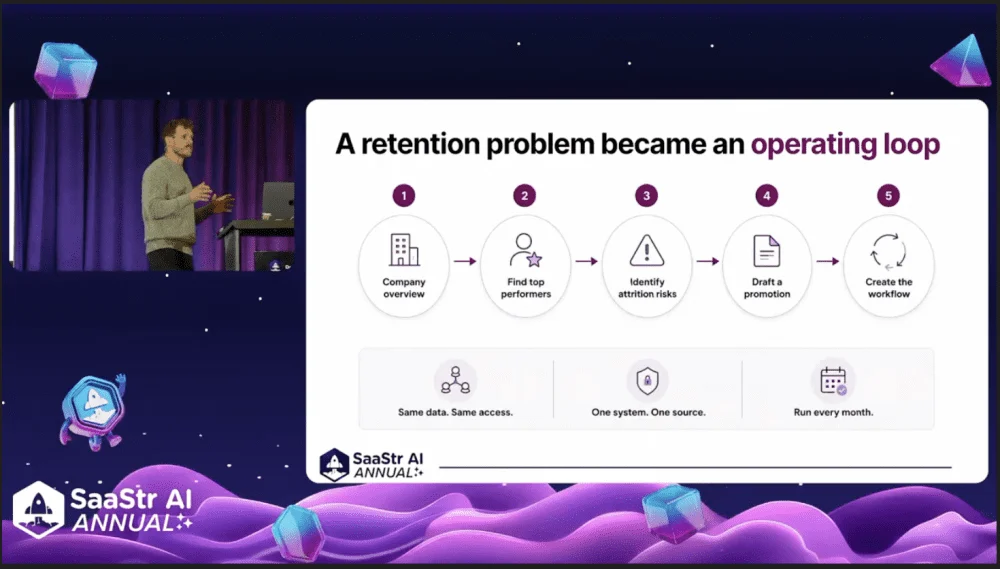
During his SaaStr AI presentation, Wagner attempted a live demo that utilized "vibe-coded" AI agents to navigate his product. When the demo failed on stage, he didn’t shy away from the embarrassment. Instead, he leaned into it as a teaching moment.
"This is what happens when you let agents build the demo you are about to give live," he remarked. The failure was a perfect illustration of the current state of AI—it is powerful and revolutionary, but the seams are still visible. The companies that will win are not those waiting for the technology to feel "finished," but those who are building for this raw, agent-driven reality today.
Strategic Implications: The Data Layer as the New Moat
The convergence of these three shifts leads to a singular strategic conclusion: the data layer is the new competitive moat.
For years, the "moat" was considered the brand, the sales team, or the proprietary UI. Today, the moat is the architecture. If you treat your database as an implementation detail, it will become your ceiling. If you treat it as your product, it becomes your greatest asset.
Why Deployment Flexibility is a Deal-Maker
The ability to meet a customer where they are—whether that is in a private VPC, on-prem, or in a specific neocloud—is now the primary filter for enterprise sales. By adopting open-source, portable analytical engines, vendors can move from being a "vendor" to being a "partner" who can deploy anywhere.
The Power of Standards
The move toward open standards is no longer just about "being open-source"; it is about agent compatibility. By adhering to standard SQL dialects and building on open systems, companies allow their customers’ agents to interoperate with their data with minimal friction. This interoperability creates a stickiness that proprietary systems simply cannot match.
The Burden of Becoming a Database
Vendors must recognize that exposing a data layer creates a new set of responsibilities. Investing in multi-tenancy, resource governance, and robust API design is no longer "backend work"—it is the equivalent of building the front door of your business. If the door doesn’t open when the agent knocks, the customer experience is effectively zero.
Conclusion: Adapting to the New Reality
The transition from human-centered UX to agent-centered interaction is the most significant shift in B2B software in twenty years. The "invisible" database is now the most visible part of your software.
For product leaders, the path forward is clear:
- Prioritize Portability: Move away from closed, cloud-locked proprietary engines.
- Standardize Interfaces: Ensure your data layer speaks the languages that AI agents understand.
- Governance is King: Build for multi-tenancy and resource isolation as if your business depends on it—because as agents start running the show, it does.
The era of "hiding the plumbing" is over. The plumbing is the product, and it is time to build it for an era where the most important users aren’t human.
Top 5 Takeaways
- The Database is the Product: The data layer has moved from a hidden backend component to the primary interface for AI agents, making its performance and accessibility the most important features of your software.
- Deployment Flexibility is a Competitive Necessity: In the enterprise space, the ability to deploy in air-gapped, on-prem, or BYOC environments is now the deciding factor in winning large-scale deals.
- Standardization vs. Proprietary Dialects: Using proprietary SQL dialects creates a "tax" on AI agents. Adopting open standards allows for better agent-driven development and integration.
- The "Database Vendor" Transition: Once you expose a query interface to customer agents, you are effectively a database vendor. You must manage resource isolation, autoscaling, and reliability as a core business function.
- Open Source as an Exit Strategy: Building on open-source foundations provides a safety net; if a customer cannot adopt your managed service, they can run the open-source version, keeping them within your ecosystem rather than pushing them to a competitor.