For the past quarter-century, the fundamental workflow of a technology sales representative has remained stubbornly stagnant. Despite the transition from rolodexes to sophisticated Customer Relationship Management (CRM) systems, the modern seller finds themselves trapped in a paradox: they are hired for their ability to build human connections and close high-stakes deals, yet they spend roughly 70% to 80% of their workday buried in administrative drudgery.
Research, meeting preparation, manual CRM hygiene, and the relentless cycle of follow-ups have historically been viewed as the "cost of doing business." However, at SaaStr AI 2026, Ali Ghotbi, Chief Revenue Officer at Reevo and a 25-year veteran of the tech sales industry, presented a compelling argument that this status quo is not only inefficient—it is an existential failure of modern sales strategy. By deploying AI-native agents designed to eliminate, rather than assist, administrative tasks, Reevo is proving that the future of sales isn’t about making reps better at admin; it’s about liberating them from it entirely.
The Core Philosophy: Separating Judgment from Toil
The central tenet of Ghotbi’s presentation at SaaStr AI 2026 was a stark reality check for RevOps leaders: the most effective salespeople are frequently the worst at CRM hygiene. This is not a lack of discipline; it is a prioritization of skill. When an organization forces a high-performing closer to spend their day updating data fields, they are actively misallocating their most valuable human capital.
Reevo’s approach is defined by a clean, binary decision rule: automate all high-effort, low-judgment tasks, and rigorously protect the high-judgment, human-centric interactions.
"Most companies bolt AI onto the wrong half of the sales process and then wonder why their adoption rates stall," Ghotbi noted during his session. In his view, tasks such as meeting prep, data entry, and drafting follow-up emails fall into the "low-judgment" category. These are tasks that consume time but do not require human empathy, strategic nuance, or interpersonal rapport. The "high-judgment" category—the live customer conversation—remains the exclusive domain of the human seller. By drawing this line in the sand, Reevo has created a framework that treats AI as an autonomous worker rather than a suggestion engine.
The Operational Model: Five Agents on a Single Pane of Glass
To implement this vision, Reevo has developed an ecosystem where a single sales representative interacts with a unified interface. This dashboard displays quota attainment and team performance, surrounded by an active layer of autonomous agents. These agents are not passive; they are constantly working in the background, either presenting completed tasks for review or requesting authorization for complex next steps.
The architecture relies on a specialized suite of agents designed to handle the "administrative drag" that typically plagues the sales cycle. By centralizing these functions, the rep is never forced to toggle between tabs, copy-paste data, or manually input meeting summaries. The workflow is designed to ensure the human is always the pilot, while the agents serve as the engine room.
The Differentiator: Doing the Work vs. Suggesting the Work
One of the most profound observations from Ghotbi’s presentation was the distinction between "AI-assisted" tools and "AI-native" execution. Many current sales tools offer suggestions: "Here is a template you could use," or "Perhaps you should update this record." This approach often adds to the rep’s cognitive load, forcing them to vet and act on every suggestion.
Reevo’s agents take a different path: they perform the work and then provide the artifact for approval.
- The Artifact: If an agent is tasked with a follow-up, it doesn’t just offer a template; it drafts the email.
- Evidence-Based Action: If an agent flags an opportunity for disqualification, it provides the exact logs—such as three unanswered emails or a lack of engagement—as evidence.
- Hygiene as a Byproduct: Rather than flagging fields for the rep to fill, the agents scan communication logs and external signals to populate the CRM fields themselves.
Crucially, for decisions with high stakes—such as closing a major deal or abandoning a long-standing account—the human remains firmly in the loop. The "approve-or-reject" mechanism ensures that while the grunt work is automated, the strategic authority remains with the human, fostering a level of trust that is often missing in fully automated systems.
The Data Layer: Why Models Are Not the Differentiator
A recurring theme throughout the SaaStr AI 2026 event was the commoditization of Large Language Models (LLMs). Ghotbi candidly addressed the fact that using OpenAI or Claude to generate "personalized" outreach often results in generic, robotic-sounding messages.
The secret to Reevo’s success, according to Ghotbi, is not the base model, but the context layer. By feeding the agent deep, cross-platform signal data—including previous conversation history, nuanced account interactions, and specific product usage metrics—the output becomes genuinely specific to the prospect.
This is a vital lesson for any organization looking to scale AI: the model is a utility, but the data is the moat. A competitor can sign up for the same API, but they cannot replicate the proprietary context layer that Reevo has built. This context allows the AI to understand the why behind a sale, not just the what.
Implications and Results: A Case for Radical Efficiency
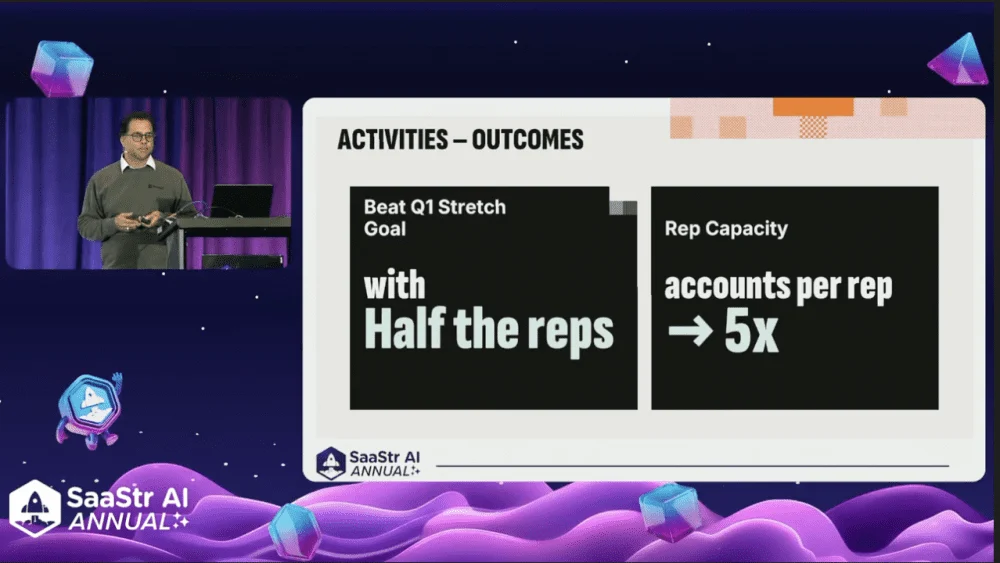
The metrics reported by Reevo are, by any standard, aggressive. Ghotbi shared that since implementing this agent-first model, his internal sales organization has seen a fivefold increase in productivity.
Perhaps most striking was the change in individual rep capacity. Previously, a high-performing rep at Reevo could effectively manage 10 to 15 opportunities without compromising the quality of the relationship. With the administrative load removed by agents, that number has surged to between 50 and 75 opportunities per rep, with what Ghotbi described as "zero leakage" in the sales process.
The business implications for Reevo were equally transformative. Ghotbi revealed that the company hit its revenue targets with only half the headcount it had projected needing. While these figures represent a vendor’s internal benchmarks, they align with a broader industry trend: organizations that successfully offload administrative tasks to AI-native agents are finding that their best closers become significantly more lethal.
Strategic Takeaways for RevOps Leaders
For leaders looking to integrate agents into their own sales organizations, Ghotbi offered a clear, four-step playbook:
- Stop Training, Start Removing: Do not invest in training your sales team to be better at CRM hygiene or administrative follow-ups. If a task is administrative, it should not be performed by a human.
- Prioritize "Done" Over "Suggested": Select tools that complete the task and present the output, rather than tools that offer suggestions or prompts. The goal is to reduce the rep’s cognitive load, not add to it.
- Build the Context Layer: Your AI is only as effective as the data you feed it. Invest in pipelines that consolidate cross-platform signals into a unified data structure that the agents can interpret.
- Protect the Human-in-the-Loop: For high-judgment tasks, ensure your architecture requires a human "approve-or-reject" function. This maintains accountability and ensures the human remains the strategic driver of the relationship.
Conclusion: The New Standard for Sales
As we look toward the remainder of 2026 and beyond, the narrative surrounding AI in sales is shifting from "productivity gains" to "structural transformation." Reevo’s approach represents a fundamental pivot from traditional software—which acts as a repository for data—to AI-native agents that act as autonomous employees.
The administrative drag that has defined the last 25 years of sales is becoming a competitive liability. Companies that continue to rely on manual data entry and human-led administrative workflows will find themselves unable to compete with organizations that have successfully offloaded these tasks to the machine. By letting the agent do the work and the human handle the relationships, the industry is entering an era where the quality of the conversation, rather than the quantity of the paperwork, will finally determine the winners.