The recent fiscal first-quarter earnings report from Braze (fiscal year 2027) serves as more than just a financial disclosure; it is a clear-cut signal that the customer engagement software industry has reached a fundamental inflection point. While headline figures suggest a standard beat-and-raise scenario for the enterprise-grade platform, a deeper analysis reveals a widening chasm in the market.
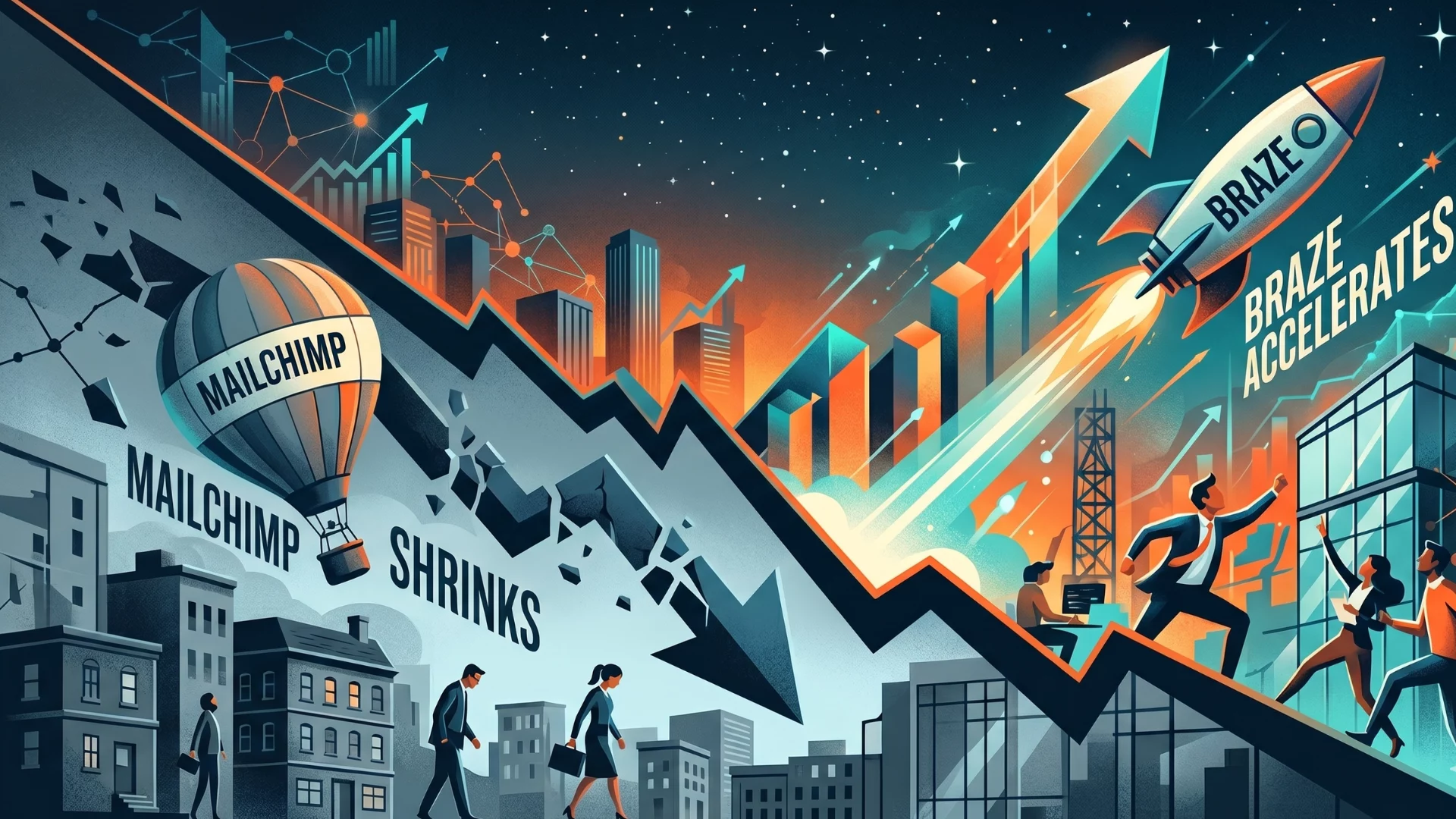
For years, analysts and investors grouped all email and engagement tools into a single, monolithic category. However, recent data—juxtaposed against the struggles of legacy giants like Mailchimp—proves that the "engagement" sector is no longer a monolith. Instead, it has fractured into two distinct markets: one focused on simple, commoditized communication, and the other on complex, data-driven orchestration.
The Main Facts: A Strong Quarter for Braze
On May 27, Braze reported robust growth for its fiscal first quarter, reflecting its position as a preferred partner for large-scale enterprise customer engagement. The company posted total revenue of approximately $211 million, a significant leap from the previous year. The core of this growth remains its subscription model, which generated $195.2 million, up from $154.9 million in the same period last year.
Perhaps most tellingly, the company’s remaining performance obligations (RPO)—a key indicator of future contracted revenue—have officially crossed the billion-dollar threshold, reaching $1.08 billion. This figure underscores the stickiness of the Braze platform among its 2,713 enterprise customers, a cohort that has grown steadily from 2,342 in the prior year. With a trailing twelve-month net revenue retention rate of 110%, it is clear that Braze is successfully executing a "land and expand" strategy.
A Chronology of Market Bifurcation
To understand the current state of the industry, one must look at the diverging paths of the sector’s major players over the past 18 months.
- Q3 2025 – Q1 2026: The "Volume" model, typified by Mailchimp, begins to face intense pressure. As commerce platforms (like Shopify) and website builders began bundling email services into their core products, the value proposition of a standalone, entry-level email service provider (ESP) began to erode.
- Q4 2026: Braze reports its third consecutive quarter of accelerating organic growth, signaling that demand for complex, cross-channel orchestration is decoupling from broader, macroeconomic-sensitive SaaS spending.
- Q1 2027 (Current Period): The industry split becomes impossible to ignore. While Braze reports 30% revenue growth, parent company Intuit announces a 17% workforce reduction, citing declining performance within the Mailchimp business unit.
This chronology illustrates a shift in capital allocation. Enterprises are moving away from "send-and-forget" tools and toward systems that integrate live customer data into behavioral messaging.
Supporting Data: The Tale of Two Models
The divergence in the market is not merely anecdotal; it is mathematically observable.
The Enterprise Orchestration Playbook
Braze’s business model is built on high-complexity tasks: triggering messages across push, in-app, SMS, and email based on real-time user behavior. The data confirms this:
- Customer Growth vs. Revenue: While the total customer count rose by 16% year-over-year, total revenue grew by 30%. This indicates that revenue per customer is rising, as existing clients utilize more of the platform’s advanced capabilities.
- The "Land and Expand" Machine: A 110% net retention rate proves that once Braze is embedded in an enterprise’s tech stack, it becomes an indispensable utility, rather than a discretionary expense.
The Margin Compression Reality
However, beneath the headline growth, there is a complex story regarding the cost of innovation. Braze’s GAAP gross margin dipped to 65.7% from 68.6% a year ago. Furthermore, professional services revenue—which carries much thinner margins than software—more than doubled to $15.8 million.
This reveals a hidden truth about the "AI era" of software: AI decisioning and inference are expensive. Products like those acquired through the OfferFit deal are compute-hungry by design. The increase in professional services suggests that enterprise AI deployments remain labor-intensive, requiring human consultants to fine-tune models and integrate data pipelines. Braze is growing faster, but the "unit economics" of AI-driven engagement are currently heavier than the traditional pure-software model.
Official Responses and Strategic Pivot
In their latest investor communications, Braze leadership, including CEO Bill Magnuson, has leaned heavily into the "AI-powered engagement" narrative. The acquisition of OfferFit is being positioned as a primary driver of the company’s momentum, with management arguing that the demand for algorithmic decision-making is currently outpacing the demand for standard messaging.
Conversely, the narrative coming from the "low-end" of the market—such as Intuit/Mailchimp—is one of consolidation and cost-cutting. Their official stance focuses on simplifying the user experience and integrating email into the broader Intuit small business ecosystem. The divergence in these official narratives highlights the difference between selling a "feature" (email) and selling a "business capability" (orchestration).
Implications: What This Means for the Industry
The split between the Mailchimp-style model and the Braze-style model creates a binary future for those working in the marketing and email space.
For the Practitioner
If your role is currently defined as a "campaign sender"—someone whose primary value is selecting templates and hitting send—the market is shifting against you. These tasks are being absorbed by AI assistants and native platform tools. However, if your role is defined by the management of lifecycle logic, data quality, and cross-channel strategy, your value is actually increasing. The complexity of orchestrating a cohesive, personalized customer journey is growing, and those who can navigate it are becoming the most critical assets in a company’s marketing department.
For the Vendor Landscape
The "middle" of the market is facing an existential crisis. Mid-market ESPs, which are neither simple enough to be bundled into a Shopify subscription nor robust enough to compete with the orchestration power of Braze or Klaviyo, are being squeezed. We should expect to see:
- Increased Consolidation: Smaller players will be acquired by commerce or CRM platforms to serve as "plug-and-play" features.
- The Rise of the "Orchestration Layer": The high end will continue to coalesce around a few platforms that can handle the sheer volume of data and the complexity of AI decisioning.
- Pricing Pressure: As vendors pass the high cost of inference compute onto their clients, brands will need to be increasingly discerning about where they derive the most value.
The Bottom Line
The billion-dollar RPO figure reported by Braze represents a long-term bet by the enterprise world on a specific type of technology. It is a bet that the future of engagement lies in the intelligent, automated orchestration of data, not just the distribution of messages. As we look at the opposing trajectories of these industry giants, the lesson is clear: in the age of AI, the standalone tool is becoming an accessory, while the data-driven engine is becoming the infrastructure. Companies that fail to differentiate between these two will find themselves on the wrong side of the market divide.