At last month’s Google Marketing Live (GML) event, the search giant unveiled a staggering array of approximately 70 new features, marking what may be the most significant structural shift in its advertising history. The common thread woven through these updates is unambiguous: Google is transitioning from a keyword-matching utility to a fully realized, conversational, AI-driven engine. For digital marketers, this signifies the end of the "set it and forget it" era and the beginning of a collaborative relationship with generative AI.
This shift presents a dual reality for brands. On one hand, the barriers to creating sophisticated, high-performing campaigns are lowering; on the other, the loss of granular control over creative execution is accelerating. As Google’s algorithms increasingly dictate the "how" and "where" of ad delivery, advertisers must adapt their strategies to maintain brand integrity.
The New Frontier: AI Mode and Automated Ad Formats
Google’s most visible shift is the introduction of "AI Mode," a paradigm shift in how ads are surfaced to consumers within the search environment. Rather than static text ads, Google is now injecting dynamic, AI-generated formats directly into the user’s search journey.
The Trio of AI-Driven Formats
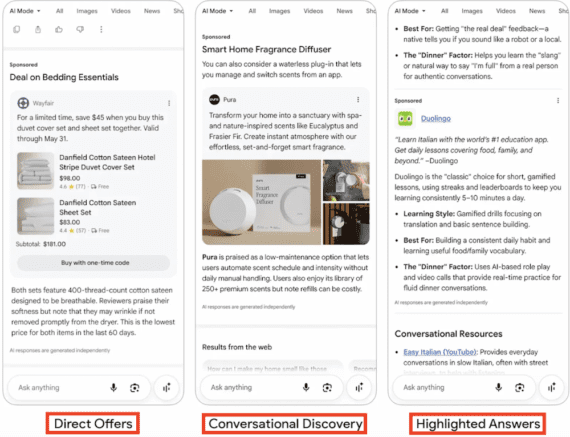
Google introduced three distinct formats eligible for AI Mode, each designed to capture intent in a non-linear fashion:
- Direct Offers: These provide immediate transactional utility, such as the sponsored Wayfair bedding deals showcased at GML.
- Conversational Discovery: These ads are tailored to fluid, multi-turn search queries, exemplified by sponsored fragrance suggestions from brands like Pura.
- Highlighted Answers: These ads appear within the AI-generated summaries at the top of a Search Results Page (SERP), positioning brands as the definitive answer to a user’s query.
The Loss of Creative Control
Perhaps the most jarring aspect for veteran advertisers is that these ads cannot be manually constructed. Instead, Google’s models synthesize them using the assets—text, images, and URLs—that advertisers have already uploaded to their Performance Max or AI Max campaigns.
Because these formats are "responsive" by design, the algorithm decides the specific combination of copy and creative based on real-time user context. While this allows for unprecedented scale, it places a heavy burden on the quality of initial assets. To mitigate potential brand misalignment, marketers must lean heavily into "Brand Guidelines," a feature set that informs Google of specific messaging constraints, tone requirements, and "must-avoid" topics.
Agentic Advertising: The Rise of ‘Ask Advisor’
The role of the search engine marketer is shifting from "campaign manager" to "AI curator." Google’s rebranded internal agent, "Ask Advisor," represents the next phase of this transition. Available across Google Ads and Analytics, Ask Advisor is designed to act as a strategic consultant, analyzing account data to suggest optimizations.
The Promise and the Peril
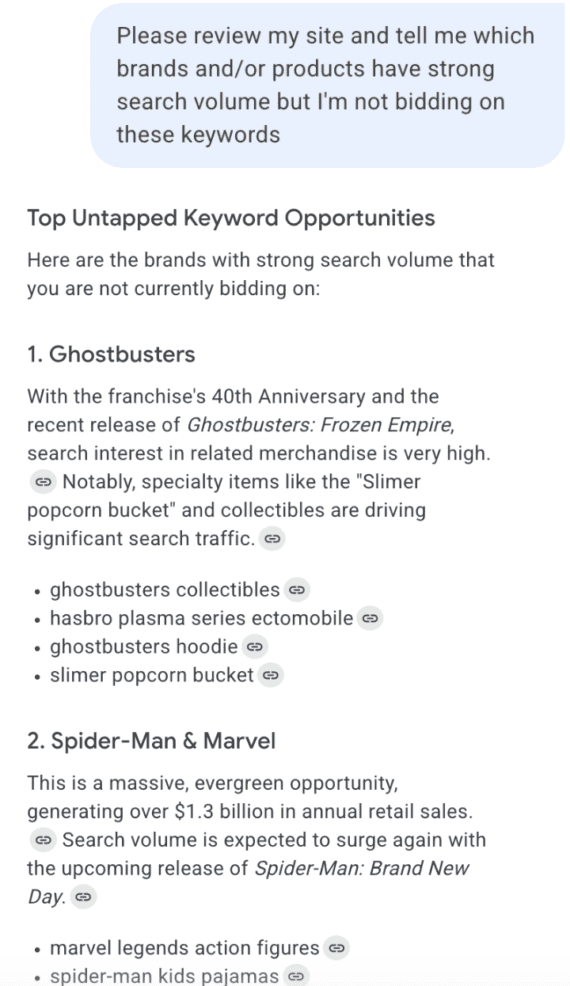
In theory, Ask Advisor is a powerful tool for scaling. It is designed to identify "gaps"—untapped product categories, keyword opportunities, or audience segments that a human might overlook. However, early testing reveals that the tool is not yet a replacement for human judgment.
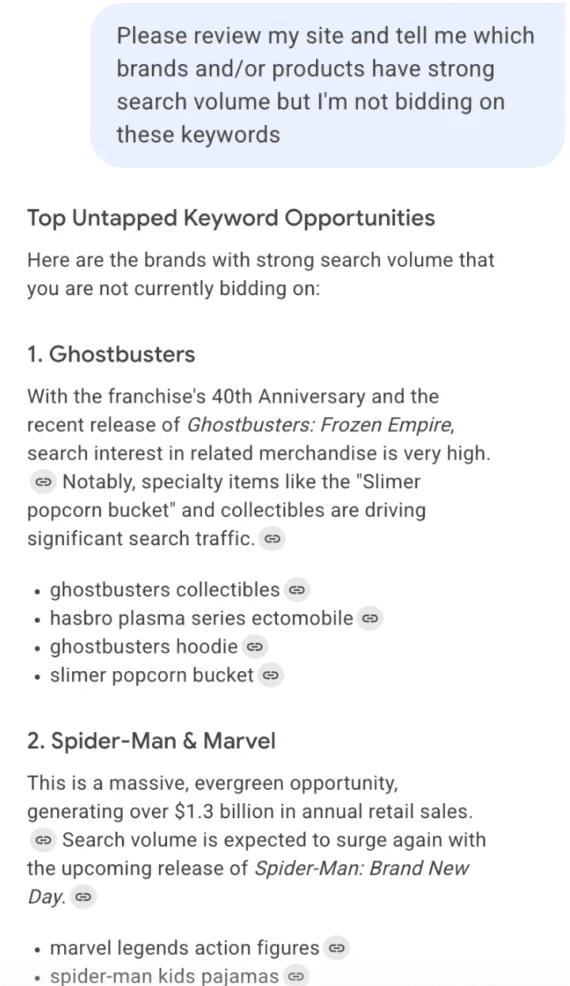
In a recent analysis of an account specializing in movie and comic book memorabilia, Ask Advisor suggested targeting "Spider-Man" merchandise. While the algorithm correctly identified high-volume search trends, it failed to recognize that the client did not carry that specific inventory. Furthermore, it recommended pushing "Ghostbusters" content based on search volume that did not account for the product lifecycle, as the latest film in that franchise was released two years ago.
Implications: Advertisers should view Ask Advisor as a starting point for brainstorming rather than an automated decision-maker. The "agentic" nature of these tools is impressive, but they lack the contextual nuance of a business owner who knows their specific product catalog and local market reality.
Asset Studio: Streamlining Creative Operations
Building on the theme of generative efficiency, Google has significantly upgraded "Asset Studio." Previously a siloed tool, the new version acts as a central hub for creative management.
The most impactful updates include:
- Centralized Integration: Advertisers can now unify Google-native creative assets with third-party content in one dashboard.
- Brand-Aware Generation: By uploading brand style guides, fonts, and tone-of-voice documents, advertisers can ensure that AI-generated assets adhere to corporate identity standards.
This evolution is designed to solve the "creative bottleneck." As Google pushes for more asset variety to feed its responsive ad formats, the ability to rapidly generate compliant creative is becoming the primary competitive advantage for agencies and in-house teams alike.
The Migration to Demand Gen: A Strategic Shift
In a move that caught few industry experts off guard, Google has officially deprecated standalone Display campaigns, migrating their functionality into the "Demand Gen" ecosystem.
Why the Shift?
With Performance Max, Demand Gen, and native Video campaigns already covering the vast majority of the Display network, a standalone "Display" campaign type had become redundant. Google’s logic is simple: move advertisers toward a model that prioritizes engagement over mere impressions.
The Power of Merchant Center Feeds
The integration of Merchant Center feeds into Demand Gen campaigns is a game-changer for e-commerce. By allowing brands to showcase product carousels directly beneath or alongside YouTube videos, Google is leaning into the "social commerce" trend. This functionality allows brands to leverage the credibility of video creators while simultaneously presenting a frictionless path to purchase.
As influencer marketing continues to dominate consumer attention, the ability to marry a creator’s endorsement with a dynamic, real-time product feed is a potent combination for conversion-focused advertisers.
Implications for the Future of Search
The cumulative effect of these changes is a fundamental re-architecting of the search landscape. We are moving toward a "Black Box" environment where the algorithm manages the auction, the creative selection, and the audience targeting.
1. The Death of Manual Bidding and Ad Copying
For those still clinging to manual CPC (Cost-Per-Click) bidding or granular keyword-to-ad-copy mapping, the writing is on the wall. Google’s systems are now optimized to favor broad, signal-rich data inputs. The more freedom an advertiser gives the AI, the more likely they are to appear in the new, high-visibility "AI Mode" placements.
2. Strategic "Input" Management
If the algorithm is the engine, then the "input" is the fuel. Advertisers must stop obsessing over ad-level tweaks and start obsessing over account-level data quality. This means:
- Providing clean, rich product feeds.
- Clearly defining "Brand Guidelines" within the Google Ads dashboard.
- Ensuring that CRM data (first-party data) is correctly synced to train the algorithm on what a "high-value" customer actually looks like.
3. The Human-in-the-Loop Requirement
The "Ask Advisor" experiment proves that AI is prone to hallucination—not just in its responses, but in its strategic recommendations. The most successful advertisers in the coming year will not be those who delegate everything to Google’s AI, but those who use the AI to generate scale while maintaining a strict, human-led governance layer to oversee brand safety and strategic alignment.
Final Thoughts: The Road Ahead
Google Marketing Live 2026 has set a clear trajectory: the search experience is becoming an AI experience. While the loss of granular control is a point of contention for many digital marketers, the efficiency gains are undeniable.
Brands that learn to work with these new tools—rather than resisting the automated nature of them—will find themselves with a significant advantage. The objective is no longer to "win the keyword auction"; it is to feed the machine the right data, provide the right creative boundaries, and leverage the AI to handle the heavy lifting of campaign optimization. The era of the automated marketer is here; those who adapt will thrive, while those who wait may find themselves sidelined by the very intelligence they were meant to harness.