
Are your Facebook ad campaigns generating plenty of clicks but failing to convert into meaningful revenue? For many eCommerce business owners, the digital advertising landscape has become a source of frustration, characterized by skyrocketing acquisition costs and erratic algorithm performance.
According to Sam Piliero, a veteran strategist and founder of The Moonlighters, the problem isn’t the platform—it’s the approach. In a comprehensive breakdown of his proprietary "M4 Method," Piliero outlines a four-stage framework designed to transform ad accounts from chaotic money pits into consistent, predictable engines of profit.
The Two Primary Roadblocks to eCommerce Growth
Before diving into technical tactics, Piliero identifies two psychological and operational traps that keep advertisers stuck in a cycle of stagnation.
1. The Efficiency Trap
Many advertisers fall in love with "vanity" efficiency metrics, such as Return on Ad Spend (ROAS) or Cost Per Acquisition (CPA). While these are useful guardrails, they are not the end goal. Piliero argues that the obsession with high ROAS often blinds business owners to the bigger picture: contribution margin.
A brand chasing a 10x ROAS might be keeping its spend so low that it fails to capture market share. Conversely, a brand operating at a 2.2 ROAS might be acquiring customers aggressively, fueling long-term lifetime value (LTV), and benefiting from organic word-of-mouth compounding. For most eCommerce brands, a 10–20% profit margin on revenue is the target that truly indicates a healthy, scalable business.
2. The Illusion of Control
Advertisers tend to gravitate toward two extremes: over-engineering accounts with dozens of fragmented campaigns, or "setting and forgetting" by letting the algorithm run wild. Both methods are flawed. The sweet spot lies in a structured, deliberate management style. When executed correctly, the results can be transformative—Piliero cites five of his clients who, within one year, scaled from sub-$100,000 monthly revenue to over $50 million.
The M4 Method: A Four-Stage Architecture
The M4 Method is a systematic approach built upon four pillars: Account Structure, Creative Strategy, Deep Dive Analysis, and Scaling. Each stage relies on the previous one to function.
Stage 1: Foundational Account Structure
Think of your account structure as the foundation of a house. Even the most compelling creative will underperform if it is housed in a disorganized, bloated account.

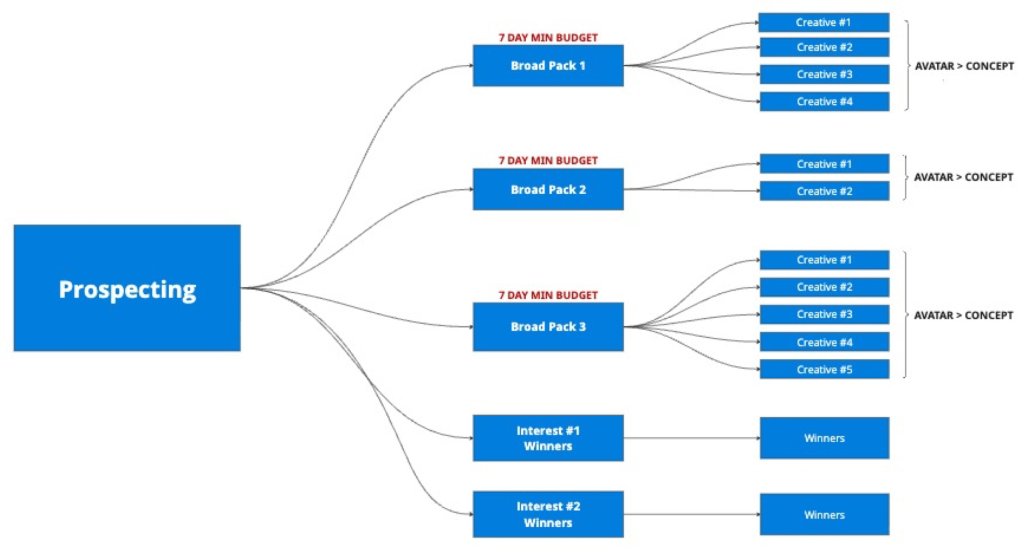
Piliero advocates for a consolidated setup using a single prospecting campaign governed by Campaign Budget Optimization (CBO). Within this campaign, ads are organized into "packs"—grouped sets of creative. This structure allows the algorithm to act as a dynamic allocator, shifting spend toward whichever ads are converting best in real-time.
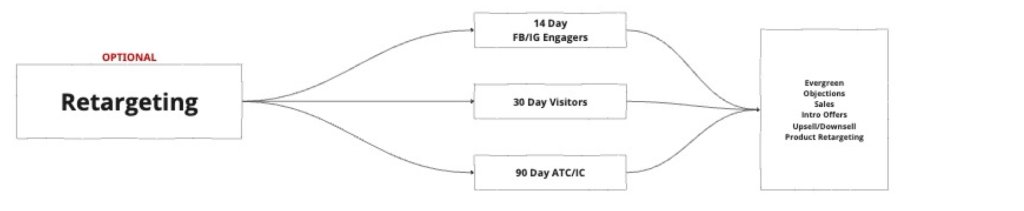
Complementing this is a dedicated retention campaign focused on existing customers. By separating these audiences, you gain clear visibility into where your budget is going, ensuring that you aren’t accidentally paying to "re-acquire" customers who are already loyal to your brand. Optional retargeting and high-spend scaling campaigns can be added as the business grows.
Stage 2: The Creative Engine
In the era of Meta’s "Andromeda" algorithm, creative is targeting. Because the algorithm analyzes the content of your ad to determine who sees it, generic, one-size-fits-all messaging is dead.
The Problem-Solution Framework:
Successful ads identify a specific customer avatar, articulate their unique pain point, and present the product as the tailored solution. Instead of marketing a back brace to "everyone with back pain," successful ads target specific cohorts—such as construction workers—using imagery and copy that resonates with their specific professional struggles.
Key Tactics for Creative Success:
- Leverage Data: Use the Facebook Ads Library and research tools like MagicBrief to identify competitors’ long-running ads. Longevity in the feed is a reliable proxy for performance.
- UGC at Scale: Invest in semi-professional User Generated Content (UGC). Partner with micro-influencers (1,000–20,000 followers) to create native-feeling video content. Provide them with key talking points, but allow their authentic delivery to shine.
- Iterate, Don’t Reinvent: If an ad hits your ROAS target and captures 10% of your budget, it’s a "hit." Rather than starting from scratch for your next ad, build variations. Swap the hook, change the talent, or adjust the headline. These incremental iterations are significantly more efficient than producing entirely new concepts.
Stage 3: Deep Dive Analysis
Most businesses fail to capitalize on the "hidden" patterns in their data. Piliero emphasizes that consumer behavior is rarely flat across a seven-day week.
By analyzing 90 to 180 days of non-holiday data, advertisers can identify specific days of the week or audience segments where performance consistently spikes. For example, pet brands often see weekend surges, while B2B or productivity-related goods may peak on Mondays and Tuesdays.
The Action Plan:
Once a 20–30% performance variance is identified, don’t just kill the low-performing days. Instead, adjust your budget pacing: lower the spend on "slow" days to protect margins, and push the budget aggressively on high-performing days to capture volume. This shift, while seemingly simple, often yields a 20% improvement in overall ROAS.

Stage 4: Strategic Scaling
Scaling is a privilege reserved for high-performing accounts. Piliero categorizes scaling into three distinct modes:
- Vertical Scaling: Increasing the budget of an existing, profitable campaign by 10–30% every few days. This allows the algorithm to adjust without entering a disruptive "learning phase."
- Horizontal Scaling: Launching temporary, separate campaigns for specific events like seasonal sales or new product launches. This keeps your evergreen "always-on" prospecting campaign clean and unaffected by short-term spikes.
- Twin Engine Scaling: The combination of both methods. When an ad in your prospecting CBO becomes a "hit," you create iterations of that ad, inject them back into the CBO, and increase the budget vertically. This creates a compounding effect where your spend climbs while your ROAS remains stable.
Implications for Modern eCommerce
The shift toward the M4 Method marks a move away from "manual micro-management" and toward "systematic optimization." The core implication is that the modern marketer’s role has shifted from being a media buyer to being a creative producer and data analyst.
The "King Goal" Philosophy
Underpinning the entire M4 Method is the concept of the "King Goal." Every business must have a single North Star metric—whether it is CAC (Cost Per Acquisition), ROAS, or LTV. When the King Goal is being met, minor fluctuations in proxy metrics like CPM (Cost Per Mille) or CPC (Cost Per Click) should be ignored.
This philosophy prevents the "analysis paralysis" that often leads to reactive, poor decision-making. By focusing on the one metric that defines survival and growth, marketers can maintain the discipline required to scale through the noise of a crowded digital marketplace.
A Note on Constraints
Finally, Piliero offers a vital warning: Scaling requires operational readiness. If your business cannot fulfill increased demand, aggressive scaling will only result in eroded customer trust and operational collapse. For supply-constrained businesses, the goal of the M4 Method should be inverted—focusing on maximizing efficiency and profit per order rather than raw customer growth.
Ultimately, the M4 Method provides a roadmap for those willing to do the work. By prioritizing foundational structure, iterative creative, data-driven analysis, and disciplined scaling, eCommerce brands can transcend the volatility of Facebook ads and build a sustainable, profitable future.