In the rapidly evolving landscape of digital advertising, a fundamental shift is occurring. For years, the industry operated on the premise that granular, manual control—meticulous keyword management, rigid match-type configurations, and daily bid adjustments—was the hallmark of a successful marketing strategist. However, as AI-driven platforms like Google Ads and Meta undergo a profound transformation, that "manual-first" philosophy has moved from being a best practice to a bottleneck.
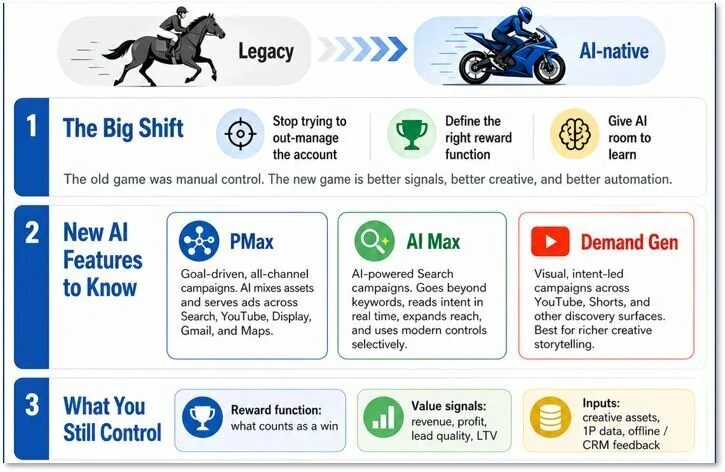
The question facing today’s digital leaders is stark: In an era defined by fuel-efficient, high-performance motorcycles, why are so many professionals still insisting on riding horses?
The Paradigm Shift: From Manual Micromanagement to Machine Intelligence
For nearly two decades, Search marketing has been framed through the lens of brand versus non-brand performance, with agencies proving their value by the frequency of their manual account tweaks. Today, this approach is increasingly viewed as "profit-pulverizing."
The modern Google Ads ecosystem is no longer a collection of levers and buttons for humans to pull; it is a sophisticated, AI-powered engine designed to optimize for business outcomes. Whether through Performance Max (PMax), the newly evolved AI Max, or Demand Gen, Google is moving toward a "let us do everything for you" model. By shifting focus from keyword-level management to outcome-oriented goal setting, marketers can unlock levels of scale and efficiency that were previously unattainable.
The Core Philosophy: Embrace and Extend
The transition to AI-native advertising is not merely a technical upgrade; it is a cultural and strategic necessity. Industry experts, including former Google insiders, argue that the "choice to stay in the past" is no longer a viable business strategy. The optimal path forward is to "embrace and extend"—accepting that while AI systems may occasionally make errors, their capacity for rapid learning and signal processing far exceeds human capability.
When you lose three or four times to win thirty or forty times, the trade-off is not just acceptable—it is the cornerstone of a winning performance strategy.
Chronology of the Transformation: From AdWords to AI Maturity
To understand how we reached this tipping point, one must look at the evolution of the Google Ads platform over the last decade.
- 2010–2015: The Era of Control. This period defined the "AdWords" mindset. Agencies and in-house teams focused on SKAGs (Single Keyword Ad Groups), heavy manual bidding, and complex, siloed campaign structures. Success was measured by the ability to beat the auction through superior manual configuration.
- 2016–2020: The Rise of Smart Bidding. Google began introducing machine learning-driven bidding strategies (Target CPA, Target ROAS). While adoption was initially slow, the performance gap between manual bidders and those using automation began to widen, signaling the beginning of the end for manual bid modifiers.
- 2021–Present: The AI-Native Shift. With the introduction of PMax and the sunsetting of traditional, manual-heavy workflows, the platform shifted its focus. Today, the focus is on "reward functions"—telling the machine exactly what a high-value customer looks like and allowing the AI to navigate the vast, real-time data signals required to acquire them.
Supporting Data: The Maturity Model Framework
A critical barrier to progress is the lack of objective self-assessment. Many organizations believe they are "advanced" because they use some automation, while in reality, they are merely "tourists" in an AI-driven landscape. To combat this, experts have proposed a two-dimensional maturity model: Capability Scoring and Depth Scoring.
Assessing Capability (0–4 Scale)
- 0 (Legacy): Manual CPC, heavy reliance on bid modifiers, and an obsession with exact-match keywords.
- 2 (Hybrid): A mix of manual and automated, often characterized by a "control-first" mindset despite having access to modern tools.
- 4 (AI-Native): Full reliance on AI-driven platforms, with human effort focused on strategy, data signals, and creative input rather than administrative button-pushing.
Assessing Depth
Depth is the critical guardrail against self-deception. It measures the percentage of budget, conversions, or campaigns governed by these modern strategies. An organization that uses AI for a 5% pilot program is fundamentally different from one that uses AI as its default execution mode (75%–100% of activity).
The goal for any modern enterprise is to achieve a score of 85 or higher on the maturity index, ensuring that AI is not just an experiment, but the engine of the entire marketing department.
Official Perspectives: The Role of the Reward Function
Google’s evolving offerings are built on two core principles: defining the "reward function" and leveraging wide-set signal analysis.
The Reward Function
The AI is only as intelligent as the data it is fed. If a marketer optimizes for "clicks," the AI will deliver clicks. If a marketer feeds the system "real business value"—such as CRM-integrated lead quality, offline conversion data, or lifetime value (LTV) models—the AI will optimize for revenue. This places the burden of success back on the marketer, but in a more strategic capacity: acting as the architect of the data ecosystem rather than the technician of the ad account.
AI Max and Demand Gen
Google’s newer tools, such as AI Max, eliminate the need for traditional keyword segmentation. By analyzing intent signals far beyond the literal text of a search query, these systems identify high-intent users in real-time. Similarly, Demand Gen uses AI to deliver visually rich content across YouTube and Shorts, utilizing predictive intent to place ads where they are most likely to convert.
Implications for Modern Marketing Professionals
The shift to AI-native advertising has profound implications for the structure of marketing teams and the future of the profession.
1. The Redefinition of "Account Management"
The role of the Search Marketer is undergoing a total transformation. The "soul-sucking" work of manual keyword maintenance, bid adjustments, and ad group sculpting is effectively dead. In its place, the new role requires mastery of:
- Measurement Architecture: Ensuring the data fed to the AI is clean, accurate, and reflects true business value.
- Creative Strategy: Because AI can mix and match assets, the quality and variety of the creative (images, video, text) become the primary differentiator.
- Governance: Setting the boundaries for the AI—such as brand safety controls and location targeting—rather than micromanaging the auction.
2. Financial and Operational Impact
Organizations that successfully pivot to an AI-first operating model report significant gains in efficiency. By removing human bias and administrative delay from the auction process, companies can achieve 3x, 5x, or even 20x increases in revenue and profit. The "cultural pain" of learning this new game is high, but the cost of staying in the past—losing market share and wasted ad spend—is significantly higher.
3. The End of "Guesswork"
Perhaps the most liberating aspect of the AI transition is the end of the "human-versus-machine" debate. We have moved past the point where a human can consistently out-manage a machine in the auction. Recognizing this truth is the first step toward reclaiming time for high-level strategy. When we stop trying to "sculpt" accounts, we gain the bandwidth to focus on the broader customer journey, competitive analysis, and the integration of marketing data into the company’s wider CRM and sales infrastructure.
Conclusion: The Path Forward
The future of digital advertising is already here; it is just unevenly distributed. To remain competitive, organizations must move beyond the "AdWords-era" mindset and embrace the possibilities of the present.
This requires a fundamental commitment to truth: performing honest maturity audits, fixing primary conversion tracking, and giving the machine the room it needs to learn. It is time to retire the "horse and buggy" tactics of the past. For those who choose to evolve, the reward is not just better metrics—it is a more meaningful, strategic, and ultimately more profitable career in the world of marketing.
The transition will be uncomfortable for some, but for those who master the machine, the growth potential is limitless. Carpe diem.