The landscape of B2B software has undergone a seismic shift, and at the heart of this transformation is a single, potent reality: AI agents have officially moved from the experimental lab to the front lines of production. At SaaStr AI 2026 in San Mateo, the message was clear—agents are no longer just "nice-to-have" features. They are carrying quota, writing directly to systems of record, and fundamentally redefining the architectural blueprints of modern companies.
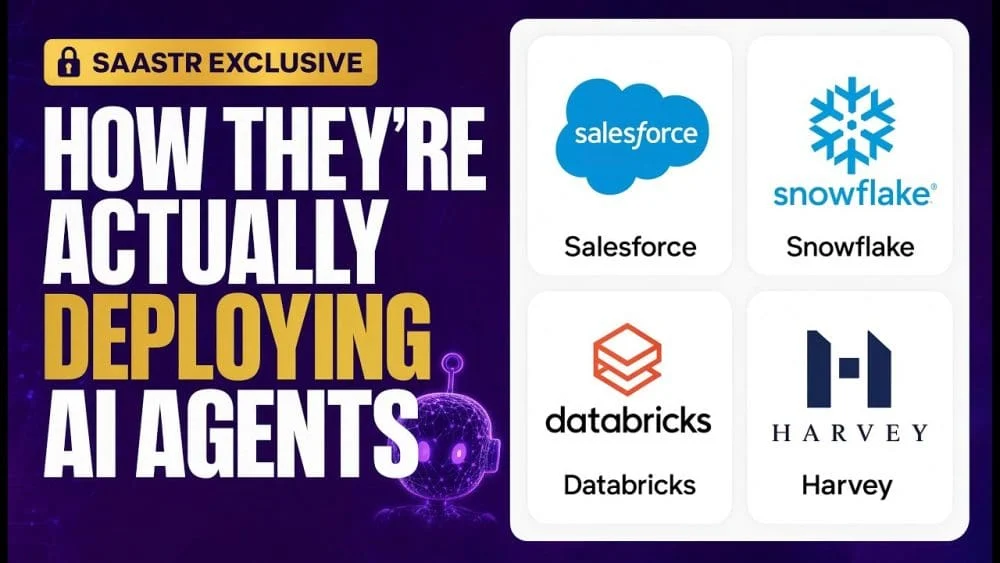
The event served as a definitive state-of-the-union for the industry, featuring insights from heavyweights like Salesforce, Snowflake, Databricks, and Harvey. Across every session, a singular truth emerged: the era of "vibe coding" a cheap clone of a legacy platform is dead. We have entered the era of the autonomous enterprise, where the competitive advantage is defined by how effectively a company can integrate agents into its core operations.
The New Reality: From "Cushy" to "Mission-Critical"
Jason Lemkin, the architect of SaaStr, opened the main stage with a provocative diagnosis: the role of the Chief Product Officer (CPO) has undergone the most radical transformation in B2B history. For over a decade, the CPO role was characterized by strategic planning and quarterly product roadmaps. Today, it is arguably the most stressful job in the enterprise.
Every CPO is now under intense pressure to deliver "agentic" features—functionalities that don’t just suggest a task but actually execute it. The market no longer rewards passive tools; it demands agents that operate autonomously to drive tangible ROI.
Insights from the CPO Frontline
The CPO panel, featuring leaders from Rubrik, Webflow, Glean, and Harvey, highlighted the divergence in implementation:
- Rubrik’s Anneka Gupta detailed the evolution of "Ruby," an agent for platform operations. What began as a RAG-based documentation assistant has matured into an agent capable of forward-looking capacity planning. Crucially, Rubrik maintains a deterministic guardrail; while LLMs generate the recovery plans, the execution remains strictly governed to ensure core service stability.
- Webflow’s Rachel Wolan framed Webflow as an "agentic web marketing platform." Their latest innovation—an answer engine optimization agent—autonomously monitors competitor activity and drafts content. With 18% of the top 2,000 websites under their belt, Webflow’s customers are seeing a 75% increase in organic traffic, a necessary response to the shift where 50% of user discovery now happens through answer engines.
- Glean’s Emrecan Dogan noted that the world is moving beyond information retrieval. Glean has repositioned itself as the "AI front door," acting as a single server that feeds rich company context into external harnesses like Cursor and Claude Code, creating a powerful ecosystem effect.
- Harvey’s Anique Drumright emphasized that Harvey is not a feature, but a fully agentic platform. For legal firms, the challenge is not just generating output but coaching associates to verify an agent’s logic. The success of Harvey, despite the inherent friction of selling into law firms where partners are personally liable, serves as a benchmark for agentic adoption in high-stakes environments.
The SaaSpocalypse and the Rise of the AI-Native
In his keynote, Jason Lemkin dismantled the "tired vs. wired" narrative that currently grips the venture capital and public markets. While public software leaders have seen valuations plummet by as much as 70%, the "wired" side—AI-native firms—is seeing unprecedented growth.
The Death of the "Vibe Code" Myth
Lemkin was blunt: you cannot "vibe code" a platform that replaces a multi-billion-dollar incumbent. While it is possible to build quick prototypes, the real value lies in deep integration. A CRM that simply exists is a commodity; a CRM that proactively manages your calendar and closes deals is worth $50,000 to $100,000 per customer.
Market Dynamics and the "Three Big IPOs"
The market is currently in a "SaaSpocalypse," characterized by a drought of successful IPOs since 2021. However, Lemkin predicted a massive correction, suggesting that we are on the verge of the three largest IPOs in tech history: SpaceX, Anthropic, and OpenAI. He further forecasted that a $100 billion startup acquisition is likely within the next 12 months.
The Human-to-Agent Ratio
Lemkin provided a live case study using SaaStr itself. In 2024, the organization relied on 20+ humans to handle operations. Today, with the integration of AI agents like "10K" (AI VP of Marketing) and "QB" (AI VP of Customer Success), that headcount has been reduced to three humans overseeing 20 agents. The cost savings are staggering—roughly $257 per month for the agents versus the $500,000 in human labor costs previously required.
Operational Excellence: Salesforce, PayPal, and Databricks
Scaling SMBs with Salesforce and PayPal
Amelia Lerutte hosted a critical session on how AI is turning the SMB segment into a powerhouse. Salesforce’s Adam Alfano noted that Agentforce is currently managing thousands of deals across the startup segment. The commonality? A shift toward "headless" operations. Account executives are now working almost entirely within Slackbot interfaces, with agents handling the heavy lifting of outbound email, onboarding, and revenue orchestration.
PayPal’s Eitan Saban shared a sobering lesson in scale. After deploying an SDR agent to manage 8,000 leads a month, meeting conversion rates jumped by 50%. The takeaway: "The real question is not whether AI replaces people, but which people AI makes irreplaceable."
Databricks and the "Dashboard Graveyard"
Arsalan Tavakoli of Databricks offered a reality check on enterprise adoption. While the Twitter discourse suggests universal AI adoption, the reality is that most enterprises are still in the early phases. The "token-maxing" problem—where spend on AI increases without a corresponding increase in ROI—is rampant.
Databricks is tackling this by moving away from "dashboard graveyards." Instead, they are pushing toward natural language interfaces where users query data directly. Tavakoli argued that the "moat" of the future is not proprietary code, but "organizational context"—the deep, embedded knowledge of how a specific business functions.
Implications: The New Rules of Engagement
As the dust settles on SaaStr AI 2026, four clear implications for founders and executives have emerged:
1. Responsibility as the Ultimate Feature
The recurring theme across every panel was accountability. As agents take more autonomous actions, the vendor must be prepared to accept the consequences of those actions. This requires a transition from "move fast and break things" to "move fast and verify outcomes."
2. The End of Feature Moats
Elena Verna of Lovable emphasized that in an AI-native world, features are no longer moats. If an agent can write 80% of the code, a feature can be copied in weeks. The only sustainable moats are now hardware, deep data, complex compliance integrations, and brand loyalty.
3. Marketing as a Product Engineering Function
For non-AI-native marketing teams, the advice is clear: let the engineering team lead the transformation. Marketing must move from being a creative silo to an integrated part of the product engineering lifecycle, utilizing the same velocity that AI brings to development.
4. The Bifurcation of the Market
The most vital takeaway is the widening gap between the "Exploders" and the "Waiters." The companies that are actively tapping into AI budgets to re-architect their go-to-market strategies are growing at rates previously thought impossible (e.g., Palantir’s jump from 27% to 85% growth). Meanwhile, companies waiting for a return to 2021-era software norms are effectively waiting for a recovery that will not happen.
Conclusion
SaaStr AI 2026 was not just a conference; it was a wake-up call. The "SaaS" era, defined by manual workflows and static interfaces, is being supplanted by the "Agentic" era. Whether it is Snowflake’s Raven agent managing pipelines, or SaaStr’s own lean operation, the message is unequivocal: the future belongs to those who build with agents, think in terms of outcomes, and embrace the chaos of the Cambrian explosion currently unfolding in B2B tech. The barrier to entry has collapsed, but the barrier to excellence has never been higher.