In the rapidly evolving landscape of artificial intelligence, a common frustration has emerged among entrepreneurs and business leaders: the "one-size-fits-all" AI agent. While the internet is saturated with tutorials promising to build sophisticated AI assistants in mere minutes, the reality for most professionals is a cycle of disappointment—generic outputs that fail to capture the nuance of their specific business processes.
However, a new paradigm is shifting the narrative. By moving away from off-the-shelf solutions and toward custom-built, orchestrated agent ecosystems, business leaders like Keith Moehring, founder of L2 Digital, are achieving something once thought impossible: the automation of 60% of their total workload. This transition represents a shift from "using AI" to "architecting AI," turning digital assistants into a cohesive, second-brain infrastructure that handles complex, repeatable tasks with surgical precision.
The Hard Truth: Why Templates Fail
The allure of "spin up an agent in six steps" is strong, but it is often misleading. According to Moehring, the primary reason most AI implementations fail is a lack of deep, contextual integration.
"Building an AI agent that reliably performs a specific task in the specific way you do requires real work," Moehring explains. "You have to provide context. You have to define the process. You have to iterate until the output matches what you actually want."
The critical takeaway is that your AI system must be a reflection of your unique business architecture. Borrowed templates lack the internal logic of your organization. When you invest the upfront time to build an agent that handles 80% of a recurring task, you create a "second brain"—a system that logs, consolidates, and makes your business data queryable. When you forget a project detail or a specific process step, you don’t hunt through emails; you query your agent.
A Layered Approach: Scaling From Tasks to Orchestration
AI agents perform best when given specific, repeatable mandates rather than broad, abstract goals. To move from manual labor to automated systems, one must adopt a tiered strategy:
1. The Entry Level: Task-Specific Agents
At this stage, you build individual agents designed to handle small, time-consuming actions. These are the "workhorses" of your operation. Whether it is drafting email responses, summarizing documents, or formatting data, these agents are built to do one thing perfectly every time.
2. The Intermediate Level: Workflow Coordination
Once you have several task-specific agents, you begin to build "coordination agents." These agents act as middle managers, stringing together the outputs of your task-level agents. They provide direction, ensuring that the output of an research agent feeds correctly into a drafting agent, and subsequently into a final delivery agent.
3. The Advanced Level: The Orchestration Layer
This is the pinnacle of the system. An orchestration agent manages the entire process from start to finish. For instance, Moehring uses an orchestration agent named "Leo." With a single prompt at the start of the month, Leo identifies the necessary tasks for distributor clients, triggers the appropriate sub-agents, updates project management platforms like ClickUp, and drafts necessary communications.
What previously consumed two weeks of management time is now reduced to one hour of oversight on the first day of the month.
Chronology of an Implementation: Building Your System
To successfully transition to an AI-augmented operation, you must follow a structured, logical sequence.
Phase I: Mapping the Org Chart
Before writing a single line of code or prompt, you must map your business. Using an "accountability chart," document your business functions (Marketing, Sales, Operations, Finance), the roles assigned to those functions, and the recurring tasks within each.

For the solopreneur wearing every hat, this map is essential. By visualizing your responsibilities, you identify the low-hanging fruit—the tasks that are most repetitive and least rewarding. Tools like Ninety.io or Claude can assist in visualizing this hierarchy, providing a clear blueprint for where your first agents should be deployed.
Phase II: Establishing the Tech Stack
A high-functioning AI system relies on three pillars:
- The AI Model: While LLMs like Claude, OpenAI, and Gemini are all capable, the key is choosing the right model for the complexity of the task.
- The User Interface: Cursor, a code editor that connects AI directly to your local files, has become the industry standard for this workflow. By allowing the AI to "see" your project files, it gains the context it needs to execute tasks without constant manual input.
- The Context Layer: This is the "brain." By creating a structured folder hierarchy (e.g., "Operations," "Client Data," "Templates"), you give the AI a map. It learns where to retrieve information and where to save output, allowing it to function autonomously.
Phase III: The Playbook Process
Playbooks are the Standard Operating Procedures (SOPs) for your agents. You must document your process in a way the AI can interpret.
- Define the Task: Outline the current manual steps.
- Identify Tech Connections: Ensure you have the necessary APIs (like the Model Context Protocol or Granola for meeting notes).
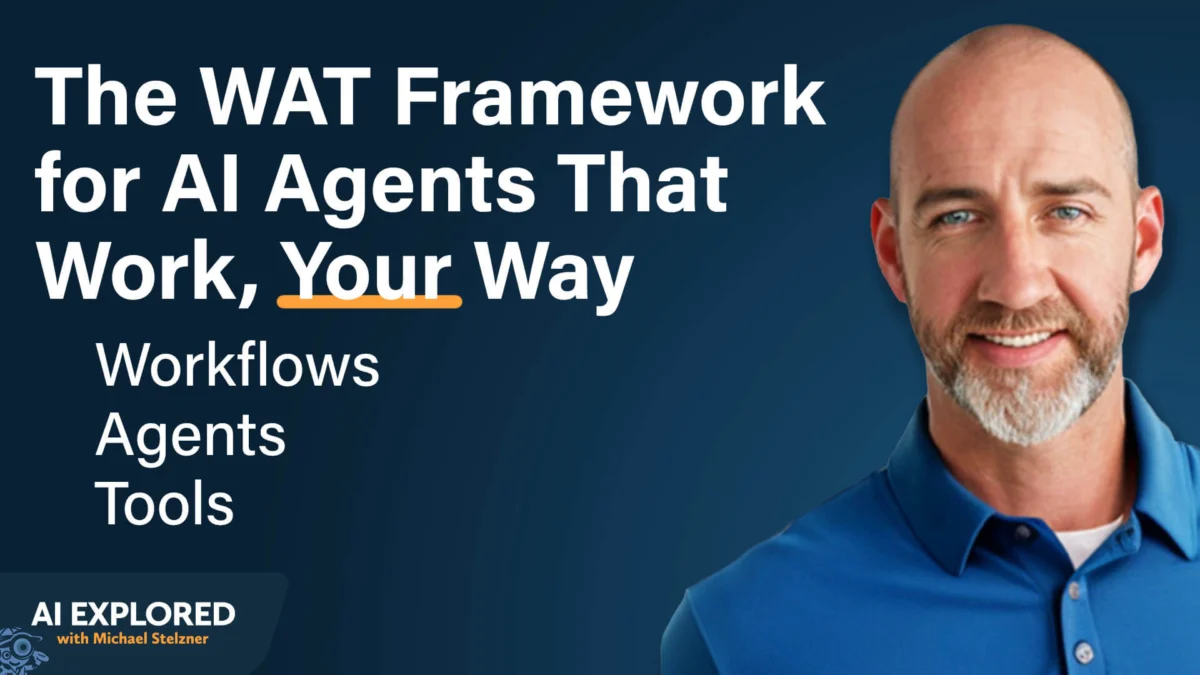
- Build and Refine: Use the WAT framework (Workflows, Agents, and Tools) to instruct the AI to build the agent step-by-step. Review the build in real-time, adjusting as the AI troubleshoots its own connections.
Supporting Data and Real-World Application
The power of this system is best illustrated by the "Post-Meeting Follow-Through" agent. Previously, this was a major pain point: client meetings occurred, but action items were lost in the shuffle.
Now, by using the Granola API, the agent pulls meeting notes, cross-references them with the client list, identifies specific action items, and generates tickets in ClickUp with full context. By utilizing a specific naming convention (e.g., ClientAcronym_MeetingType), the agent knows exactly which folders to access. The result is a 100% capture rate of action items without the entrepreneur ever having to touch a project management dashboard.
Implications for Future Business Models
The transition to agentic workflows has profound implications for the future of professional work:

- Human-in-the-loop Efficiency: The goal of these agents is not to remove the human, but to elevate the human to a reviewer role. The 20% of work that requires human intuition and decision-making becomes the focus, while the 80% of "grunt work" is handled by the system.
- Scalability without Headcount: For small agencies and firms, this allows for rapid scaling. Businesses can take on more complex projects without a linear increase in administrative staff, as the "agent workforce" handles the overhead.
- Institutional Memory: Perhaps the most undervalued benefit is the creation of a permanent, searchable institutional history. Because every action is logged within the agent’s context layer, the business becomes less dependent on the individual memory of the owner.
Final Strategy: Start Small, Build Upwards
The biggest mistake aspiring AI architects make is trying to build a "master agent" from day one.
"Start with your simplest, most repetitive task," advises Moehring. "If writing a piece of content requires research, asset gathering, and an interview, don’t build one ‘content agent.’ Build three separate agents. Once each does its job reliably, stack them in sequence."
This bottom-up approach ensures that when you eventually add an orchestration layer, you are managing a stable, proven system rather than a chaotic, unpredictable one. By focusing on modular, repeatable, and context-rich agents, the promise of the "automated business" moves from the realm of science fiction into a tangible, measurable, and highly profitable reality.
As the landscape matures, the competitive advantage will not belong to those who use the most advanced AI tools, but to those who have the best-organized, most context-heavy agent systems that truly reflect the soul and strategy of their business.