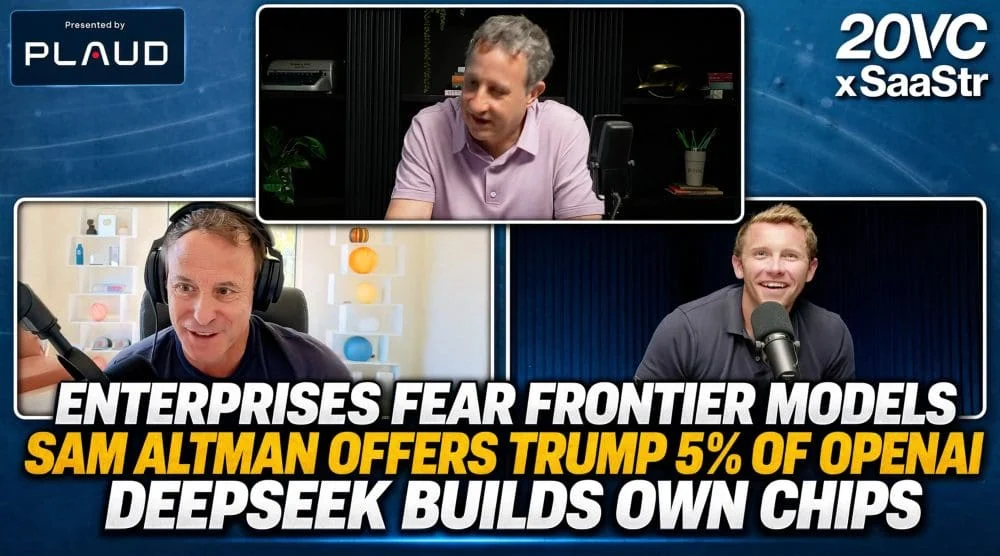
In the wake of a high-octane discussion on the 20VC x SaaStr podcast—featuring Harry Stebbings and Rory O’Driscoll—the discourse surrounding Artificial Intelligence has shifted from mere "hype" to the cold, hard mechanics of institutional survival. From the geopolitical implications of AI model sovereignty to the granular realities of seed-stage dilution, the landscape is evolving at a breakneck pace.
What follows is an in-depth synthesis of the critical strategic pivots currently defining the industry, derived from recent market observations and expert analysis.
1. The Geopolitics of Sovereignty: Why Access Restrictions Backfire
The most profound realization from recent global analysis is the unintended consequence of restricting AI access. A two-week deep dive into China and Hong Kong reveals a stark reality: when frontier models like Claude or OpenAI are geofenced or blocked, it does not stop the evolution of AI in that region. Instead, it forces a localized, rapid-response innovation cycle.
Currently, six of the top-performing models on OpenRouter are of Chinese origin. The lesson for Western policymakers and industry titans alike is clear: cutting off a market from technology does not hinder the competitor; it mandates their self-reliance. By enforcing digital borders, the West is inadvertently funding and accelerating the creation of indigenous, world-class alternatives.
2. The "5% Alignment" Strategy
Sam Altman’s proposal to offer a 5% government stake in AI labs was met with initial skepticism, yet it reflects a sophisticated understanding of corporate power dynamics. In the venture capital world, a 5% stake held by a major strategic partner often yields disproportionate influence.
If a 5% equity slice can guarantee regulatory alignment and long-term stability, it is a masterstroke of defensive posturing. However, the nuance remains: if AI truly evolves into the existential labor threat some predict, the government’s appetite for control may not stop at 5%. For now, however, dilution is the price of admission to the table of "good actors."
3. The New Arithmetic of Seed Investing
The "headline price" of a seed round has become a deceptive metric. In the current AI cycle, investors must look toward an "effective price" that is often 4x the stated valuation.
Why? Because the path to building an AI decacorn is no longer a three-round affair. Founders are now executing 12, 16, or even 20 rounds of financing, with each dilution event shaving off another 5–6%. For modern seed investors, the mandate is clear: underwrite for massive dilution from day one, or risk seeing your ownership position vanish into the ether of the cap table.
4. The Death of "Block Risk" and the Rise of Risk-Taking
For a generation of founders, the fear of "block risk"—where a late-stage investor imposes terms that prevent a lucrative exit—was a constant shadow. That era is effectively over.
Standard venture players have moved toward a "take the 1x and move on" philosophy. This reduction in exit friction has unleashed a wave of entrepreneurial risk-taking. Founders are no longer terrified of being trapped by the "last money in," which has fundamentally shifted the velocity of M&A activity and long-term strategic planning.
5. The "Cash-Rich Core" as a Sandbox for Innovation
When a company’s core business—like Meta’s social media advertising engine—generates billions in cash, the mandate for its AI division shifts from "proving ROI" to "permission to swing."
Companies with a healthy, cash-printing core do not need to have all the answers regarding their $70B AI spend. They have earned the right to experiment without the immediate pressure of fiscal justification. This "swinging" mentality is the primary driver of rapid innovation. The takeaway for founders: if your base business is secure, you aren’t obligated to be right immediately; you are obligated to remain in the game.
6. The Paradox of "Cheap" Models
In the race to commoditize AI, many are optimizing for the lowest cost-per-token. However, the most expensive mistake a business can make is using a "cheap" model for a complex problem.
Evidence suggests that for difficult, unbounded problems, frontier models are actually the most cost-effective solution. A $500, day-long struggle with a cheaper, less capable model is objectively more expensive than an instant, accurate resolution from a premium model. Optimization should focus on the outcome—the resolved problem—not the token invoice. When the ROI is clear (e.g., replacing a $3 human interaction with a $0.50 automated resolution), paying a premium for quality is the only logical business choice.
7. The Customer Lifecycle: Compounding Early Adopters
Incumbents frequently make the mistake of prioritizing the "big logo" while neglecting the tiny, early-stage startups that represent the future. Nvidia’s aggressive compute-now-pay-later strategy highlights a key truth: capture the customer early and lock in the relationship.
The smallest early customer, if nurtured, compounds harder than any enterprise logo. In a world of high switching costs, the highest-ROI activity an incumbent can perform is showering small startups with attention and support. Ignoring these customers is effectively handing future market share to competitors.
8. The Talent Bottleneck: A Two-Person Ceiling
While demand for AI integration is near-infinite, the supply of qualified talent is shockingly thin. Even at leading tech firms, the bench of "forward-deployed engineers"—the experts who actually embed AI into enterprise workflows—is often only one or two people deep.
This scarcity is the true ceiling on AI adoption. You cannot scale enterprise transformation by hiring thousands of mediocre customer success representatives. Until companies solve the "depth" problem, AI implementation will continue to run significantly slower than market hype suggests.
9. Liquidity as the New IPO
With the IPO window stretching to a decade, tender offers have become the new proxy for public market validation. ElevenLabs’ secondary market valuation at $22B is the new standard.
This shift has changed the talent equation: top-tier operators now view themselves as "sequential VCs." They are no longer joining companies for the logo; they are joining for the liquidity path. A company without a clear, two-year horizon for a tender offer is effectively invisible to the best talent in the market.
10. Implications: The Path Forward
The convergence of these trends suggests a market that is maturing rapidly. We are moving away from a period of "growth at any cost" toward a period of "strategic survival."
- For Founders: Focus on building a cash-generating core to earn the right to innovate, and prioritize liquidity paths (tender offers) to attract elite talent.
- For Investors: Account for 4x dilution in your models and look for companies that prioritize customer depth over surface-level logos.
- For Strategists: Understand that market restrictions are the ultimate catalyst for competitive development.
The AI age is not just about the quality of the model; it is about the structural integrity of the business model. As the industry moves forward, those who optimize for outcomes over tokens, and depth over breadth, will be the ones left standing when the dust settles.
Chronology of Recent Market Shifts
- Early 2024: Rise of the "AI Agent" as the primary unit of enterprise value.
- Mid-2024: Global pivot toward sovereign AI models in response to international access restrictions.
- Q3 2024: The normalization of secondary tender offers as the primary liquidity mechanism for pre-IPO startups.
- Q4 2024: The realization that talent depth, not compute capacity, is the primary friction point for AI deployment.
Summary Table: Strategic Priorities
| Category | Traditional Approach | New AI-Age Approach |
|---|---|---|
| Pricing | Low cost-per-token | Value of resolved problem |
| Talent | Scale via mass hiring | Scale via high-depth engineering |
| Liquidity | Wait for IPO | Build for tender-ready secondary markets |
| Competition | Block access to markets | Accept, compete, and lead |
For further insights, tune into the full weekly recap on the 20VC x SaaStr podcast.