The current landscape of sales technology is cluttered with vendors promising a "silver bullet." Founders routinely take to stages at industry conferences like SaaStr, wielding slick, high-gloss demos that promise the death of the Business Development Representative (BDR). Yet, scratch the surface of these AI-driven pitches, and the facade often crumbles under the weight of a single, pointed question.
However, at the recent SaaStr AI Annual, Jaspar Carmichael-Jack, founder and CEO of Artisan, took a markedly different approach. Eschewing the typical "AI will replace everyone" platitudes, Carmichael-Jack provided a granular, at-times brutal, autopsy of his own product’s performance. He shared case studies of campaigns that initially failed, provided transparent cost-per-lead metrics, and articulated a firm, legally-backed philosophy on why his product—the autonomous AI BDR known as "Ava"—refuses to engage in AI cold calling.
This level of specificity is a rare commodity in the B2B SaaS world, offering a roadmap for how companies should evaluate, build, and deploy AI agents for go-to-market (GTM) operations.
The Core Philosophy: Accountability Over Automation
The traditional outbound sales stack is a precarious "Frankenstein" of software: a sequencer, a data enrichment provider, a copywriting tool, and an analytics suite, often held together by a dedicated GTM engineer. The industry’s prevailing frustration isn’t just that this stack is expensive or cumbersome to maintain—it is that it obscures the Return on Investment (ROI).
When sales operations are fragmented across five different platforms, no single tool owns the outcome. Sales leaders are left guessing which component of their tech stack is responsible for a flat response rate, all while burning through capital on contracts that generate little more than noise.
Artisan’s value proposition is built on the antithesis of this fragmentation. Within the Artisan interface, the focus is shifted to "accountability metrics": cost-per-lead, cost-per-meeting-generated, and the precise credit cost required to achieve each milestone. Every campaign is distilled into a single, unambiguous metric: the total spend per positive reply or booked meeting. For modern revenue teams, this represents a fundamental shift—moving from purchasing a suite of software to purchasing a guaranteed business outcome.
Chronology: From 1.0 to 2.0 and the "Outbound Market Fit"
The evolution of Artisan’s AI, Ava, reflects a broader maturation of the entire AI agent category.
The 1.0 Era: Writing and Sending
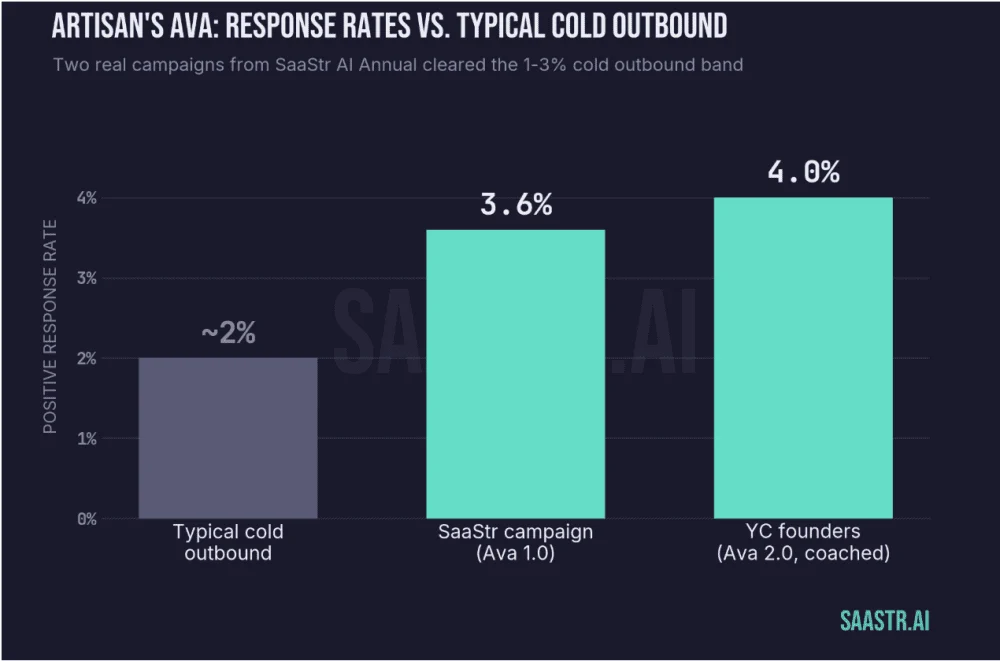
In its initial iteration, Ava was a high-frequency email generator. It was designed to handle the heavy lifting of drafting and distributing outbound sequences. During a six-week period for SaaStr’s own internal outbound operations, Ava 1.0 processed 7,000 emails, achieving a 3.6% positive response rate. While the percentage may seem modest to the uninitiated, it generated hundreds of thousands of dollars in revenue, demonstrating that AI-driven outreach can be a high-leverage channel when properly calibrated.
The 2.0 Era: Closing the Loop
The release of Ava 2.0 marked a transition from a passive generator to an autonomous agent. The product now handles "response handling" and calendar integration. Once a lead replies, Ava engages in a multi-turn conversation, addresses common objections, and coordinates meeting logistics—all without a human needing to touch the thread.
This represents the transition toward "full autonomy." While human oversight remains an option via escalation rules, the goal of the 2.0 architecture is to remove the human from the tactical workflow entirely. Future updates promise a "self-driving" mode where the agent suggests campaign strategies, identifies target audiences, and independently crafts messaging based on real-time website analytics.
The "Outbound Market Fit" Concept
Perhaps the most significant takeaway from Carmichael-Jack’s talk was the introduction of the term "Outbound Market Fit." Product-Market Fit (PMF) does not automatically guarantee that cold outbound will work for a company.

Carmichael-Jack highlighted the story of Cook Unity, a client that saw "terrible" results for the first two months of their engagement. Rather than discarding the tool, the team iterated on their messaging, targeting criteria, and the "Who, What, and When" of their outreach. By persisting, they eventually brought their cost-per-meeting below $50. This experience highlights a vital truth: 90% of "failing" outbound campaigns are merely misaligned on their core pillars, but 10% are simply not suitable for cold outreach. Acknowledging that cold calling might not be the right channel is a level of honesty rarely seen in vendor sales pitches.
Supporting Data: The Pillars of Outbound Strategy
Artisan’s performance hinges on three strategic pillars: Who, What, and When.
- Who (The Data Layer): Artisan utilizes two massive proprietary databases—one containing 280 million B2B contacts and another mapping global businesses with Google Maps profiles. However, the most effective data comes from the client’s own CRM via webhooks. By leveraging existing relationships and prior interaction data, Ava is able to personalize outreach at a depth that cold data cannot provide.
- What (The Messaging Layer): Artisan’s energy is heavily focused here. By aggregating data from dozens of enrichment sources, Ava creates a composite profile of the prospect. It then selects the most relevant hook—such as a CFO’s recent 10K filing or a company’s recent hiring spree—and constructs a message tailored to that specific context.
- When (The Intent Layer): Artisan provides de-anonymized website visitor data, allowing for "just-in-time" outreach. By layering funding and hiring signals over intent data, the platform ensures that the message reaches the prospect when they are most receptive.
Official Stance: Why Artisan Rejects AI Cold Calling
One of the most defining aspects of Artisan’s strategy is its vocal refusal to enter the AI voice/cold calling space.
In a market where competitors are racing to build AI agents that can "make the call," Carmichael-Jack’s stance is one of calculated restraint. He identifies two primary reasons for this:
- Legal and Ethical Constraints: Outbound cold calling is subject to a complex, evolving web of regulations. Artisan views the legal risk as an insurmountable barrier to quality execution.
- Technological Maturity: Carmichael-Jack posits that AI voice is still at least two years away from being indistinguishable from a human. He notes that current AI voice models suffer from latency issues, nuance failure, and "hallucinations" that can damage a brand’s reputation.
Instead of force-fitting AI into a medium it isn’t ready for, Artisan provides a native dialer that queues calls for human reps, provides per-prospect talking points, and drafts the follow-up email. This "human-in-the-loop" approach acknowledges the limitations of the current technology rather than pretending they don’t exist.
Implications for the Industry
The success of Artisan’s "accountability-first" model carries significant implications for the broader SaaS ecosystem:
1. Data Quality over Quantity
Artisan’s decision to delete 178 million contacts from their database—trimming from 450 million to 272 million—challenges the industry-wide obsession with "more is better." By prioritizing verified, high-quality records over raw volume, they have proven that a curated list yields higher ROI than a bloated one.
2. Incentive Alignment via Pricing
By making lead discovery free and charging only for enrichment and execution, Artisan has aligned its incentives with the customer. If the lead is low-quality, the customer doesn’t pay to discover it. They only pay when they choose to act on the lead. This "value-first" approach, bolstered by a $300 free-credit trial, serves as a strong trust-building mechanism in a market saturated with skeptical buyers.
3. The Power of "No"
Perhaps the most potent lesson from Artisan is the strategic advantage of "knowing what not to do." By refusing to ship a mediocre AI voice agent, the company has established a brand identity based on competence and integrity. In an era where AI hype often outpaces product utility, this restraint serves as a significant competitive moat.
4. Marketing as a Function of Attention Arbitrage
The "Stop Hiring Humans" marketing campaign was intentionally polarizing. Yet, internal testing showed that it consistently outperformed "safer" messaging. This confirms that in a crowded category, loud, provocative creative is a data-backed strategy, not just a gimmick.
Conclusion
The rise of AI in GTM is inevitable, but the way it is deployed is currently at a crossroads. Founders like Jaspar Carmichael-Jack are signaling that the future of AI SDRs isn’t just about replacing headcount—it’s about providing clear, measurable accountability. By focusing on the "Who, What, and When" while demonstrating the courage to leave certain categories to humans, Artisan is setting a new standard for how AI companies should communicate with their customers. For those looking to integrate AI into their sales cycle, the lesson is clear: verify the data, measure the result, and don’t be afraid to admit when a channel simply isn’t working.