The WordPress ecosystem is currently navigating a period of profound transformation. While the initial wave of artificial intelligence (AI) discourse focused heavily on content generation and automated site building, a more nuanced, strategic shift is occurring behind the scenes. For agency owners, the conversation has moved from "Can AI build a website?" to "How can AI optimize the business of running an agency?"
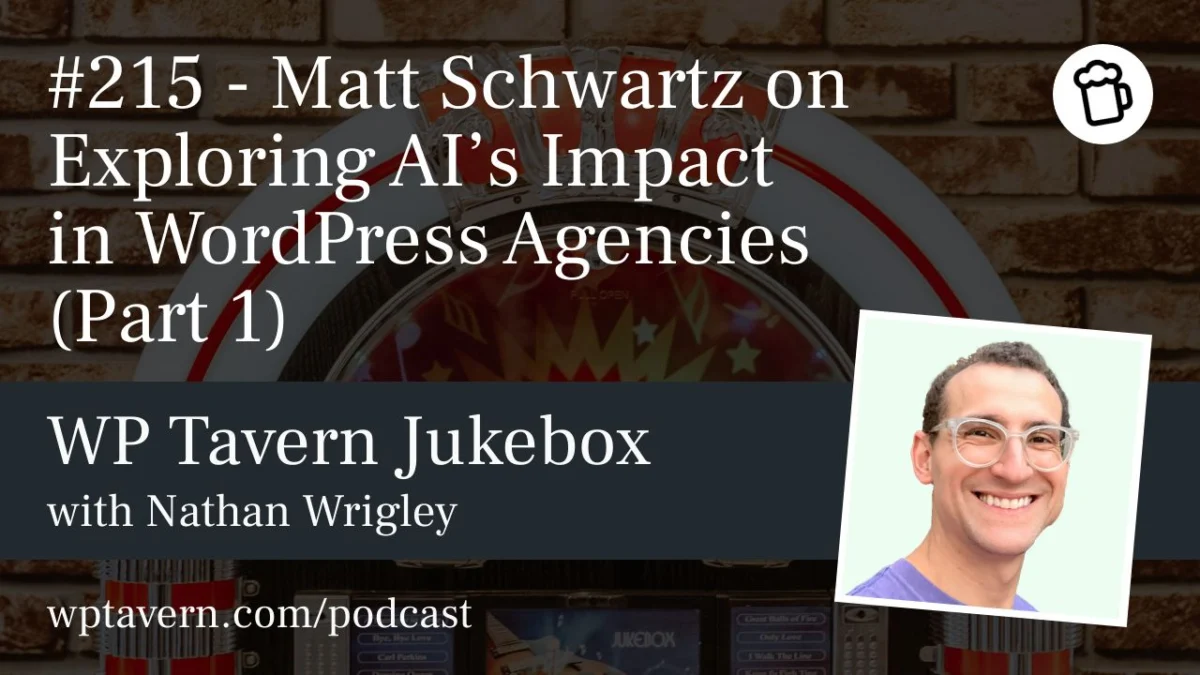
In a recent installment of the WP Tavern Jukebox podcast, host Nathan Wrigley sat down with Matt Schwartz, founder of the Atlanta-based WordPress and WooCommerce agency Inspry, to discuss the practical, operational, and ethical integration of AI. Schwartz, who has been working with WordPress since 2011, offers a perspective that prioritizes process efficiency over mere technological novelty.
The Evolution of the Agency Model
The story of the modern agency owner is often one of "stumbling" into the profession. Like many of his peers, Schwartz began his journey as a teenager, building websites for local clubs and small businesses, eventually formalizing his work into a full-scale agency. For most in this field, professional growth was never guided by a corporate-issued Standard Operating Procedure (SOP). Instead, owners had to invent their own workflows, pricing models, and client communication strategies from scratch.
This history of self-invention is exactly why the AI revolution feels so significant. For over a decade, agency processes were built through trial and error. Today, AI presents an opportunity to codify, streamline, and scale those processes in ways that were previously unimaginable.
Defining the "AI Vision Document"
A critical takeaway from the discussion is the concept of an "AI Vision Document." Many agencies are currently experimenting with AI in a haphazard, reactive manner—the "YOLO" approach to integration. Schwartz argues that this is a mistake.
An AI Vision Document serves as a strategic roadmap, outlining exactly where AI fits into an agency’s operations and, more importantly, where it does not. By auditing internal workflows—using data from time-tracking software or project management tools—agencies can identify repetitive, low-value tasks that are prime candidates for AI, while simultaneously setting "guardrails" for tasks that require human judgment.
This document acts as a safeguard. It ensures that when employees or contractors use AI, they are doing so within the parameters defined by the agency’s standards, thereby protecting the company’s reputation and quality of service.
AI as a New Core Service Offering
As the execution of simple, brochure-style websites becomes increasingly commoditized, agencies are finding it harder to justify premium pricing for basic builds. Schwartz suggests that the path forward lies in transforming AI expertise into a tangible client service.
The goal is not necessarily to market "AI services" explicitly, but to offer solutions that solve business problems through automation. By utilizing tools like n8n or Make, agencies can build custom workflows, internal applications, and automated reporting systems for their clients. This shifts the agency’s value proposition from "website builder" to "business process consultant."
Clients may not care about the underlying technology, but they care deeply about cost savings and operational efficiency. When an agency can demonstrate how a custom-built, AI-driven automation saves a client thousands of dollars, the value becomes self-evident.
Operational Efficiency: Meeting Summaries and Beyond
One of the most immediate, low-hanging fruits for agencies is the use of AI in daily operations. The adoption of automated meeting assistants—bots that join calls to transcribe, summarize, and extract action items—has become remarkably commonplace.
While the technology is now considered "pedestrian" compared to its initial, awe-inspiring introduction, its impact on agency productivity is undeniable. By removing the friction of manual note-taking and task assignment, agencies can ensure that discovery calls and project meetings are translated into clear, actionable next steps immediately.
However, this efficiency comes with a warning. As Schwartz notes, there is a delicate balance to strike. The "pain moments" of client interaction—such as technical support—are the most sensitive. While AI can analyze error logs and suggest resolutions faster than any human, over-relying on bots for support can lead to customer frustration. The consensus is clear: AI should be used to empower the human expert, not to replace the human connection.
Debugging and WordPress Infrastructure
The technical side of WordPress is also undergoing a seismic shift. Modern AI agents are becoming increasingly adept at debugging complex PHP issues, parsing error logs, and navigating the WordPress REST API.
WordPress itself is evolving into an "AI-ready" foundation. Through the work of the core AI team and various third-party integrations, the platform is moving toward a future where the administrative interface serves as the scaffolding, while AI agents handle the heavy lifting of site management.
For developers, this means fewer hours spent on mundane troubleshooting. For clients, it means faster resolution of technical hurdles. Yet, the requirement for a "human in the loop" remains absolute. As Schwartz aptly puts it: "If you hire a developer and they lie to you twice, you fire them. But with AI, we keep giving it a second chance." Until AI achieves a level of reliability that eliminates the "hallucination" factor, professional human review remains a non-negotiable step in the development lifecycle.
Implications for the Future of Agencies
The current landscape forces a hard truth upon agency owners: execution is becoming a commodity. The ability to "knock out" a website is no longer the competitive advantage it once was.
Instead, the future belongs to agencies that prioritize:
- Strategic Value: Moving beyond the screen to optimize the client’s entire business workflow.
- Intentional Integration: Using an AI Vision Document to ensure that technology serves the business, rather than the business serving the technology.
- Human-Centric Service: Knowing exactly when to deploy a bot and when to pick up the phone.
The transition to an AI-augmented agency is not merely about staying relevant; it is about reclaiming time from repetitive tasks to focus on the high-level strategy that truly drives client success. As the industry continues to iterate at a breakneck pace, the agencies that survive will be those that view AI not as a replacement for human talent, but as a catalyst for human potential.
This article is based on the first part of a two-part series on the Jukebox Podcast. For more insights on the future of WordPress agencies, tune in to the upcoming second installment at wptavern.com/podcast.