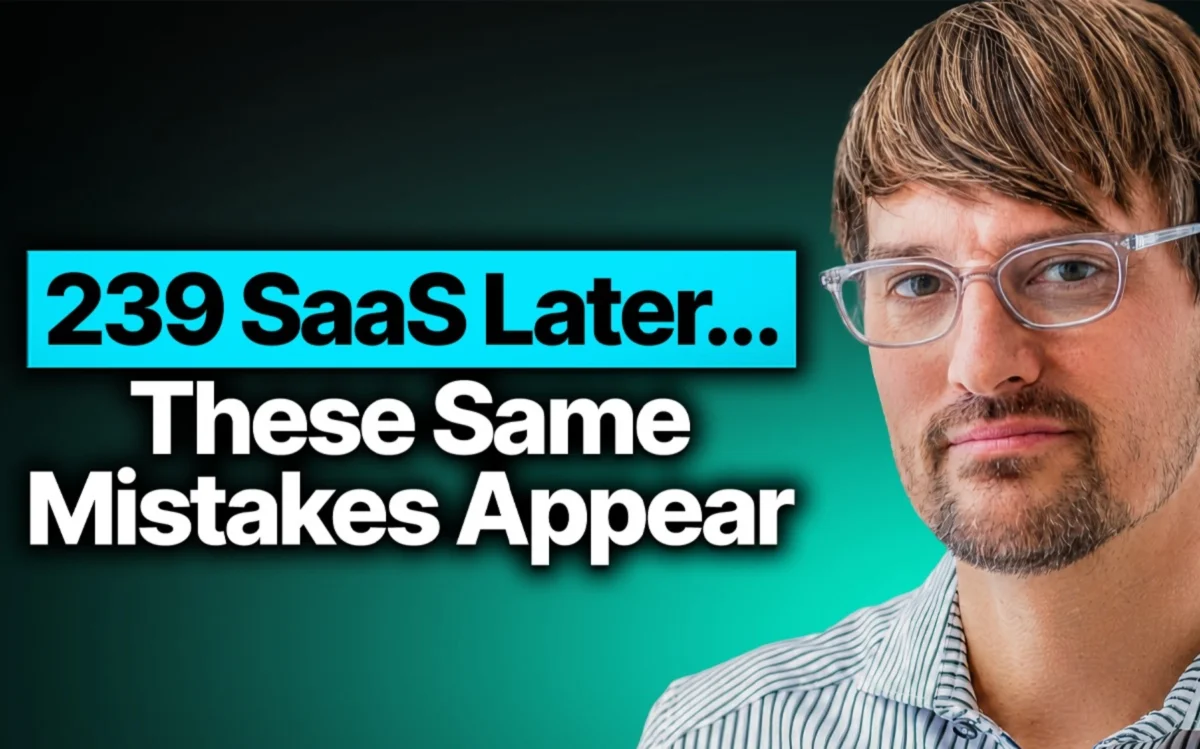
In the rapidly shifting landscape of software-as-a-service (SaaS), few stories capture the transition from the "golden age" of SEO to the modern, AI-integrated era as effectively as that of Christopher Gimmer. As a seasoned entrepreneur who scaled the graphic design platform Snappa to $1.5 million in Annual Recurring Revenue (ARR), Gimmer has spent the better part of a decade navigating the volatile waters of digital product growth.
In a recent episode of the Niche Pursuits podcast, Gimmer joined host Spencer Haws to deconstruct the anatomy of a successful SaaS startup. Their conversation moved beyond the typical "how-to" advice, instead diving into the harsh realities of product-market fit, the psychological toll of technical debt, the nuances of exit timing, and why the next generation of software must be built for a world dominated by AI agents.
Main Facts: The SaaS Entrepreneur’s Blueprint
The core of Gimmer’s philosophy rests on the transition from "side hustle" to "scalable system." Unlike many founders who jump straight into complex enterprise solutions, Gimmer’s journey began with the identification of a simple, universal frustration. He was a professional in finance and accounting who found the industry-standard tool, Adobe Photoshop, to be an inefficient barrier to productivity for marketers and non-designers.
By focusing on a niche—graphic creation for marketers—he built Snappa. The product wasn’t meant to replace professional design suites; it was meant to eliminate the friction of basic content creation. This focus on "low-complexity utility" allowed Snappa to achieve early traction, reaching $2,000 in monthly recurring revenue (MRR) within its first month and hitting $10,000 MRR by the six-month mark.
Chronology of Growth: A Decade of Iteration
Gimmer’s path was not a linear ascent. It was a series of strategic pivots and lessons learned in the trenches of the internet’s evolving search landscape.
The Pre-SaaS Era
Before Snappa, Gimmer and his co-founder, Marc Chouinard, cut their teeth on smaller projects. Their most notable early endeavor was BootstrapBay, a marketplace for web developers. While it generated a respectable $10,000 in monthly revenue, the take-home profit—roughly $3,000 after platform commissions—served as a vital lesson in the limitations of operating on someone else’s ecosystem. It underscored the necessity of owning the platform, which eventually led to the development of Snappa.
The 2015 "Reset"
The launch of Snappa in 2015 was marked by a harrowing technical realization. Shortly after going live, Gimmer and Chouinard discovered that their initial architecture could not handle the scaling requirements of a growing user base. In a move that defines "grit" in the startup world, Chouinard spent an entire month refactoring the codebase while the founders simultaneously managed incoming customer feature requests and growth. This period was a baptism by fire, proving that technical infrastructure is the silent foundation upon which all marketing success rests.
The COVID-19 Acceleration
The trajectory of Snappa was largely steady until the global pandemic triggered a surge in digital content demand. Between 2019 and 2021, the company moved from $1 million in ARR to $1.5 million. However, this period also introduced a "plateau" phase, which Gimmer now views as a critical teaching moment regarding the lifecycle of a business.
Supporting Data: The Economics of Scaling
Gimmer’s experience provides a masterclass in SaaS economics, particularly concerning the "prosumer" market. He discovered that in categories where competitors are abundant, there is a rigid pricing ceiling. Users have a psychological threshold for what they will pay for a "simple" design tool.

The data suggests that once a company hits this ceiling, it cannot simply raise prices without a significant expansion of value. Gimmer noted that the growth curve of a SaaS business is the primary driver of its valuation. When growth slows—even if the business remains highly profitable—the multiplier applied to the company’s valuation drops significantly. This realization has fundamentally changed how Gimmer approaches his latest venture, GoodMetrics.
The Pivot to GoodMetrics: A New Paradigm
GoodMetrics is a response to the modern failure of analytics platforms. Gimmer, frustrated by the complexity and lack of intuition in Google Analytics 4 (GA4), identified a gap in the market for a privacy-focused, user-friendly alternative that doesn’t sacrifice data integrity.
Unlike his approach with Snappa, Gimmer is building GoodMetrics with an eye toward "AI-native" functionality. He argues that modern software is no longer just for human eyes; it must be optimized for AI agents—the automated systems that will increasingly interact with software, pull data, and make decisions on behalf of users.
Implications for the Future of Marketing
Perhaps the most significant takeaway from Gimmer’s recent work is his assessment of the current marketing environment. The "SEO gold rush" of the mid-2010s, which he successfully exploited by creating content around "social media image sizing" keywords, is effectively over.
The Death of Passive Content
Gimmer asserts that the era of relying solely on broad, top-of-funnel content to drive traffic is waning. With the rise of AI Overviews and an increasingly crowded search results page, content must now be "bottom-of-funnel." This means:
- High-intent documentation: Detailed guides that answer specific questions for both human researchers and AI LLMs (Large Language Models).
- Direct Outreach: Moving away from passive blogging toward active, community-based engagement. This involves identifying potential users who are complaining about competitors on social platforms and engaging them directly in the conversation.
- Comparison Pages: Creating transparent, feature-by-feature breakdowns that allow potential customers to clearly distinguish between products.
Official Perspectives: The Founder’s Reflections
Reflecting on his journey, Gimmer is candid about the "what ifs." He admits that his biggest regret was not being more aggressive about exploring an exit during Snappa’s peak growth phase. He emphasizes that founders often become overly attached to their "baby," ignoring the cold, hard reality that a business is an asset meant to be valued, optimized, and eventually liquidated or transitioned.
He urges founders to maintain a "market-first" mindset. If the market shifts—as it has with the integration of AI into every facet of software—the founder must be willing to rebuild, or at least re-architect, their strategy.
Conclusion: Adapting to the AI Horizon
Christopher Gimmer’s story is a testament to the fact that success is rarely a straight line. It is a series of experiments, technical pivots, and the hard-won wisdom of knowing when to change course. As we look toward the future, his transition from a design-tool founder to an analytics-focused entrepreneur highlights a crucial truth: the tools change, the search algorithms evolve, and the market ceilings fluctuate. However, the ability to identify a genuine, frustrating problem and solve it with a scalable, intentional product remains the gold standard for entrepreneurial success.
For those currently building in the SaaS space, the message is clear: stop relying on the old playbooks. Build for the future where your software is as much for the AI agent as it is for the person paying the invoice. The window for passive growth has closed; the era of intentional, high-intent, and AI-optimized building has arrived.