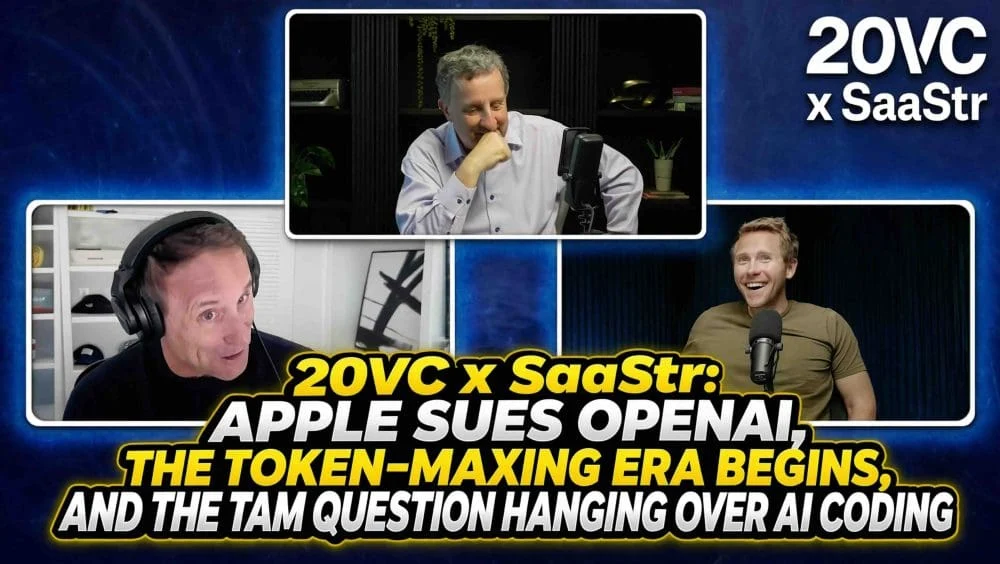
In a week that underscored the intensifying volatility of the Artificial Intelligence gold rush, the industry was rocked by a high-stakes legal confrontation between Apple and OpenAI. While the lawsuit—centering on allegations of trade secret theft—has grabbed headlines for its dramatic narrative of corporate espionage, industry analysts suggest the implications run far deeper. Beyond the courtroom drama, the tech sector is grappling with a profound shift: the realization that the AI "coding" boom may be approaching an economic ceiling, and that the aggressive pursuit of consumer hardware by AI labs may be a distraction from the only sector currently printing real money.
Main Facts: The Anatomy of a Trade Secret Dispute
The legal firestorm erupted when Apple filed suit against OpenAI, alleging a brazen theft of proprietary hardware prototypes. According to the complaint, a six-year veteran of Apple’s hardware division allegedly walked physical prototypes out of the office, acting on the encouragement of a 24-year Apple veteran now spearheading OpenAI’s hardware efforts.
The legal experts involved in the recent 20VC x SaaStr podcast, featuring Harry Stebbings, Jason Lemkin, and Rory O’Driscoll, were blunt in their assessment: the individuals directly implicated are likely "toast." The litigation serves as a loud, public warning from Apple to the broader AI industry: poaching talent is one thing, but the misappropriation of physical intellectual property will be met with the full force of the law.
However, observers note that in the context of California employment law—which famously eschews non-compete agreements—the physical theft was not only criminal but strategically redundant. The "doctrine of inevitable disclosure" ensures that the knowledge embedded in an engineer’s brain is portable; hiring a domain expert inherently transfers their expertise. By resorting to physical theft, the defendants risked everything for information that was, in many ways, already legally mobile.
Chronology of a Shifting Landscape
- Early 2024: AI labs shift from "token-unlimited" experimentation to strict enterprise budget management as CIOs begin to audit AI spending.
- February 2024: ClickHouse reports a 60x increase in AI spending, signaling a massive surge in developer productivity tools.
- Mid-2024: Meta announces the launch of Spark 1.1, marking a pivot from purely open-weights models to a paid API model, intensifying price competition at the "cheap-token" tier.
- Current Week: Apple files suit against OpenAI for trade secret theft, coinciding with broader internal questions at OpenAI regarding the viability of their hardware ambitions.
- Ongoing: Industry-wide realization that developer-driven token consumption is reaching levels that may exceed the total annual US developer wage bill ($250 billion).
Supporting Data: The Economics of the Token Economy
The financial mechanics of the current AI boom are creating unprecedented pressures on both developers and CFOs. Data from the industry suggests that the most successful AI companies are becoming victims of their own rapid growth.
The Developer Wage Ceiling
Rory O’Driscoll pointed to a staggering realization: with roughly 1.8 million software developers in the United States earning a combined $250 billion annually, the current trajectory of enterprise API revenue—driven almost exclusively by AI coding assistants—suggests that the industry is already capturing nearly 20% of the entire software labor market. If growth continues at this pace, these companies may hit a "ceiling of the till" faster than any software business in history. The fundamental question remains: can the market support a spend on tokens that rivals the total cost of human engineering labor?
The "Ankle-Biter" Thesis
Jason Lemkin argues that the threat to incumbents like Figma or Salesforce is not a sudden death, but "slow funnel erosion." As developers adopt agentic workflows, the next generation of software creators may bypass legacy platforms entirely. If new startups begin their lifecycle with AI-native tools, they never "graduate" into the legacy enterprise funnel. This structural decline is slow to show up in quarterly earnings but is potentially terminal over a five-to-ten-year horizon.
Official Responses and Strategic Implications
The legal action taken by Apple is widely interpreted as a leverage play. With over 400 former Apple employees now working at OpenAI, Apple’s lawsuit is less about recovering specific prototypes and more about establishing a discovery process that could reach the highest echelons of OpenAI’s leadership.
OpenAI’s Hardware Ambition: A Distraction?
OpenAI’s $6 billion investment in Jony Ive’s design team, intended to birth a new hardware category, is now under the microscope. Given the intense concentration of value in enterprise coding, the hardware project is increasingly viewed as a distraction. As Lemkin noted, this lawsuit might provide OpenAI with the perfect "excuse" to wind down hardware initiatives that were never truly aligned with their core economic engine: enterprise-grade reasoning.
The "Two-Tier" Model Strategy
Every major company is now moving toward a bifurcated AI strategy. Organizations are realizing that they cannot afford to run every task through the most expensive frontier model. Instead, they are adopting a two-tier system:
- The Frontier Tier: Expensive, high-reasoning models reserved for complex architecture and problem-solving.
- The Commodity Tier: Low-cost, high-volume models used for simple, repetitive tasks.
This shift renders "price-per-token" a misleading metric. CIOs are increasingly evaluating "cost-per-completed-task." As evidenced by the Databricks research, a model with higher base costs can actually be more efficient if it reduces the total human and computational time required to finish a project.
The Broader Outlook: From Coding to a "10% Software Tax"
While the developer wage ceiling poses a significant hurdle, the long-term bull case for AI is the transition into a general "10% software tax" on all corporate operations.
The Agentic Tax
If corporations can integrate AI agents across their entire stack—from sales to HR—at a cost of roughly 10% of revenue, the Total Addressable Market (TAM) expands significantly beyond the current coding-centric focus. Unlike coding, which is currently burning tokens at an unsustainable rate, general agentic tasks have more predictable ROI profiles. Salesforce, for instance, could sustain a 10% token tax, but it could never survive a 40% tax, given its current operating margins.
The Memory Cycle and Venture Risk
The hardware cycle is also showing signs of maturity. SK Hynix’s record-breaking $26.5 billion NASDAQ listing highlights the cyclical nature of memory manufacturing. While operating margins for memory players have surged to 70%, historical data suggests this is a temporary peak. IBM’s recent 20% stock drop, blamed in part on the "crowding out" of mainframe budgets by memory and token spending, serves as a cautionary tale: when tech budgets are finite, the rise of AI infrastructure necessarily leads to the decay of legacy segments.
Conclusion: A New Asset Class
The shift in venture capital toward "late-stage growth" as a distinct asset class reflects the maturation of the AI market. Companies are staying private longer and scaling to billions in value at record speeds, effectively replacing the role once played by small-cap public markets.
However, as the TouchBistro acquisition by Constellation at 1x revenue demonstrates, the "AI-native" era is brutal for stalled, pre-AI B2B companies. When switching costs drop from a year to a single day—thanks to LLM-powered migration tools—terminal decay is no longer a slow crawl; it is an immediate collapse. For the industry at large, the lesson of the week is clear: the era of "growth at any cost" is giving way to an era of "ROI-driven adoption," and the companies that survive will be those that realize the real value lies not in stealing hardware secrets, but in mastering the economics of the agentic workforce.