In the fast-paced world of digital development, the industry is perpetually obsessed with the how: What framework are we using? How do we optimize performance? How do we ship faster? Yet, this relentless pursuit of technical efficiency often comes at a steep cost: the total neglect of the why.
For digital accessibility practitioners, the term "equivalent experience" serves as a north star. It is not merely a box-ticking exercise for legal compliance; it is a philosophy that demands we build for the widest possible spectrum of human ability and interaction. Creating an equivalent experience requires a deep, empathetic understanding of how people—all people—engage with technology and the systemic barriers that currently exclude them.
The State of Things: A Default Bias
Despite living in an era defined by a vast, heterogeneous landscape of smartphones, augmented reality, voice assistants, and IoT sensors, the digital industry remains tethered to a narrow, biased default. We still design and develop primarily for the "standard" user: someone with full sight, full motor control, and a high-speed connection on a high-end desktop device.
This is not a neutral design choice; it is an act of exclusion. When a developer says, "It works on my machine," they are effectively saying, "I do not care if it fails on yours." This bias is baked into our workflows, our hiring practices, and our product roadmaps. To deliver an equivalent experience, we must preserve the intent of the product—the core motivation behind why a user visits a site—regardless of the device, software, or physical ability of the person behind the screen.
Chronology of an Exclusionary Web
The history of the web is one of democratization, but our implementation has often been exclusionary.
- Early Web (1990s): Accessibility was an afterthought as the web grew in complexity.
- The Rise of Mobile (2000s-2010s): The "mobile-first" movement improved responsiveness, yet many developers failed to implement proper mobile breakpoints, forcing users on small screens to pinch-and-zoom their way through unusable interfaces.
- The Modern Era (2020s): As digital services have become essential to daily life—from grocery shopping to job applications—the failure to provide equivalent access has shifted from a "poor UX" issue to a civil rights crisis.
We have moved from a time where accessibility was an "optional feature" to a landscape where inaccessible design is increasingly viewed as a failure of professional ethics and, increasingly, a legal liability.
Supporting Data: The Cost of Ignoring Reality
The argument for accessibility is often framed as a moral imperative, but the data proves it is also an economic necessity.
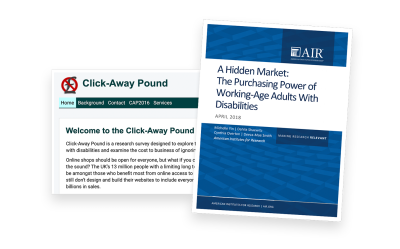
Research from the Click Away Pound Survey reveals that over 4 million people in the UK alone have abandoned retail websites due to accessibility barriers. This resulted in an estimated £17.1 billion (~$21.1 billion USD) in lost revenue. Similarly, the American Institutes for Research found that working-age adults with disabilities possess an estimated $490 billion in disposable income.
When a digital product is inaccessible, it is not just "breaking" for the user; it is hemorrhaging potential revenue for the business. As the digital economy grows, these "unmet needs" represent a massive, untapped market. Companies that prioritize accessibility are not just being "nice"; they are capturing a demographic that competitors are actively driving away.
Official Responses and Legal Precedents
The legal landscape has shifted dramatically. Courts are no longer viewing websites as abstract spaces, but as extensions of physical commerce and public life.
The landmark ruling involving Domino’s Pizza, which reached the U.S. Supreme Court, signaled a turning point: a business cannot hide behind the argument that its website is merely a "digital gateway." By failing to make their app and site operable for screen readers, they created a barrier to service. This ruling reinforced that under the Americans with Disabilities Act (ADA) and similar international regulations, such as those in the EU and Asia, digital accessibility is a civil right.
When companies ignore accessibility, they face the high cost of litigation, public relations damage, and the loss of customer trust. As seen in the case of Winn-Dixie, which was successfully sued for an inaccessible website, the cost of implementing inclusive design is significantly lower than the cost of defending a lawsuit in court.

The "Rube Goldberg" Problem: Accessibility vs. Equivalency
It is vital to distinguish between a "technically accessible" experience and an "equivalent" one.
Many digital experiences today are akin to a Rube Goldberg machine. A user with a disability may eventually accomplish a task, but only by navigating a labyrinth of workarounds, custom scripts, and hours of troubleshooting. While the task is completed, the experience is not equivalent.
For instance, a user might be able to complete a purchase using a screen reader, but if the process takes them four times as long and leaves them physically exhausted—a phenomenon known as the "chilling effect"—the system has failed. This is particularly critical for users with motor control disabilities or cognitive differences, where unnecessary complexity causes genuine fatigue.
Implications: Autonomy and the "Spoon Theory"
At the heart of the equivalent experience is the concept of autonomy. When a user is forced to rely on a sighted person to order groceries or fill out a job application, we have stripped them of their independence.

The "Spoon Theory"—a metaphor for the limited amount of mental and physical energy a person has in a day—is essential here. Every inaccessible hurdle consumes a "spoon." When an interface is poorly designed, it drains the user’s resources, leaving them less capable of participating in other aspects of digital life.
When people are repeatedly told, "You don’t matter," through broken interfaces, they don’t just stop using the product; they abandon the category entirely. As developer Karl Groves once noted, "Nobody has complained before" is not a sign of success; it is a sign that users have already left.
The Path Forward: How to Maintain Equivalency
Building an equivalent experience is a deliberate process that requires us to challenge our own biases. Here is how organizations can pivot toward true inclusion:
1. Treat Accessibility as a Primary Bug
Accessibility issues should be prioritized with the same urgency as security vulnerabilities or system crashes. If a user cannot complete a checkout process because of a missing label, it should be treated as a "critical" issue.
2. Move Beyond "Works on My Machine"
Designers and developers must test with assistive technology and diverse user groups. A designer claiming, "It has enough contrast for my eyes," is as intellectually dishonest as a developer claiming, "It works on my machine."
3. Create a Culture of Feedback
Establish clear, accessible channels for users to report accessibility issues. When a user takes the time to report a barrier, respond with transparency. Acknowledge the issue, explain the fix, and—most importantly—don’t treat the user as a nuisance.
4. Foster In-House Empathy
The most effective teams are those that listen to the lived experiences of disabled users. Whether through user testing or by hiring people with disabilities, the goal is to shift the mindset from "compliance" to "innovation."
Conclusion: A New Standard for the Web
Accessibility is not a problem to be "solved" and then forgotten; it is a lens through which we must view all digital creation. The web’s foundational promise was that it would be a space for everyone. By failing to provide equivalent experiences, we have allowed that promise to erode.
As web professionals, we have a unique opportunity to reclaim that vision. By questioning our assumptions, listening to the disability community, and viewing accessibility as a core business value rather than an optional chore, we can build a digital world that is truly for everyone. In the next part of this series, we will move from theory to practice, exploring the concrete steps required to implement these equivalent experiences in our daily code and design.