In the digital age, the "World Wide Web" is becoming increasingly global, yet a significant linguistic barrier remains. For years, the prospect of translating a WordPress website was a daunting, expensive, and technically cumbersome task. However, as discussed on a recent episode of the WP Tavern Jukebox podcast, the landscape of web localization is undergoing a seismic shift.
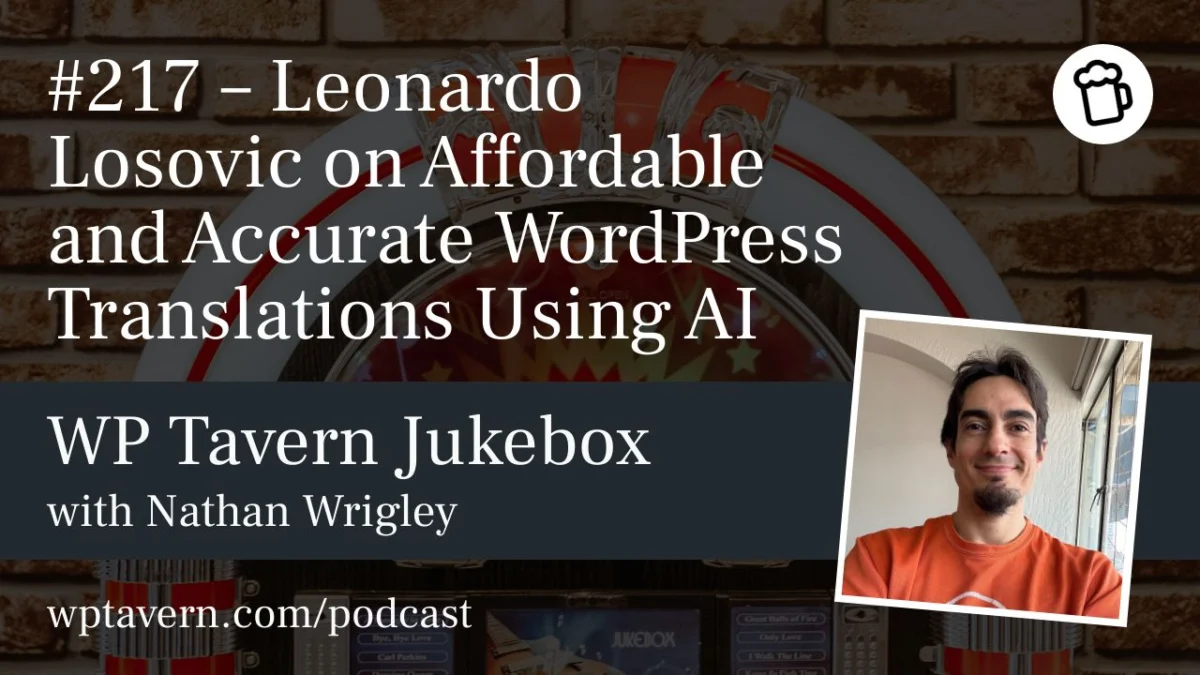
Host Nathan Wrigley sat down with veteran WordPress developer and innovator Leonardo Losoviz to explore how Artificial Intelligence is transforming the way site owners approach multilingual content. From the technical evolution of translation plugins to the "arms race" of global content accessibility, the message is clear: if you aren’t translating your site, you are already falling behind.
The Evolution of Web Translation
For those who have been part of the WordPress ecosystem for over a decade, the memory of translation workflows is often associated with high costs and manual frustration. Historically, scaling a website to include multiple languages was an enterprise-level endeavor. It required identifying every translatable string, sourcing professional human translators, negotiating rates, managing complex file handoffs, and painstakingly integrating translated text back into the WordPress backend.
"Ten years ago, this was a fairly lengthy, probably quite costly enterprise," noted Wrigley. Site owners had to navigate complex UIs to ensure that English strings were correctly swapped for German, French, or Spanish counterparts. This friction often acted as a deterrent, limiting many websites to their original language regardless of their potential audience.
Today, that barrier has effectively collapsed. With the advent of large language models (LLMs) like OpenAI’s GPT, Anthropic’s Claude, and Google’s Gemini, the process has moved from a weeks-long project to an automated task requiring only a few clicks.
The Case for Multilingualism: Moral and Business Imperatives
The discussion surrounding translation often bifurcates into two camps: the moral argument and the business argument. Legally, many businesses in regions like the UK or Canada are already compelled by law to provide content in multiple languages. For these entities, translation is not a choice but a compliance requirement.
However, for the majority of site owners, the decision is strategic. Losoviz argues that the primary question should no longer be "Should I translate my site?" but rather, "Why wouldn’t I?"
By leveraging AI, the cost of translation has plummeted from hundreds of dollars per post to a mere fraction of a cent in token fees. This drastic reduction in overhead allows site owners to reach new demographics in regions previously considered "too expensive" to target. "If you have potential visitors to your website speaking different languages, why wouldn’t you want to track them?" asks Losoviz. "Why wouldn’t you want to show your content to a new user base?"
Technical Strategies and the Role of AI
At the heart of this transformation is Losoviz’s own contribution to the ecosystem: Gato AI Translations for Polylang. This plugin functions as a wrapper for the popular Polylang framework, automating the connection between WordPress content and AI engines.
The technical workflow has become remarkably streamlined. In the modern WordPress environment, a user can select a post, choose the target languages, and trigger a bulk action that duplicates the post, translates the content, and maintains the necessary SEO metadata—all in seconds.
The Human-AI Hybrid Model
While AI has achieved a level of accuracy that Losoviz estimates at roughly 99%, the role of the human expert has not been entirely eliminated. It has, however, shifted. Instead of performing the bulk of the translation work, human professionals now focus on "polishing"—checking technical terminology, verifying industry-specific jargon, and ensuring that the nuance of the brand voice remains intact.
"You don’t need to engage the translator for 100% of the translation," Losoviz explains. "But you might still want them to look at the technical terms or industry-specific acronyms." This hybrid model ensures that while the speed is provided by machines, the precision is guaranteed by human oversight.
The Future: WordPress 7.0 and Collaborative Editing
One of the most exciting aspects of the discussion is the role of upcoming WordPress core updates. With the release of WordPress 7.0, the platform is doubling down on collaborative editing—a feature long awaited by the community.
While many initially envisioned this "Google Docs-style" functionality as a way for two humans to collaborate on a post, the potential for AI integration is profound. Losoviz paints a picture of a future where an AI could act as a co-editor, highlighting potential translation errors or ambiguities directly within the WordPress editor.
Imagine a "sticky note" functionality where an AI assistant points to a specific paragraph, suggesting, "I am not 100% confident in this translation; please double-check." This type of granular interaction is poised to move translation from a "one-and-done" process to a living, breathing dialogue between the author and the machine.
The "Arms Race" of Digital Accessibility
Perhaps the most sobering insight from the discussion is the inevitability of this trend. As AI-powered translation becomes ubiquitous, the competitive advantage of being a multilingual site begins to fade.
"When it’s so easy, everyone will do it," Losoviz admits. "And when everybody does it, you’re not moving forward. You’re just running to stay on the same spot."
This "arms race" mentality suggests that translating your website is becoming a new baseline for digital hygiene. Just as HTTPS became a mandatory standard rather than a luxury, multilingual capability is rapidly becoming an expected feature for any professional website. Those who fail to adopt these tools risk being sidelined by competitors who can seamlessly communicate with global audiences.
Best Practices for Site Owners
For those ready to dive into AI translation, Losoviz offers a clear, actionable checklist to avoid resource waste:
- Finalize the Origin Content: Do not initiate translation until the source post is 100% final. Every edit made post-translation requires re-running the process, which, while cheap, is still an unnecessary drain on resources.
- Audit Visual Assets: Ensure images do not contain embedded text. Text-heavy images are difficult for AI to translate, and replicating an image for every language creates unnecessary clutter and storage bloat.
- Use Language-Agnostic Imagery: When possible, use images that don’t rely on text. If text is required, use page builder overlays so that the text can be translated as data rather than as part of the image file.
- Leverage SEO Best Practices: Ensure your chosen plugin handles
hreflangtags correctly. This tells search engines that your various language pages are related, preventing "duplicate content" penalties and ensuring the right content is served to the right user.
Conclusion: The New Standard
The era of manual, expensive, and slow translation is firmly in the past. Today’s WordPress users are equipped with tools that make global communication not just possible, but inevitable. Whether for legal compliance, business growth, or simply keeping pace with an increasingly globalized internet, AI translation is a tool that every site owner must now consider.
As Leonardo Losoviz aptly puts it, the technology exists, the costs are negligible, and the barrier to entry is gone. The only remaining question for site owners is whether they will choose to speak the language of their global audience, or remain silenced by the limits of a single-language site.