In the rapidly evolving landscape of cyber warfare, a new, sophisticated threat has emerged that threatens to undermine the very foundations of email security. Microsoft Threat Intelligence recently unveiled details of an active, persistent campaign targeting hospitality organizations across Europe and Asia. The campaign, which has been operational since April 2026, utilizes a technique Microsoft has dubbed "authentication laundering." By leveraging the impeccable reputations of legitimate SaaS platforms like Calendly and Google, attackers are successfully bypassing the email industry’s most robust defense mechanisms—SPF, DKIM, and DMARC—to deliver malicious payloads directly into the inboxes of high-value targets.
This revelation serves as a sobering wake-up call for cybersecurity professionals: email authentication, while essential, is no longer a proxy for safety. It confirms who sent the message, but it says nothing about the intent of the sender.
The Anatomy of the Campaign: A Chronology of Deception
The campaign, first disclosed by Microsoft on June 25, 2026, represents a shift toward exploiting the "trust architecture" of the internet.
The Inception (April 2026)
The threat actors began their operation by registering accounts on Calendly, a popular appointment scheduling platform. By design, Calendly sends automated email notifications on behalf of its users. Because these emails originate from Calendly’s own authorized infrastructure, they are inherently "authenticated." They pass SPF (Sender Policy Framework), DKIM (DomainKeys Identified Mail), and DMARC (Domain-based Message Authentication, Reporting, and Conformance) with ease.
The Lure (May – June 2026)
Throughout the spring, the attackers began blasting generic, high-volume phishing emails to hotel staff. These messages were crafted to exploit the professional workflow of front-desk and reservation employees. Using subject lines such as "Guest Complaints," "Room Enquiries," "Bedbug Reports," and "Inspections," the emails were localized into Japanese, Dutch, and Danish to maximize impact.
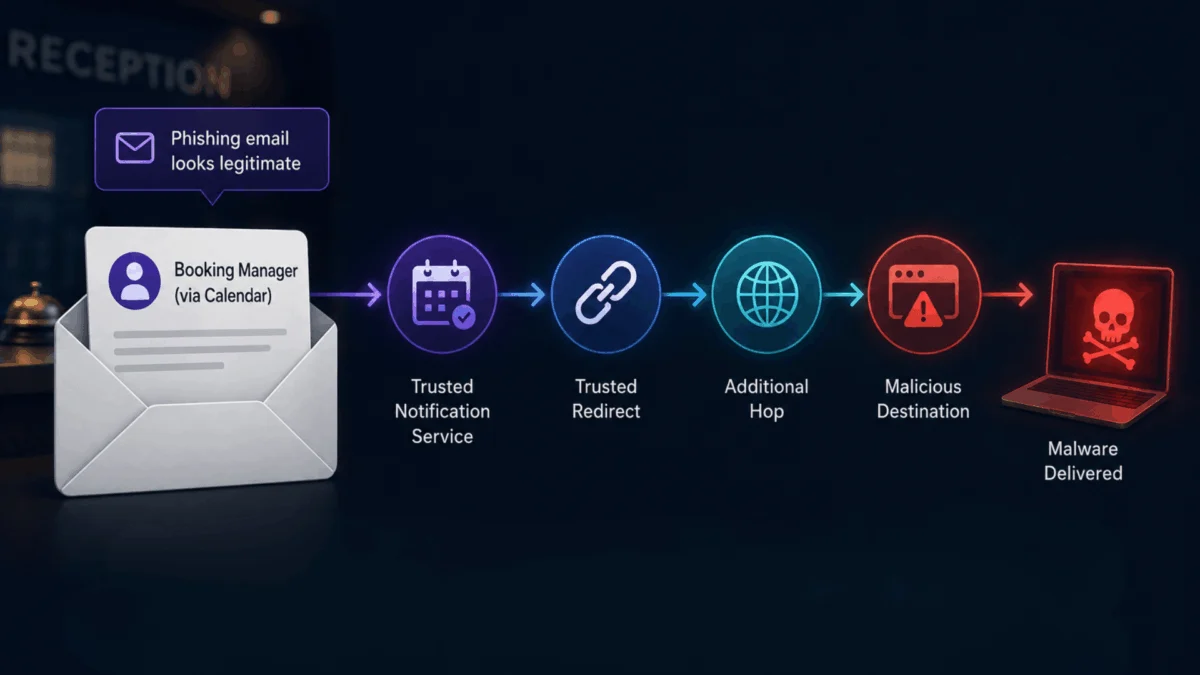
The emails consistently featured the display name "Booking Manager (via Calendly)," a psychological nudge designed to compel busy staff to act without verifying the source.
The Payload Delivery (The Multi-Stage Redirect)
The true brilliance—and danger—of the campaign lies in the "laundering" process. Once a victim clicks a link in the email, they are not sent directly to a malicious site. Instead, they are routed through a Google URL redirect. By passing the victim through share.google and then google.com, the attackers strip away security scrutiny, as most enterprise filters treat Google-owned domains as inherently safe.
Only after these hops is the user directed to a freshly registered, Cloudflare-fronted .cfd domain. Here, the victim is presented with a Turnstile challenge—a tool intended for security, but here used to block automated analysis engines and geofence the target. If the user passes this gate, they are prompted to download a ZIP archive containing a shortcut file disguised as an image (e.g., IMG-numbers.png.lnk).
Execution and Persistence
Upon opening the shortcut, an obfuscated PowerShell script executes. Microsoft researchers observed this script evolving through seven distinct phases of obfuscation, suggesting a highly adaptive adversary. The final goal is the installation of a Node.js implant that persists via registry modifications and beacons out to command-and-control (C2) servers using non-standard ports.
Supporting Data: Why Current Defenses Fail
To understand the severity of this campaign, one must understand the misconception surrounding DMARC and its counterparts. These protocols were built to prevent domain spoofing—the act of an attacker pretending to be a bank or a government agency. They were never designed to police the content of the message itself.
The Multi-Tenant Trap
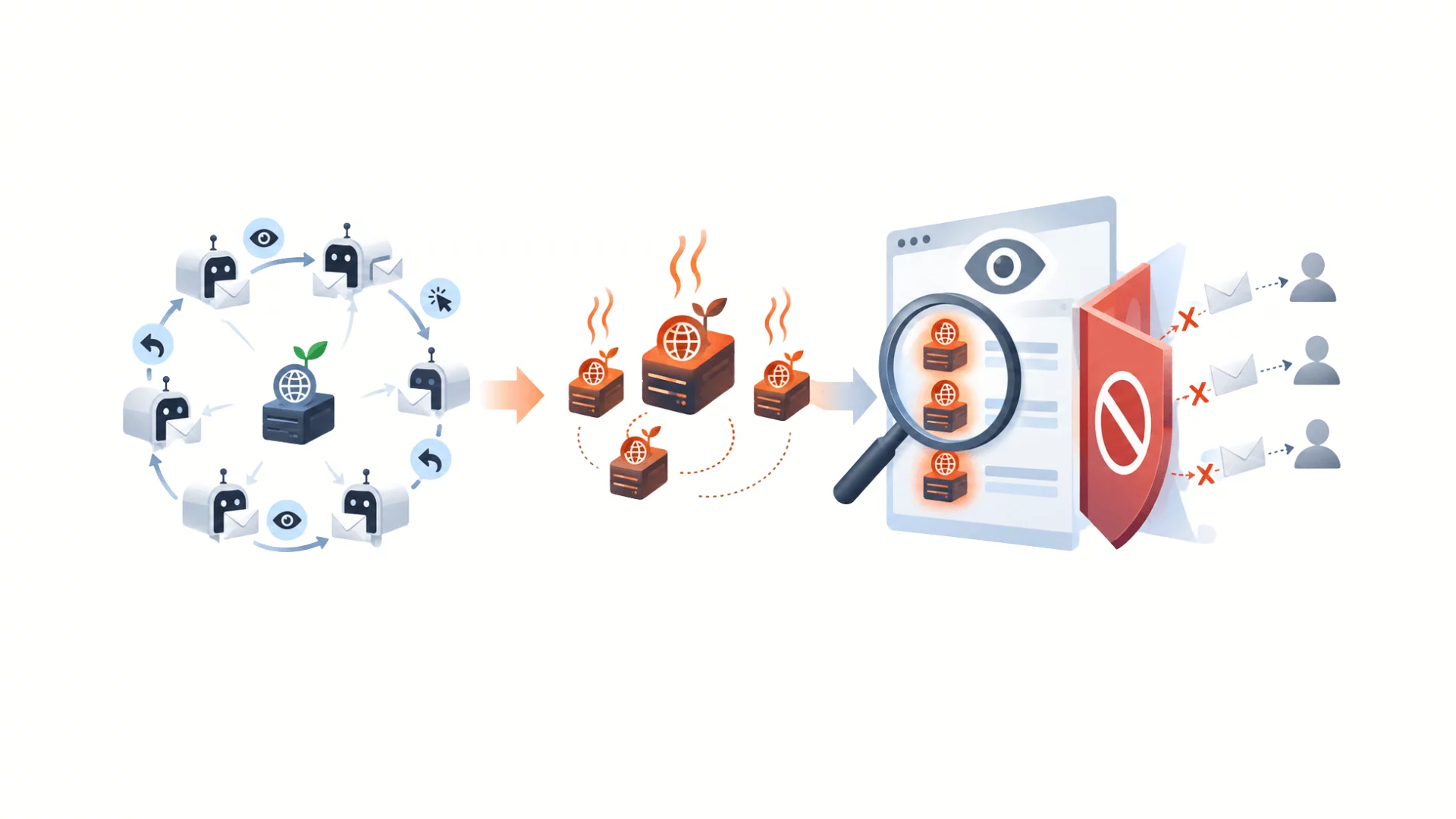
The vulnerability lies in the multi-tenant nature of SaaS platforms. When a platform like Calendly allows any user to generate notification mail, it effectively "rents out" its domain reputation to that user.
If a malicious actor creates an account, that account becomes a legitimate sub-entity of the platform. The platform’s DMARC policy tells the world, "Everything from this infrastructure is authorized." Consequently, when the attacker sends a malicious phishing lure, the receiving mail server checks the authentication, sees that it originates from the verified Calendly infrastructure, and marks it as "Clean."
The Google Redirect Factor
The use of Google redirects serves as a secondary layer of trust laundering. Most email security gateways (ESGs) use reputation-based filtering for URLs. Because Google is a global pillar of internet infrastructure, its URLs are rarely blocked. By wrapping the malicious payload in a Google-authorized redirect, the attackers effectively bypass link-reputation analysis.
Implications for the Email Industry
The hospitality campaign has forced a difficult conversation within the email security community. The "uncomfortable gap" identified by Microsoft is now impossible to ignore: a clean authentication result is no longer a guarantee of safety.
1. The Death of "Implicit Trust"
For decades, security teams have operated on the assumption that if an email is "authenticated," it is "safe." This is no longer true. Senders and Email Service Providers (ESPs) must now treat even the most reputable platforms as potential vectors for abuse.
2. A Shift to Behavioral Hunting
Microsoft’s advice to security teams is clear: stop chasing "indicators" (like specific IP addresses or domain names) and start hunting "behaviors." Because the attackers are constantly registering new domains and using different obfuscation techniques, static blocklists are ineffective.
Organizations must instead monitor for:
- Anomalous PowerShell activity: Specifically, instances where PowerShell is used to compile .NET or modify registry keys for persistence.
- Unexpected Node.js instances: Particularly those running from user-profile directories rather than standard system paths.
- System Hardening: Monitoring for changes to Microsoft Defender exclusions, which is a common tactic used by this threat actor to hide their activity.
3. The Need for Content-Centric Inspection
For mailbox providers and enterprise security gateways, the implication is that they must pivot toward deep content inspection. If authentication is the "passport" of an email, the content and link structure are the "luggage." Just because the passenger has a valid passport doesn’t mean they aren’t carrying contraband in their bags.
Future security solutions will need to integrate real-time sandboxing of links, even those behind reputable redirects, and better behavioral analysis of the files being downloaded.
A Call for Collective Responsibility
The hospitality industry is merely the current testing ground for this technique. The methodology—"authentication laundering"—can be applied to any industry, using any SaaS platform that sends automated notifications. Whether it is project management software, customer support portals, or HR management systems, the risk is ubiquitous.
For SaaS providers, the burden of responsibility is increasing. It is no longer enough to merely ensure that their mail reaches the inbox; they must now implement more stringent monitoring of their own sub-accounts. The risk of one bad tenant destroying the domain reputation of a platform is a massive business risk that providers can no longer ignore. Per-subaccount monitoring, rate limiting, and proactive link hygiene are now, as Microsoft suggests, frontline controls.
Conclusion
The active campaign against European and Asian hotels serves as a stark reminder that in cybersecurity, convenience is often the enemy of security. By repurposing legitimate, highly-trusted communication tools into delivery mechanisms for malware, attackers have found a way to turn the industry’s own security standards against it.
Authentication is a hygiene baseline, not a trust verdict. As we move further into 2026 and beyond, organizations must stop viewing SaaS notification emails as a "green lane" to be waved through. Instead, every piece of communication—regardless of how well it is authenticated—must be subjected to rigorous inspection. The era of blind trust in authenticated infrastructure is over; the era of zero-trust email scrutiny has begun.