
By [Your Name/Journalist]
Updated July 9, 2026
In the high-stakes world of small-to-medium business (SMB) growth, misalignment between sales and marketing rarely presents itself as a catastrophic, singular event. It does not arrive with a press release or a sudden halt in operations. Instead, it manifests as a quiet, corrosive erosion of efficiency. It shows up as "qualified" leads that the sales team treats with skepticism, marketing campaigns that feel alien to the reps on the front lines, and a pipeline that appears robust on a dashboard but leaks revenue in the dark.
A comprehensive new study by Unbounce, which surveyed over 500 go-to-market (GTM) professionals, confirms that this "silent crisis" is widespread. While 87% of teams believe that superior sales and marketing alignment is the key to unlocking better performance, only 56% claim to be "highly aligned." This discrepancy reveals a profound chasm between aspiration and execution.
The Anatomy of the Alignment Gap
The data indicates that the 56% of professionals who report being "highly aligned" are often describing a surface-level success. They have the meeting cadences, the occasional collaborative syncs, and the basic handoff protocols in place. However, true alignment requires moving beyond the "meeting-cadence layer" and into the "operating-model layer."
True alignment is measurable, visible, and deeply integrated. It is defined by shared lead data, rigid and mutually agreed-upon handoff rules, and, most importantly, success measured against the same Key Performance Indicators (KPIs). When these foundational elements are missing, teams fall into a trap: they communicate more frequently, yet they continue to disagree on the fundamental definitions of a "good" lead, the optimal timing for follow-up, and, perhaps most divisively, who deserves the credit when a deal finally closes.

A Tale of Two Perspectives: The Executive Perception Gap
One of the most striking findings in the report is the "perception gap" that exists between leadership and the boots-on-the-ground staff. According to the data, 69% of executives report strong sales and marketing alignment, whereas only 47% of non-executives share that sentiment.
This discrepancy is not merely a difference of opinion; it is a structural information lag. Executives often judge alignment by strategy decks, org charts, and the existence of recurring meetings. Conversely, non-executives experience the friction of the daily workflow—the data inconsistencies, the communication barriers, and the persistent silos that leadership often fails to see. When the people closest to the customer feel the process breaking down, no amount of executive-level optimism can compensate for the resulting loss in operational efficiency.
The Financial and Cultural Toll of Misalignment
Misalignment is often dismissed as a "culture issue," but the Unbounce report categorizes it as a significant operational cost. The consequences are quantifiable and compounding.
The Immediate Consequences
When asked what poor alignment produces, 29% of GTM teams point to employee frustration as the primary byproduct. However, the revenue costs are far more dangerous because they are often obscured by vanity metrics.
- Delayed follow-up: This leads to missed opportunities that are rarely logged as "lost to delay."
- Duplicated work: Teams wasting budget and time by performing redundant research or lead nurturing.
- Conversion gaps: The discrepancy between campaign promise and sales delivery erodes buyer trust.
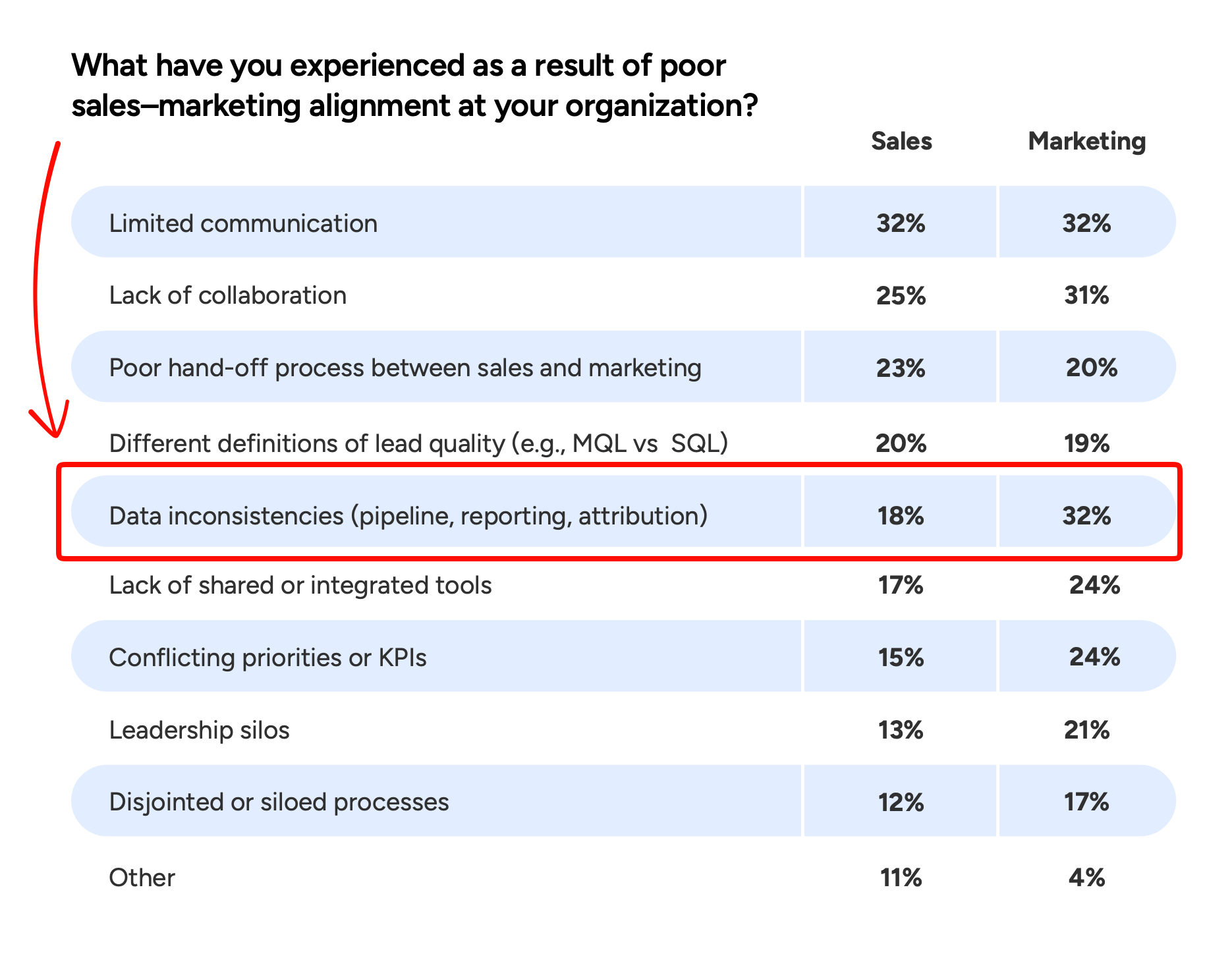
Marketers are particularly sensitive to these issues, with 32% citing delayed follow-up as a major hurdle, compared to 22% of sales professionals. This disconnect creates a vicious cycle: Marketing generates leads, Sales ignores them due to perceived quality issues, and the pipeline stalls.

Why "More Meetings" Isn’t the Answer
A critical error in modern GTM strategy is the reliance on communication frequency to solve structural flaws. Roughly 54% of GTM teams attempt to "fix" alignment by simply scheduling more meetings. While consistent communication is necessary, it is not a cure-all.
Aligned teams operate differently. They prioritize:
- Integrated Workflows: Systems that force collaboration rather than relying on interpersonal relationships.
- Shared KPIs: Moving away from separate goals for Marketing (leads) and Sales (revenue) toward a singular, unified revenue target.
- Coordinated Qualification: Agreeing on what a lead is before it enters the system.
The Four Root Causes of Dysfunction
The report breaks down the roots of misalignment into four distinct categories: Operational (53%), Goal/Incentive (43%), Cultural (40%), and Structural (34%).
Data Silos and Inconsistent Truth
Even in organizations that report "excellent" data sharing, 68% still encounter regular data inconsistencies. Marketing often relies on attribution software, while sales relies on CRM signals or personal spreadsheets. When both teams are working from different versions of the truth, the "qualified lead" becomes a matter of opinion rather than a data-backed fact.
The "Tool Bloat" Phenomenon
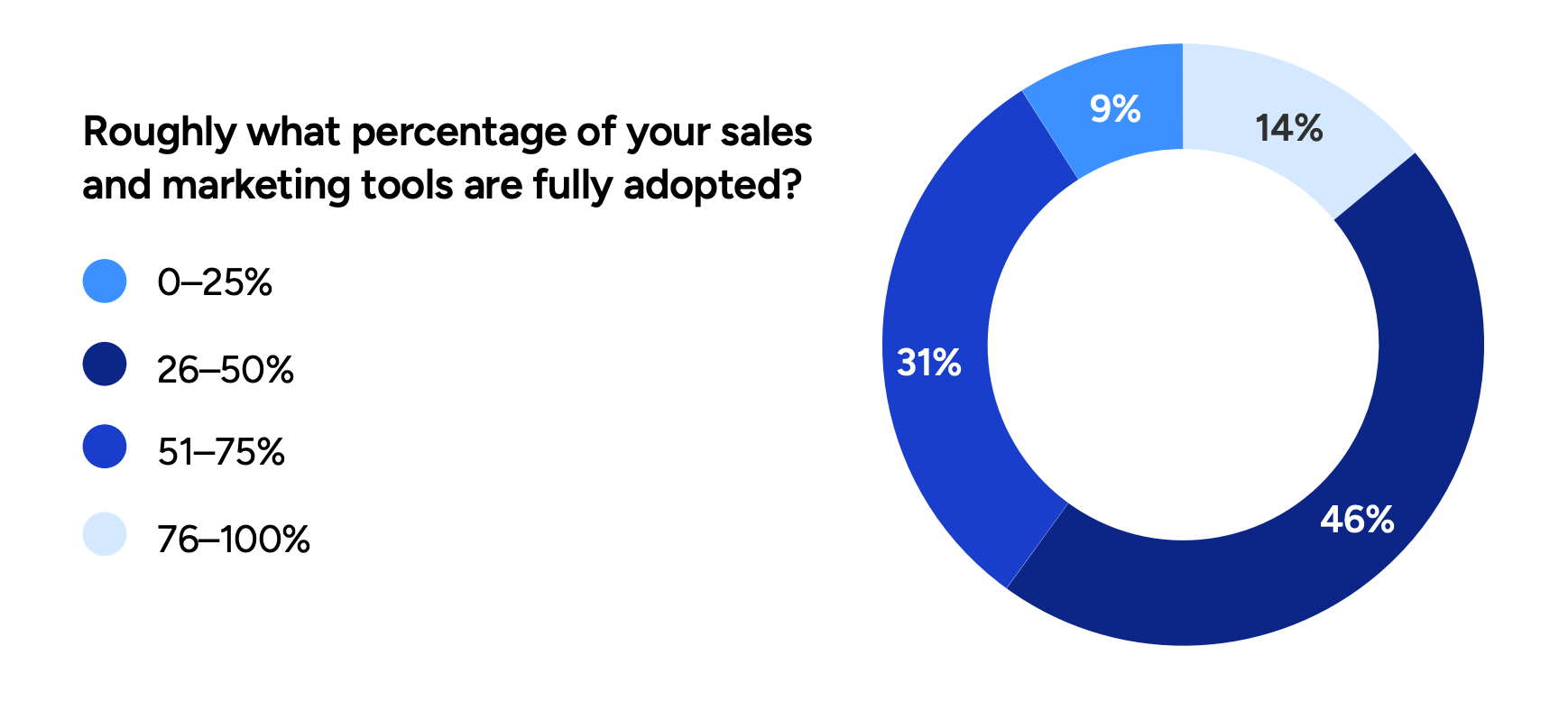
Teams are increasingly attempting to buy their way out of misalignment. 56% of professionals identify tool bloat as a major issue, with 60% of teams using less than half of their current software stack. Ironically, the more tools a team has, the more likely they are to have fragmented data. The data clearly shows that leaner, high-adoption tech stacks significantly outperform bloated, under-utilized ones.
Misaligned Incentives
Perhaps the most difficult barrier to overcome is the compensation structure. If Marketing is paid on volume and Sales is paid on closed revenue, they are structurally incentivized to prioritize their own silo over the collective goal. Until companies align their incentive models—rewarding Marketing for the quality and conversion of leads—shared KPIs will remain a theoretical exercise.
The Blueprint for High-Performing Teams
The 56% of teams that characterize themselves as "highly aligned" do three things differently:
1. Unified Data Infrastructures
These teams are 3.5 times more likely to have strong cross-functional data sharing. They do not just "discuss" data; they build systems where marketing data feeds directly into sales workflows, ensuring both teams are looking at the same dashboard.
2. Consistent Messaging Across the Journey
A buyer’s journey should feel seamless. Aligned teams ensure that the promises made in a marketing campaign are the same points reinforced during a discovery call. They achieve this by utilizing shared buyer personas and ensuring that sales reps have a seat at the table when marketing collateral is developed.
3. Intentional Tech Consolidation
High-performing teams focus on usage, not feature counts. They consolidate their stacks, which results in a 2x higher likelihood of rating lead quality as "excellent." By limiting the number of platforms, they ensure that the data flowing through those platforms is clean and actionable.
Implementing Change: Three Steps to Alignment
For organizations looking to bridge the gap, the Unbounce report suggests three actionable steps:
- Co-create Buyer Personas: Stop letting Marketing write the personas in a vacuum. Include Sales in the process to capture real-world objections and buyer language.
- Formalize the Handoff SLA: Create a Service Level Agreement (SLA) that defines exactly what data must be passed from Marketing to Sales and, crucially, what feedback Sales must provide back to Marketing.
- Integrate Reporting: Move to a shared revenue dashboard. If the team cannot agree on a single source of truth for "Customer Acquisition Cost" or "Conversion Rate," the alignment work will always be secondary to the debate over the numbers.
Conclusion: The Path Forward
The evidence is clear: sales and marketing alignment is not a soft skill; it is a hard-operating discipline. The teams that win in the coming years will be those that abandon the "meeting-first" mentality and instead build an operating model where data, incentives, and processes are unified.
As the industry moves toward more complex, data-driven GTM strategies, the cost of misalignment will only rise. The organizations that succeed will be those that view alignment not as a destination, but as a continuous, measurable, and essential requirement for survival in a competitive market. For those ready to take the next step, the path is clear: align the incentives, consolidate the tech, and, above all, agree on the data.