The rapid advancement of artificial intelligence and automated platforms has fundamentally rewritten the rules of engagement between brands and their marketing agencies. For decades, the agency model was built on the back of labor-intensive "execution armies"—teams of specialists dedicated to manual bidding, campaign architecture, trafficking, and constant reporting. Today, those tasks are increasingly handled by platform-level intelligence, rendering the traditional agency billing model not only obsolete but fundamentally misaligned with the needs of modern businesses.
As we move toward 2026, the mandate for marketing leaders is clear: the current agency operating model is failing to capitalize on AI-driven efficiency. To survive and thrive, brands must pivot from paying for "activity" to paying for "judgment."
The Strategic Shift: Why We Are Not in Kansas Anymore
The transformation currently sweeping through the marketing landscape—spanning media, creative, performance, brand, measurement, and CRM—is not merely an incremental change; it is a structural revolution. Historically, agencies were incentivized to increase volume. Whether it was the sheer number of campaigns, the frequency of adjustments, or the size of the media budget, the incentive structure was designed to reward manual labor.
However, the rise of "Agentic AI"—where platforms like Google’s PMax or Meta’s Advantage+ manage complex optimizations autonomously—has shifted the agency’s value proposition. When a machine can perform micro-optimizations, targeting, and audience segmentation with more precision than a human, the human’s role must move upstream.
The "We Are Not in Kansas Anymore" realization is driven by three strategic pillars:
- Automation of Execution: Platform algorithms have largely mastered the "assembly line" of digital marketing.
- Outcome-Based Economics: The ability to measure and attribute success is moving beyond platform-level ROAS toward true incremental profit.
- Strategic Necessity: Brands now require agencies that act as high-level consultants and data architects, not just button-pushers.
Chronology of the Transformation: The Road to 2026
The transition is occurring on a sliding scale, but the pressure to adapt is accelerating.
- 2024–2025: The period of discovery. Agencies began to realize that their traditional "optimization theater"—the daily ritual of manual tweaks and reporting—was actually damaging the performance of AI-led campaigns by resetting learning cycles.
- July 2026: The target date for widespread contract restructuring. By this time, the gap between AI-driven efficiency and legacy manual work will be so wide that continuing with an old-school Statement of Work (SOW) will represent a significant drain on marketing budgets.
- 2027 and Beyond: The era of the "Modern Agency." Firms that have successfully pivoted to strategic partnership will be indispensable, while those clinging to the "Percent of Media Spend" model will likely face existential threats as clients shift budgets toward more efficient, automated, and outcome-oriented providers.
Supporting Data: The Case for Contract Re-engineering
The financial implications of this shift are profound. By stripping away the manual tasks now handled by AI, brands can see a reduction in agency fees of between 25% and 75% for legacy work. However, this is not about "cutting to save"; it is about "cutting to grow."
The proposed financial model for modern agency contracts suggests a significant redistribution of resources:
- Lean Base Retainer (40%–50%): Covers governance, steering, and data engineering.
- Project Fees (30%–40%): Dedicated to creative ideation, pre-testing, complex strategic analytics, and portfolio strategy.
- Outcome Incentives (15%–25%): Tied directly to incremental profit or verified revenue lift, rather than vanity metrics like platform ROAS.
The current "Percent of Media Spend" model is arguably the most toxic element of modern marketing. It creates a perverse incentive for agencies to encourage higher spending, regardless of performance, and to resist the efficiency gains that AI provides. By moving to an outcome-based model, brands align their interests with those of their agencies, ensuring both parties are focused on growth rather than throughput.
The Five Clusters of Agency De-Construction
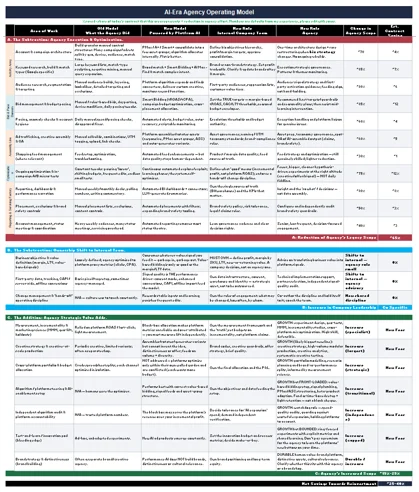
To facilitate this transition, marketing leaders should audit their agency contracts across five key areas of activity, all of which are ripe for automation-driven reduction:
1. The Agency Activity Army
Tasks like keyword research, campaign architecture, and audience targeting were once the core of agency value. Today, machines handle these at a scale impossible for humans. The agency’s role is now limited to high-level architecture design and setting guardrails.
- Potential Savings: ~78% reduction in effort.
2. The Bid & Pace Dancers
Manual budget adjustments, day-parting, and device modifiers are relics of the past. Continuous "over-touching" by human analysts often triggers AI learning resets, causing more harm than good.
- Potential Savings: ~73% reduction in effort.
3. The Assembly Line
Trafficking, tagging, and QA are increasingly handled by platform-level asset generation tools. The human role is now limited to clean taxonomy and asset preparation.
- Potential Savings: ~45% reduction in effort.
4. The Optimization Theater
Daily rituals of pausing "losers" and making minor tweaks are often destructive. Modern platforms use continuous "explore-exploit" algorithms that far outpace human reaction times.
- Potential Savings: ~75% reduction in effort.
5. The Reporting & Servicing Factory
The manual production of weekly decks and redundant check-in meetings is the largest administrative burden. With AI-powered data lakes and dashboards, these are becoming unnecessary.
- Potential Savings: ~60% reduction in effort.
Implications for Agencies: From Hamsters to Architects
While this news may cause discomfort within agency leadership, it is, in fact, an invitation to a higher form of business. For years, agencies have been stuck on a "hamster wheel," charging clients for junior-level, repetitive tasks that offer little long-term value.
By shedding this "execution army" work, agencies gain the opportunity to:
- Elevate Talent: Replace high-volume, low-cost junior staff with senior strategists, data architects, and creative directors who command higher fees for higher-impact work.
- Drive Genuine Innovation: Focus on cross-platform consumer behavior, value signal hunting, and risk reduction in experimentation.
- Increase Longevity: Agencies that move from "renting out hands" to "selling judgment" become strategic partners, making them much harder to replace during budget cuts.
The Path Forward: Avoiding the Hostage Situation
As brands embark on this restructuring, there are two critical cautions to heed.
First, own your data. Ensure that your company owns the ad accounts, pixels, and data streams. Agencies should be partners, not gatekeepers. If an agency holds your data hostage, they are not a partner; they are a vendor with leverage.
Second, address the internal friction. The "Percent of Media Spend" model is often protected by internal stakeholders—marketing managers or procurement leads who may have become accustomed to the "comfort" of traditional reporting or, in worse cases, have benefited from the lack of transparency in media markups. Removing this toxicity requires both a change in contract and a change in culture.
Conclusion: Carpe Diem
The future of marketing is not about choosing between human or machine; it is about the elegant integration of both. The agencies that thrive in this new era will be those that embrace the AI revolution, relinquish the manual tasks of the past, and double down on the one thing that machines cannot replicate: high-level, human judgment.
The work is not disappearing—it is simply evolving. For brands, the time to renegotiate is now. By moving to an outcome-based, transparent, and strategic contract model, you aren’t just saving money; you are building the foundation for a more resilient, efficient, and profitable future. The revolution is here; it is time to lead it.