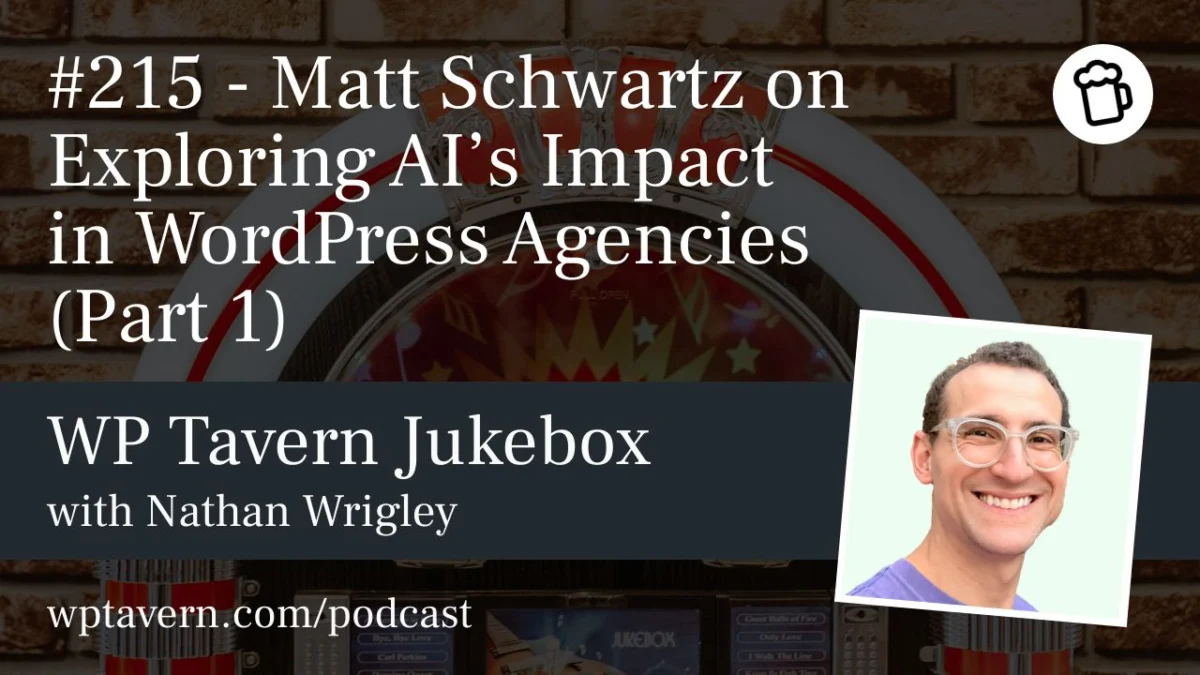
The rapid emergence of artificial intelligence has left many in the digital agency space feeling a sense of whiplash. In the WordPress ecosystem, where themes, plugins, and custom development have traditionally been the bedrock of agency business models, the conversation surrounding AI has often been polarized. While some developers fear for the future of their craft, others are rapidly integrating machine learning tools into their daily workflows.
However, as Matt Schwartz, founder of the Atlanta-based WordPress and WooCommerce agency Inspry, argues, the most profound impact of AI isn’t found in flashy website generators—it’s found in the quiet, operational infrastructure of the agency itself. In a deep-dive conversation on the WP Tavern Jukebox podcast, Schwartz explores how agencies can move past the "AI fatigue" currently permeating the tech industry and adopt a more intentional, strategic approach to integrating these tools.
The Evolution of the Agency Model: From Stumbling to Strategy
For many agency owners, the path to running a business was not a linear trajectory but a series of "stumbles." Schwartz, who launched Inspry in 2011 and has been working with WordPress since 2013, reflects on a common narrative among his peers: starting as a freelancer who learned by doing, often lacking formal standard operating procedures (SOPs).
"I didn’t look at my process for years," Schwartz admits. "I would just repeat the same thing over and over again. It wasn’t until I actually started hiring people that I realized that was even a thing."
This realization highlights a critical juncture for many agency owners. As the digital landscape matures, the "execution" of a website—the act of building the pages and configuring the CMS—is increasingly becoming a commodity. The competitive edge has shifted from technical implementation to the quality of the client experience, the efficiency of communication, and the robustness of internal workflows.
Chronology of the AI Shift: Why Now?
The transition into the AI era has not been incremental; it has been seismic. While SaaS applications and web development tools improved gradually over the last two decades, the last three to four years have witnessed a rapid acceleration of capabilities.
Schwartz points out that the "floor" for web development is rising. As AI-driven tools become more sophisticated, clients are increasingly aware of the speed at which websites can be produced. This awareness is compressing project timelines and altering client expectations regarding budgets. Consequently, agencies that rely solely on the manual execution of brochure-style websites are finding it harder to justify premium pricing. The current moment is not just an opportunity for optimization; it is a necessity for survival.
The AI Vision Document: A Framework for Guardrails
One of the most actionable strategies introduced by Schwartz is the concept of an "AI Vision Document." Rather than haphazardly deploying AI across every department, agency owners should create a formal document that outlines exactly where and how AI is permitted within the business.
Setting Internal Guardrails
An AI Vision Document serves as a compass for the team. It identifies:
- High-Impact Areas: Processes that are repetitive and low-risk, such as drafting initial meeting summaries or organizing project data.
- Human-Centric Zones: Sensitive areas, particularly in client support or critical code debugging, where human judgment is non-negotiable.
- Ethical Standards: Clear guidelines on data privacy and the disclosure of AI usage to clients.
By formalizing these rules, agencies can avoid the pitfalls of "YOLO" implementation—a trend where teams use AI without considering security, accuracy, or brand reputation. Schwartz suggests that by analyzing data from time-tracking software and project management tools, owners can identify the specific bottlenecks where AI can provide the most value without compromising the agency’s integrity.
Leveraging AI as a New Service Offering
A common mistake among technical professionals is assuming that clients want to hear about the "magic" behind the curtain. In reality, clients care about outcomes: profitability, time-savings, and efficiency.
Schwartz advocates for treating AI expertise as a new, premium service offering. Instead of marketing "AI-built websites," agencies should focus on "process automation" and "workflow optimization."
The Value-Added Approach
- Internal App Development: Agencies can now build lightweight, internal-use custom apps for clients at a fraction of the historical cost. By utilizing AI to assist in code generation—followed by rigorous human review—agencies can solve complex client problems that were previously cost-prohibitive.
- Data-Driven Insights: AI’s ability to parse massive datasets allows agencies to offer marketing and operational insights that were once the domain of large, expensive consultancies. This expands the agency’s role from a service provider to a strategic partner.
Operational Excellence: The "Low-Hanging Fruit"
For agencies looking to start their integration journey, the operational backend offers the most immediate returns.
Meeting Summarization and Proposals
Automated meeting assistants have transformed the discovery process. By generating accurate summaries and actionable task lists, these tools allow agency owners to spend less time on administration and more time on high-level strategy. This is particularly valuable for discovery calls; if a client doesn’t convert, the agency hasn’t wasted hours on a bespoke proposal.
Support Workflows
Support is perhaps the most sensitive area of an agency. Schwartz cautions against replacing humans with chatbots that frustrate customers. Instead, he proposes a "human-in-the-loop" model. In this framework, AI agents digest incoming help tickets, cross-reference them with project history and error logs, and suggest resolutions to the support staff. This speeds up response times significantly without sacrificing the human empathy required to handle client frustrations.
Implications for the Future of WordPress
The WordPress project itself is evolving to meet this new era. The Core AI team is actively developing infrastructure that allows WordPress to function as a foundation for AI-driven interaction.
"WordPress is the platform, it provides all the capabilities, but then the AI tool, mixed with the human, is essentially going to be managing the WordPress site," says Schwartz. This shift suggests a future where administrators may not need to navigate the backend dashboard in the traditional sense. Instead, they will communicate their needs to an AI agent, which will interface with the WordPress infrastructure to execute the request.
Conclusion: The Human Imperative
Despite the power of these tools, Schwartz emphasizes a vital truth: the human element remains the final arbiter of quality. Whether it is verifying code, reviewing a generated proposal, or managing a delicate support conversation, human oversight is the only way to mitigate the "hallucinations" and errors inherent in current AI models.
Agencies that thrive in the coming years will not be those that hand over the keys to an algorithm, but those that use AI as a force multiplier for human expertise. As the industry continues to evolve, the ability to balance the efficiency of automation with the nuance of human experience will define the next generation of successful WordPress agencies.
This article is the first part of a two-part series. Stay tuned for next week’s edition, where we will explore further into the ethical considerations, security risks, and the long-term impact of AI on the WordPress agency landscape.