By Digital Media & Advertising Desk
Published: October 2024
Main Facts
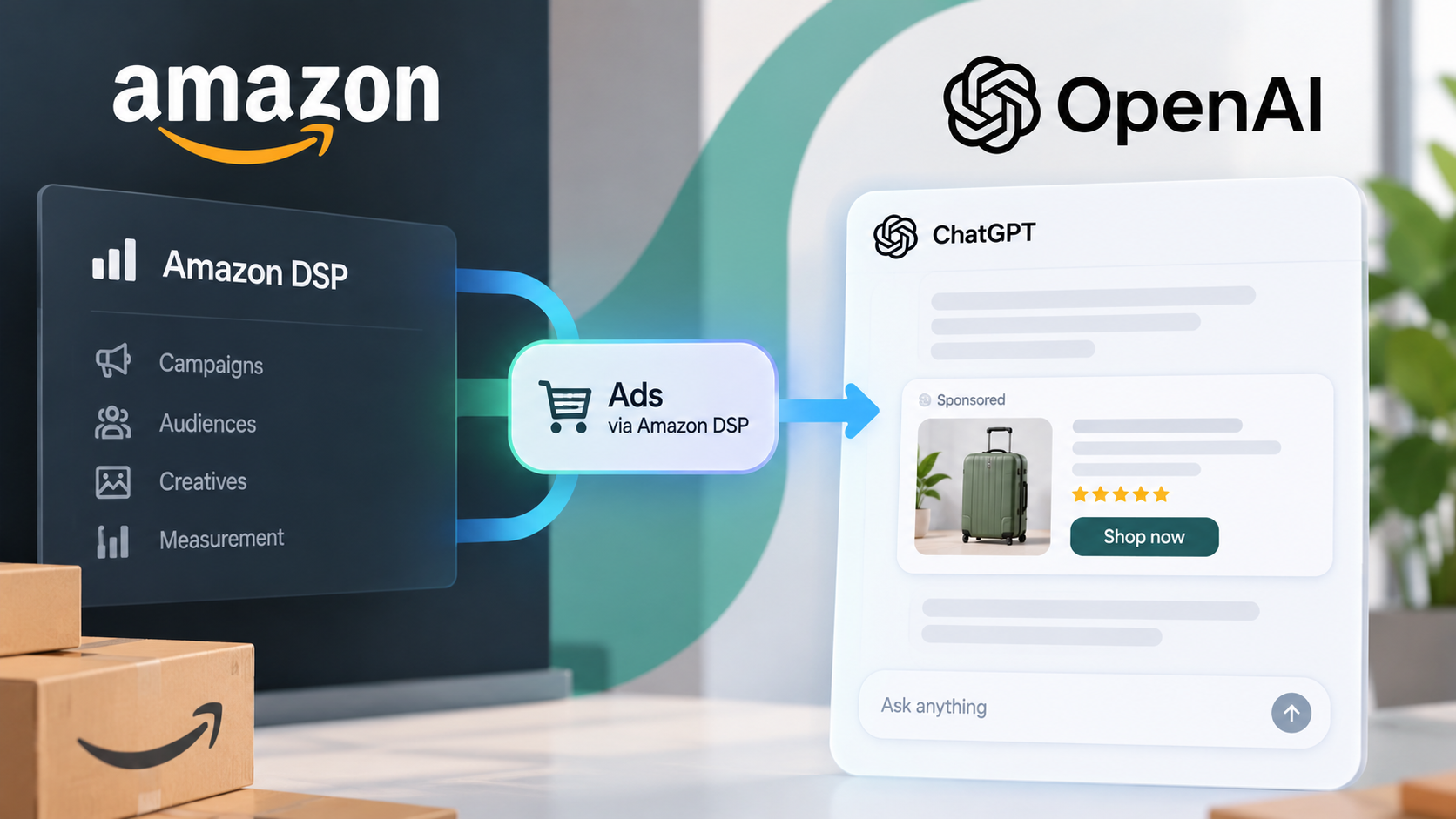
In a landmark development bridging the worlds of e-commerce retail media and conversational artificial intelligence, Amazon has announced a strategic partnership with OpenAI. The collaboration allows brands and media buyers utilizing the Amazon Demand-Side Platform (DSP) to seamlessly extend their digital advertising campaigns directly into ChatGPT.
At launch, the integration is rolling out as an exclusive, managed-service pilot in the United States. Among the select group of prominent U.S. advertisers participating in the initial phase is Delta Vacations.
Under the terms of the agreement, Amazon acts as the front-end gateway, providing campaign setup, optimization tools, and billing management. Advertisers can purchase inventory using standard pricing models, including cost-per-click (CPC) and cost-per-mille (CPM). Furthermore, Amazon is introducing product feed ads that automatically generate rich-media ad assets by pulling directly from an advertiser’s existing product catalog.
Despite Amazon managing the purchasing and optimization layer, OpenAI retains strict sovereign control over its ecosystem. OpenAI’s proprietary systems dictate ad delivery, ranking, and placement within the conversational UI. Within ChatGPT, ads appear as clearly labeled text and image units positioned neatly beneath organic responses.
Chronology of Events
The intersection of retail media networks and generative AI has evolved rapidly over the past twenty-four months, culminating in this unique partnership.
- Late 2022 to 2023: OpenAI launches ChatGPT to public acclaim, transforming how hundreds of millions of users interact with information, search the web, and formulate purchasing decisions. As user adoption skyrockets, industry speculation mounts regarding how OpenAI will monetize the platform through native advertising.
- Early 2024: OpenAI begins quietly testing monetization frameworks, signaling its intent to introduce sponsored units to its conversational interface. Concurrently, retail media networks like Amazon DSP experience unprecedented growth, cementing their status as essential components of enterprise marketing stacks.
- Mid 2024: Industry insiders report conversations between major tech conglomerates and AI labs regarding programmatic supply-chain integrations. Amazon positions its DSP as a universal buying tool capable of extending far beyond Amazon’s owned-and-operated properties (such as Prime Video and Fire TV).
- Current Launch (Q4 2024): Amazon and OpenAI formally unveil their U.S. pilot program. Advertisers gain the ability to buy ChatGPT inventory via Amazon DSP as a managed service, with launch partners like Delta Vacations testing the waters.
Supporting Data and Technical Specifications
The technical architecture of the Amazon-OpenAI partnership establishes a distinct separation of duties between buying mechanics and delivery algorithms.
Buying Models and Formats
- Pricing Structures: Advertisers can procure inventory on both a CPC (Cost-Per-Click) and CPM (Cost-Per-Mille / Thousand Impressions) basis, aligning with standard programmatic media-buying practices.
- Dynamic Product Feeds: Amazon provides automated asset creation via product feeds. Advertisers can sync their catalogs, allowing the system to dynamically generate ad units tailored to the conversational context.
- Ad Placement UI: Advertisements manifest as text and image units displayed beneath organic chatbot replies, always accompanied by clear "Sponsored" labeling to maintain transparency.
Measurement and Data Reporting
Participants in the initial U.S. pilot receive aggregated, comprehensive performance metrics to evaluate campaign efficacy. Key reporting data points include:
- Total Impressions
- Click-Through Rates (CTR) and Total Clicks
- Effective Cost-Per-Click (CPC)
- Effective Cost-Per-Mille (CPM)
- Cost-per-Result metrics
Crucially, the integration opens doors for advertisers to leverage Amazon’s granular shopping and streaming consumer data. By blending Amazon’s robust behavioral retail insights with ChatGPT’s rich conversational context, brands can target high-intent audiences with unprecedented precision.
Official Responses and Industry Dynamics
While OpenAI maintains total autonomy over how ads are served, the partnership essentially outsources a significant portion of OpenAI’s sales enablement and client relationship management to Amazon.

For OpenAI, partnering with Amazon provides immediate access to one of the largest, most sophisticated advertiser bases in the world. Scaling a proprietary advertising network from scratch is notoriously capital- and resource-intensive. By tapping into Amazon DSP, OpenAI bypasses the friction of onboarding thousands of individual brands and agencies, accelerating the commercial maturation of ChatGPT Ads.
Conversely, Amazon solidifies its value proposition to enterprise marketers. By expanding Amazon DSP’s footprint into the world’s most popular conversational AI interface, Amazon transforms its ad tech stack into an indispensable omni-channel gateway.
Industry analysts note that this move is particularly advantageous for non-endemic advertisers—companies that do not sell physical goods on Amazon’s e-commerce marketplace (such as financial services, automotive brands, travel providers like Delta Vacations, and B2B software companies). These brands already utilize Amazon DSP to buy connected TV (CTV), audio, and display inventory across the open web. Now, they can add conversational AI to their media mix without establishing a direct billing relationship with OpenAI.
Strategic Implications for Marketers
The Amazon-OpenAI alliance signals a paradigm shift in how digital marketing budgets are allocated and managed. Several core implications emerge for brands navigating this new landscape:
1. The Rise of Conversational Commerce
Consumers increasingly turn to AI chatbots not just for general knowledge, but for product discovery, comparative research, and travel planning. By placing ads directly beneath organic conversational responses, brands can intercept consumers at moments of high intent, long before traditional search engine queries occur.
2. Streamlined Multi-Channel Operations
Marketers have long suffered from fragmented ad management interfaces, requiring separate logins, reporting dashboards, and budget allocations for every new publisher. By routing ChatGPT inventory through Amazon DSP, media buyers can manage, optimize, and report on conversational AI campaigns alongside their existing retail media, streaming TV, and programmatic display strategies.
3. The Separation of Church and State (Buying vs. Serving)
The division of labor in this partnership—where Amazon controls the commercial relationship and OpenAI controls the delivery algorithm—establishes a blueprint for future AI-ad tech collaborations. Advertisers must recognize that high bids via Amazon DSP do not guarantee preferential placement; OpenAI’s machine learning models will ultimately decide which ad best serves the user’s conversational prompt.
4. Future Outlook and What to Watch
As the U.S. pilot progresses, digital marketing leaders will closely monitor three critical factors:
- Geographic Expansion: Will OpenAI and Amazon expand DSP access to international markets (such as Europe and Asia-Pacific) in 2025?
- Ad Format Evolution: Will the partnership introduce richer interactive elements, such as multi-turn conversational ad experiences or transactional checkouts directly within the chat interface?
- Adoption Rates: How aggressively will non-endemic brands shift budgets away from traditional search engines and social media platforms toward ChatGPT inventory?
Ultimately, this collaboration marks a pivotal milestone in digital advertising. As conversational AI reshapes digital habits, the marriage of Amazon’s programmatic infrastructure with OpenAI’s generative intelligence creates a formidable new channel for brand discovery and customer acquisition.