The Great Search Migration: How AI is Redistributing, Not Destroying, Global Web Traffic
A comprehensive new study has revealed that while traditional search engine patterns are undergoing their most disruptive evolution in decades, overall search demand is not shrinking. Instead, it is being rapidly redistributed.
For years, the digital marketing industry has braced for an existential crisis, driven by predictions that artificial intelligence chatbots would decimate traditional web search. However, an extensive analysis of over one million high-volume keywords and a nationwide consumer survey reveals a more nuanced reality: search behavior is shifting to new queries, alternative platforms, and conversational AI interfaces, leaving the net volume of search demand virtually flat.
1. Main Facts: Key Findings from the 2026 Search Evolution Study
The collaborative study, conducted by growth marketing agency Fractl and digital marketing publication Search Engine Land, utilized search data from Semrush to analyze the market’s current state. The core findings challenge the prevailing "SEO death" narrative while highlighting critical areas of vulnerability for digital brands:
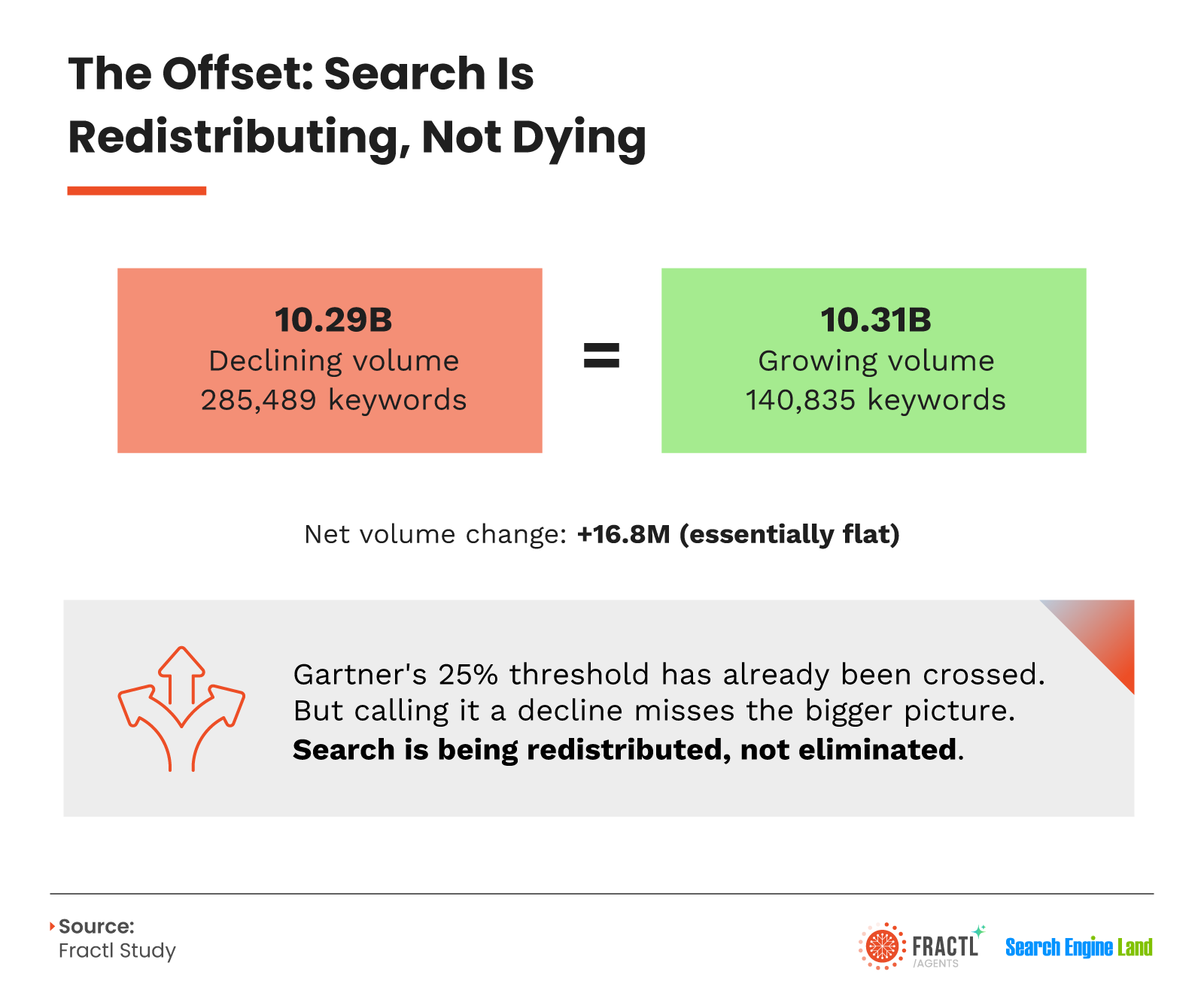
The 29% Decline is Real but Isolated: Across more than one million high-volume keywords, 29% of search volume is in active, measurable decline. This surpasses the widely cited 2024 prediction by research firm Gartner, which forecast a 25% drop in traditional search volume by 2026.
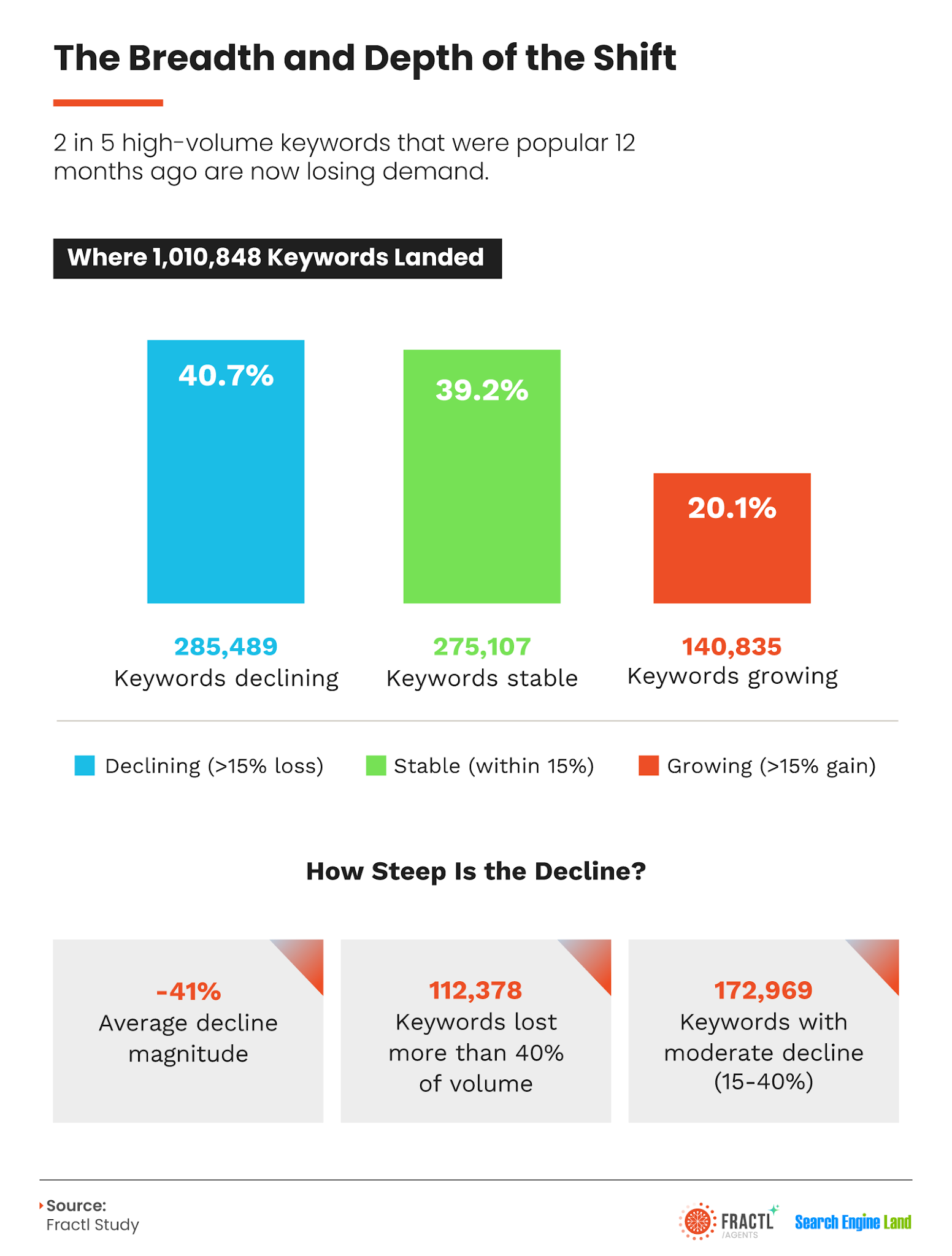
The Redistribution Paradox: While 40.7% of individual high-volume keywords experienced volume losses of 15% or more over the past year, 20.1% of keywords grew by that same margin. Mathematically, the losses and gains almost perfectly offset one another. The declining keywords represented a loss of roughly 10.29 billion in monthly search volume, while the growing keywords added 10.31 billion—resulting in a net positive change of 16.8 million monthly searches across the dataset.
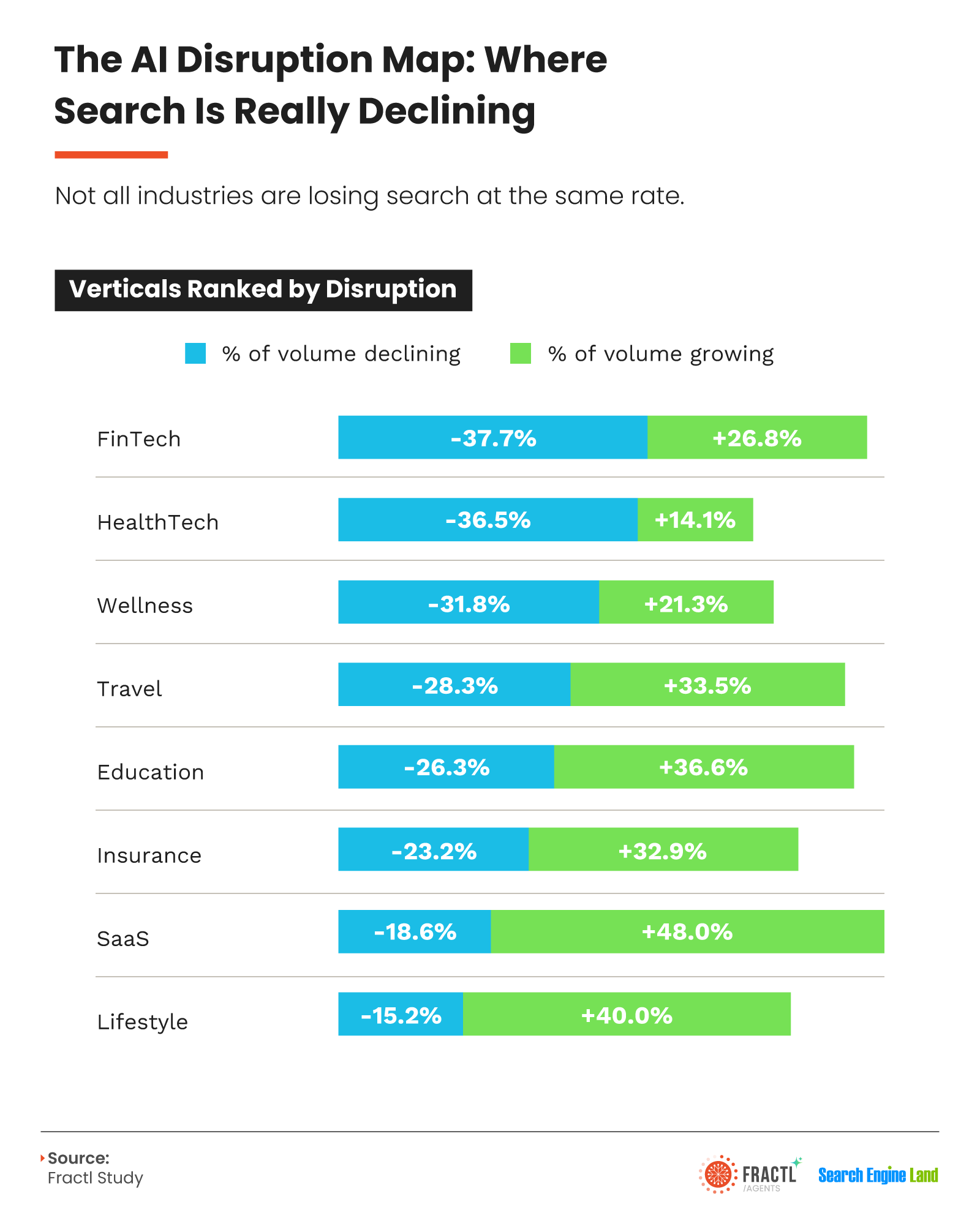
Informational vs. Transactional Verticals: Industries focused on quick, information-rich answers (such as FinTech, HealthTech, and Wellness) are experiencing severe search volume drops. Conversely, transactional and comparison-heavy verticals (such as SaaS, Lifestyle, and Insurance) are seeing stable or rapidly growing search volumes.
The Rise of Downstream Branded Search: AI chatbots are increasingly acting as the top of the funnel. When a user asks an AI for a recommendation (e.g., "What is the best project management software?"), the response often triggers a secondary, traditional search for the specific brand names recommended.
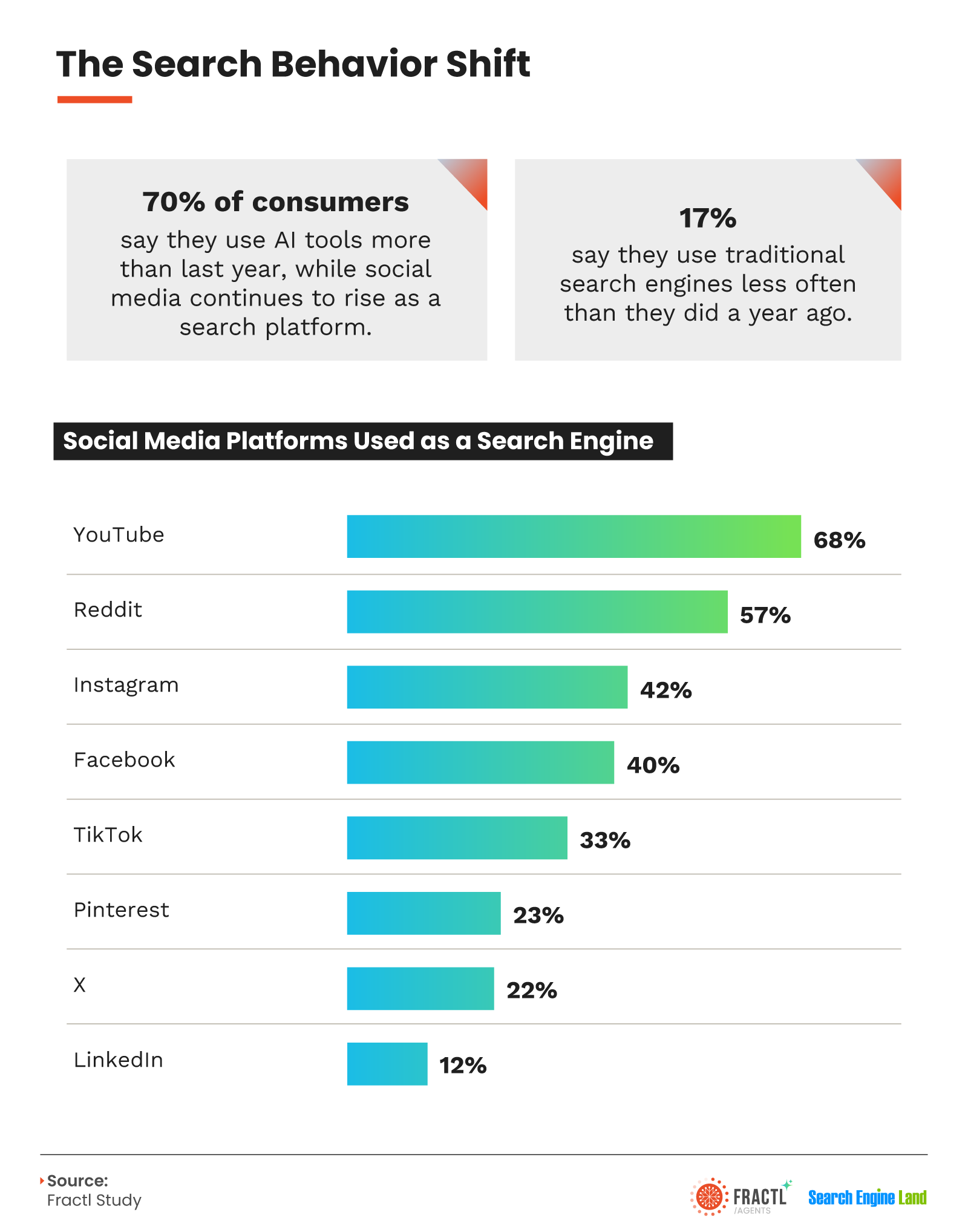
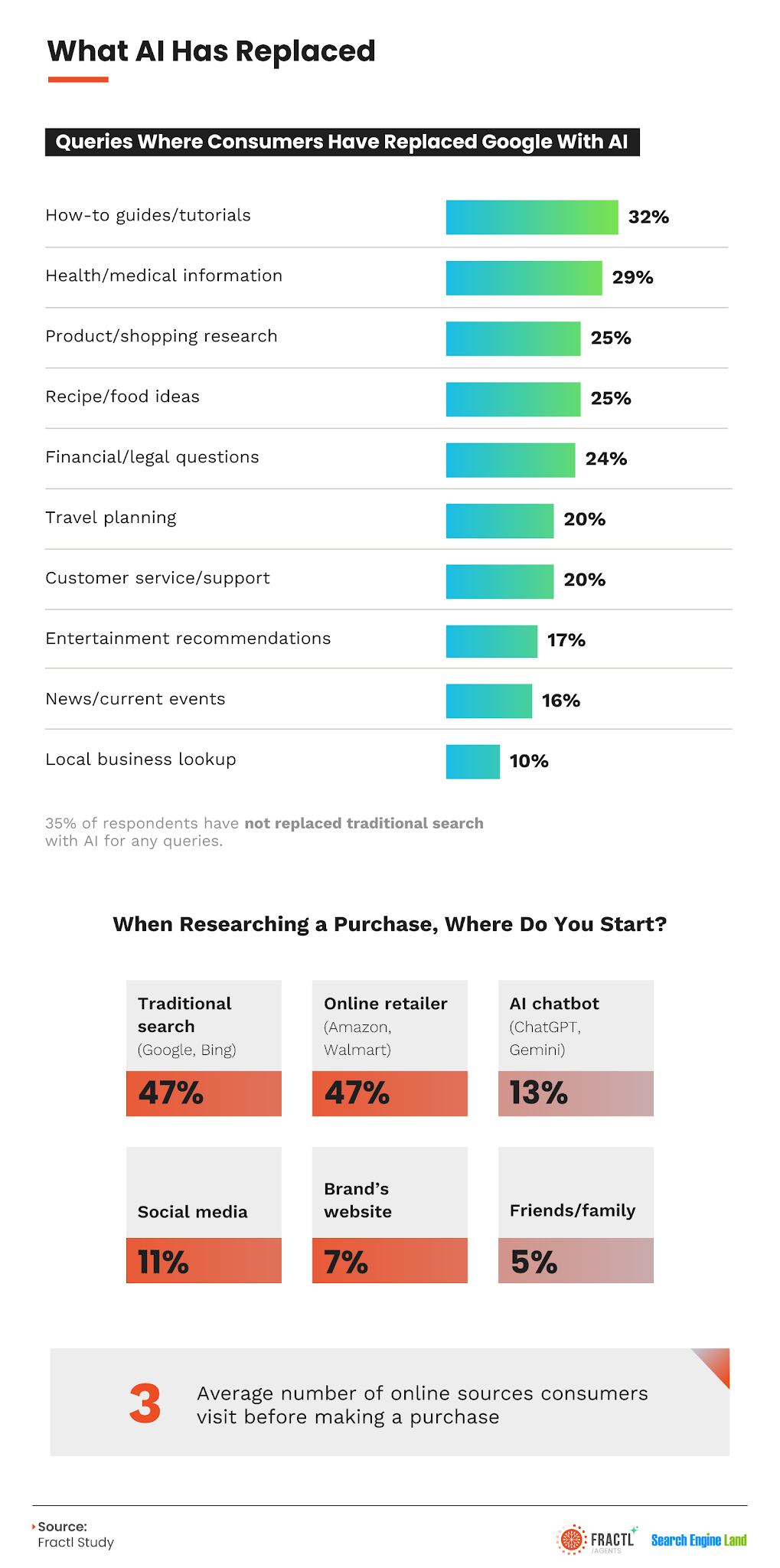
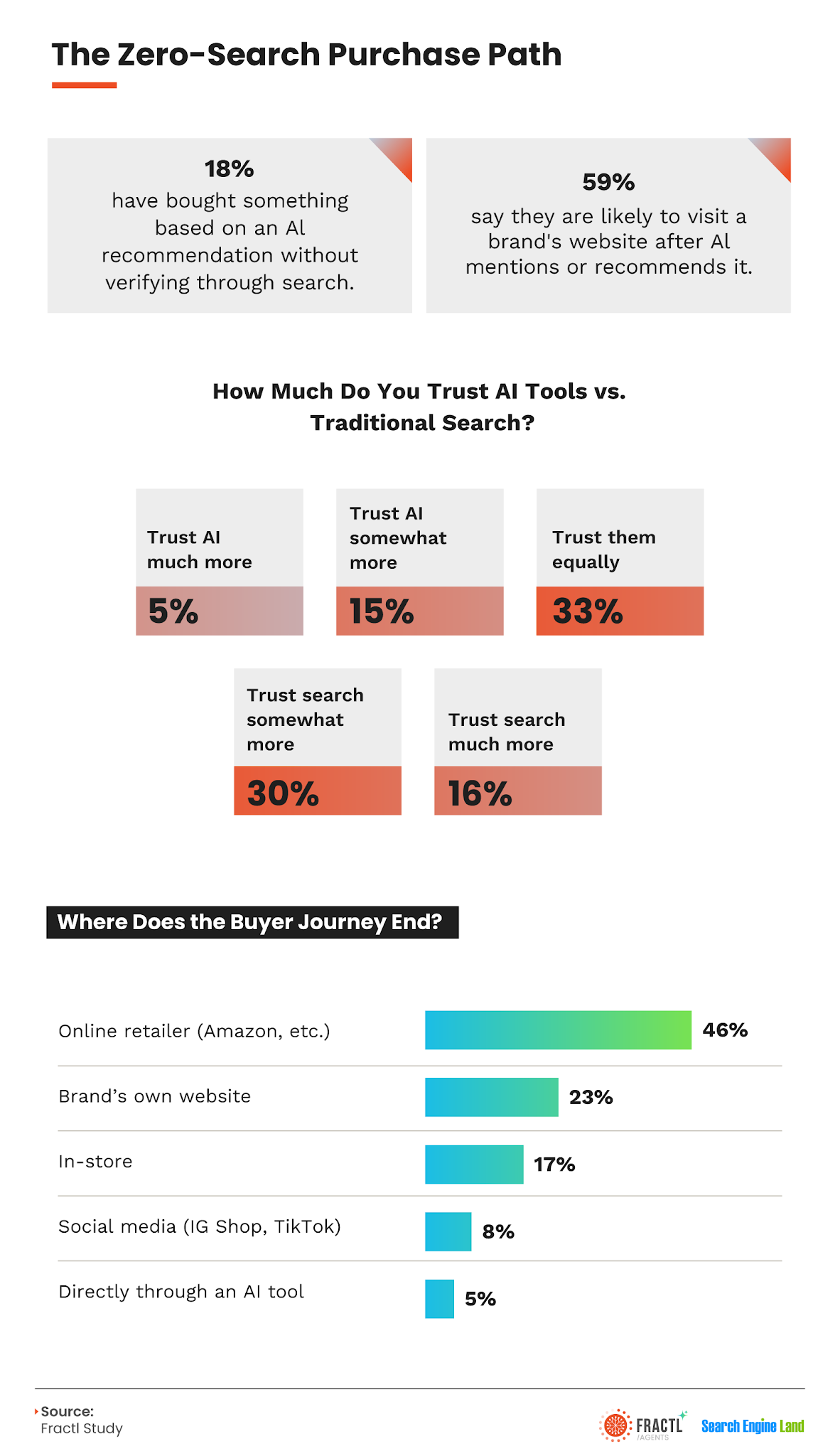
A New Consumer Funnel: Although 70% of consumers report using AI more frequently, only 17% say they are using traditional search engines less. Furthermore, 59% of consumers are likely to visit a brand’s website after it is mentioned or recommended by an AI chatbot, establishing a new pipeline for web traffic.
2. Chronology: From the 2024 Gartner Prediction to the 2026 Reality
To understand the current state of search, it is necessary to trace how industry expectations aligned—or failed to align—with actual consumer behavior over the last two years.
   [Early 2024] ----------------------> [Late 2024 - 2025] ------------------> [April 2026]
Gartner predicts 25%                 AI Overviews & Chatbots                 Fractl/Search Engine Land
drop in search engine                integrate widely; consumer              study reveals flat net volume;
volume by 2026.                      habits begin to bifurcate.              demand redistributed.
February 2024: The Gartner Warning
In early 2024, technology research firm Gartner released a benchmark prediction: traditional search engine volume would fall by 25% by 2026. Gartner warned that consumers would rapidly abandon search engine results pages (SERPs) in favor of conversational AI agents, such as ChatGPT, Claude, and Google’s Gemini. This prediction sent shockwaves through the digital marketing and search engine optimization (SEO) industries, sparking fears of a permanent loss of organic web traffic.
Mid-2024 to 2025: The Integration Era
Throughout 2024 and 2025, search engines rushed to integrate generative AI directly into their core products. Google rolled out AI Overviews (formerly SGE), and Microsoft enhanced Bing Copilot. Simultaneously, OpenAI positioned ChatGPT as a direct search competitor with prototype features like SearchGPT. During this period, consumer search habits began to bifurcate: simple informational queries started shifting to chat interfaces, while complex research, product comparisons, and transactional queries remained on traditional search engines.
April 2026: The Fractl and Search Engine Land Audit
To test whether Gartner’s 25% drop had materialized, Fractl and Search Engine Land launched an extensive data-driven audit. By analyzing historical and active keyword data up to April 2026, the study verified that while Gartner’s forecasted decline was highly accurate for specific types of search terms, it missed the concurrent explosion of new, high-volume queries elsewhere in the search ecosystem.
3. Supporting Data: A Deep Dive into the Numbers
The study’s dataset is one of the most comprehensive of its kind, combining massive keyword analysis with direct consumer sentiment surveys.
Keyword Dataset and Vertical Performance
The researchers analyzed Semrush data for 1,010,848 high-volume keywords (defined as terms with 10,000 or more monthly searches) across 379 brands operating in eight distinct business verticals. The entire keyword set represented an aggregate of 35.4 billion monthly searches.
The year-over-year (YoY) volume changes revealed a stark divide between industries:
Vertical
Search Volume Change (%)
Primary Query Type
FinTech
-37.7%
Informational / Educational
HealthTech
-31.2%
Informational / Diagnostic
Wellness
-28.4%
Informational / How-to
Education
-25.1%
Informational / Research
Travel
-24.3%
Transactional / Research
Insurance
-22.1%
Transactional / Comparison
SaaS
+48.0% (Growth)
Transactional / Branded
Lifestyle
+40.0% (Growth)
Transactional / Navigation
The Informational Drain
The data indicates that search volume declines are directly correlated with how easily a query can be answered in full by an AI chatbot.
Where a conversational agent can provide a complete, self-contained response—such as explaining a drug interaction, outlining an insurance deductible, or summarizing a mutual fund’s performance—traditional search volume has collapsed. In HealthTech and Wellness, where non-branded, informational queries make up 99.6% and 98.5% of search volume respectively, the exposure to AI-driven search loss is at its highest.
Conversely, transactional verticals where users must compare live pricing, read community reviews, or complete physical purchases are thriving. SaaS volume grew by 48% and Lifestyle by 40%, driven by users searching for specific brands and products after receiving initial recommendations from AI tools.
The consumer survey of 1,004 U.S. adults clarified how search behavior is fragmenting across non-traditional platforms. While Google remains dominant, social media and community platforms have quietly become powerful search engines:
YouTube: 68% of respondents use it as a primary search engine.
Reddit: 57% use it to find real-world reviews and discussions.
Instagram: 42% use it for visual and trend searches.
Facebook: 40% use it for local and social recommendations.
TikTok: 33% use it for short-form video guides and discovery.
When researching purchases, traditional search engines and online retailers remain tied as the starting point, each capturing 47% of consumer journeys. AI chatbots are the starting point for only 13% of shoppers.
However, a critical behavioral shift is underway: 18% of all consumers (including 20% of Gen Z and Millennials, compared to just 7% of Baby Boomers) have purchased a product based solely on an AI recommendation without verifying it through a secondary search.
4. Official Responses and Expert Perspectives
The findings have sparked widespread discussion among digital marketing executives, search scientists, and industry analysts.
The Fractl Perspective
Kristin Tynski, co-founder of Fractl, emphasized that the study should serve as a wake-up call, rather than a source of panic, for SEO professionals:
"The data proves that the demand hasn’t vanished—it has simply relocated. The brands that are losing traffic are those that continue to optimize for basic informational queries that AI can answer instantly. The brands that are winning are building deep brand equity, ensuring that when AI chatbots synthesize information, our clients are the brands being recommended."
The Search Engine Land Editorial Position
In an editorial response accompanying the study, Search Engine Land highlighted the emergence of Generative Engine Optimization (GEO) as a critical marketing discipline:
"We are moving away from a world where ranking ‘blue links’ is the sole goal of search marketing. SEO is merging with Digital PR. If your brand is not mentioned in the authoritative, third-party sources that LLMs use to train and generate their answers, you do not exist in the AI search ecosystem. Being the brand that AI recommends is the new standard for organic visibility."
Industry Analyst Commentary
Independent search analysts have noted that the 56% skepticism rate among consumers regarding AI product recommendations is a vital safeguard for traditional search. As long as consumers remain wary of AI hallucinations and biased recommendations, they will continue to return to traditional search engines to verify purchases. The study supports this, showing that 35% of users would return to traditional search if they catch an AI giving unreliable information.
5. Implications: The Future of Content and SEO Strategy
As search demand continues to redistribute, companies must fundamentally restructure their digital marketing strategies to align with the new consumer journey.
1. Shift from SEO to GEO (Generative Engine Optimization)
Traditional SEO focused on keyword density, site speed, and backlink profiles to appease search engine crawlers. GEO, however, requires brands to focus on digital PR, entity authority, and trust signals. To appear in AI chatbot responses, brands must be frequently cited in high-authority publications, industry forums, and credible third-party reviews, which serve as training data and real-time retrieval sources for large language models (LLMs).
2. Prepare for the "No-Click" Informational Funnel
For companies in HealthTech, FinTech, and Wellness, informational content must be re-evaluated. If your traffic relies on "What is X" style queries, expect continued declines. Instead of trying to capture high-volume, low-intent informational searches, focus content creation on proprietary data, original research, and expert-led opinions that AI models cannot easily replicate or summarize without citation.
3. Optimize for Downstream Branded Search
Because AI recommendations trigger downstream branded searches, companies must ensure their brand-name search results are flawless. When an AI chatbot suggests a product, the user’s next step is often to search for "[Brand Name] reviews" or "[Brand Name] coupon code." If a brand’s owned channels and review profiles are not optimized for these high-intent navigational queries, they risk losing the conversion at the very end of the funnel.
4. Leverage Multi-Platform Search Ecosystems
With platforms like YouTube and Reddit capturing a significant portion of active search behavior, content strategies must extend beyond Google. Creating high-quality video content for YouTube and participating authentically in Reddit communities are no longer optional additions; they are core components of a modern search strategy that directly index on Google while capturing native platform traffic.
The 5-Year Outlook
The transition is far from over. While 52% of consumers believe Google will remain their primary search tool in five years, 20% believe they will transition away from it entirely, and 27% remain undecided.
The digital brands that survive this transition will not be those that fight the rise of AI, but those that adapt their content to feed it—ensuring that whenever and wherever a user asks a question, their brand is the answer returned.