SAN FRANCISCO — In the hyper-accelerated landscape of artificial intelligence, traditional enterprise software playbooks are being rewritten almost daily. Few companies, however, have experienced a ascent quite like ElevenLabs.
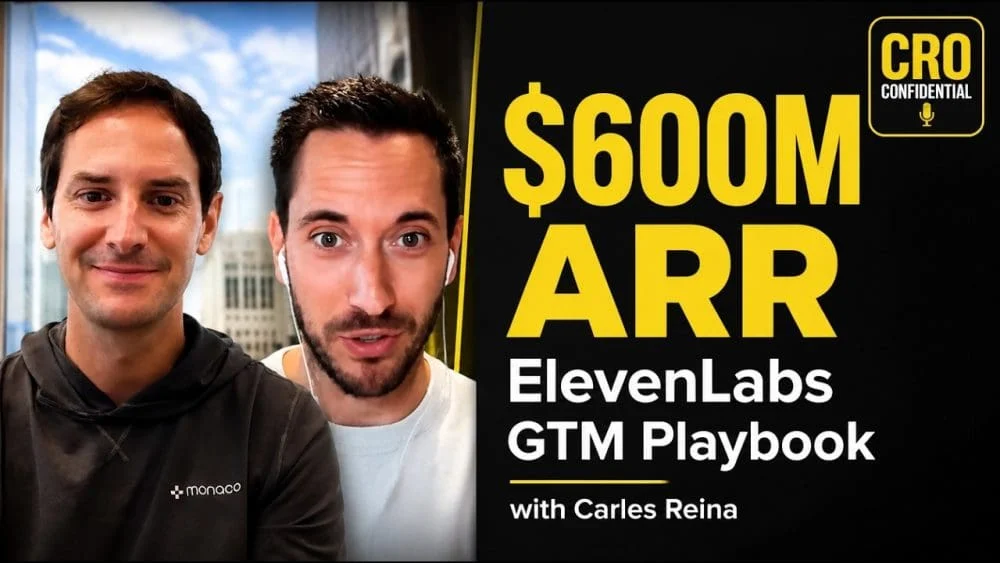
Carles Reina, employee number four at the voice-generation unicorn and its inaugural go-to-market hire, recently sat down on SaaStrAI’s CRO Confidential podcast alongside host Sam Blond—founder and CEO of Monaco and former CRO at Brex and Zenefits. Reina, who spent his first nine months executing enterprise sales solo before building out ElevenLabs’ entire commercial organization, pulled back the curtain on a meteoric rise that saw the company scale from zero to over $600 million in ARR in just 41 months.
Now operating full-time as a solo General Partner at Baobab Ventures, Reina’s retrospective insights offer a masterclass in modern B2B revenue architecture, AI-driven automation, and the operational friction points of ultra-rapid scaling.
The Chronology of an AI Phenomenon: From Solo Hustle to Global Scale
To understand the scale of ElevenLabs’ achievement, one must examine the timeline. Built over a compressed 41-month window, the company’s trajectory defies historical B2B benchmarks.
- Phase 1: The Solo Foundation (Months 1–9): Carles Reina served as the sole commercial engine, testing product-market fit, signing early developer accounts, and mapping out enterprise use cases by hand.
- Phase 2: The Competitive Disruption (The Grants Play): Faced with early-stage rivals possessing equivalent funding and developer focus, Reina engineered a high-stakes customer acquisition gamble: a three-month free tier for any startup under 25 employees.
- Phase 3: Global Expansion and Structural Codification: ElevenLabs rapidly established multi-regional beachheads across the United States, Europe, Japan, India, Korea, Brazil, Mexico, Colombia, and the Middle East—each armed with a strict localized thesis and dynamic channel strategy.
- Phase 4: Agentic Integration and Commercial Maturity: Rather than resisting automation, the company integrated AI sales and customer success agents into the workforce, aligning human incentives to ensure smooth adoption and driving average commercial team attainment to an astonishing 167% per quarter.
Supporting Data and Financial Metrics
The numbers underpinning ElevenLabs’ growth trajectory illustrate a compounding engine where the rate of expansion accelerated as the absolute numbers grew larger.
- Overall ARR Growth: Scaled from $0 to over $600 million in 41 months.
- Enterprise Attribution: More than 10% of total enterprise revenue originated directly from the early-stage startup grants program cohort.
- Quota Structure: Base quota set at an aggressive 20x base salary (e.g., a $100K base demanding $2M in new ARR), balanced with uncapped commissions and rigorous quota relief during macroeconomic or localized market shifts.
- Team Performance: Average quota attainment across the global go-to-market team reached 167% per quarter, with top-performing account executives regularly running at 300% to 600% of plan.
- Valuation Multiple Logic: Recurring revenue contracts governed all commission payouts; zero commission was awarded on Proofs of Concept (POCs), adhering to an equity-value logic where $1M in ARR roughly correlates to $33M in enterprise value.
Core Strategies: The Eight Takeaways from $1M to $600M+
Reina’s breakdown of the journey offers actionable lessons for founders and revenue leaders navigating the new normal of B2B AI.
1. When the AI Agent Closes It, Still Pay the Human
Two and a half years ago, during a team offsite in Switzerland, Reina pitched the founders on building an autonomous GTM organization: an AI SDR, an AI Account Executive, and an AI Customer Success Manager. The initial response was a flat rejection—the technology wasn’t ready, and the mandate was simply to hire more humans.
Reina persisted, eventually securing a single developer to build out go-to-market AI tooling. The internal pushback from human reps was immediate: Am I being replaced?
Two realities resolved the tension:
- Performance: An AI SDR answering inbound queries and calling back immediately converted at a higher rate than a human responding within 30 minutes. Furthermore, no sales rep genuinely enjoys guarding an inbox. Meanwhile, an AI CSM handling SMB and mid-market longtail upsells unlocked revenue streams the team previously lacked the bandwidth to pursue.
- The Comp Decision: ElevenLabs committed to paying human reps their standard commission even when an AI agent closed or unlocked revenue on an account they owned. Reina stresses that companies attempting to deploy internal AI agents without protecting human commissions will fail. Reps will quietly sabotage or work against systems they perceive as threats. Paying twice—once for the agent, once for the human—is the necessary price of friction removal.
2. The Startup Grants Program: A Defensive Masterstroke
During his holiday with his wife—governed by the personal rule of figuring out how to neutralize current competitors—Reina conceived the ElevenLabs Grants Program.
Offering three months of free usage to any startup with under 25 employees, the company generated massive public noise and distributed tens of thousands of grants. Competitors of similar size and funding levels, who relied entirely on developer and startup adoption to survive, suddenly found their primary acquisition channel blocked. They could not afford to match the play.
The cost was three months of infrastructure usage per account; the return was that over 10% of subsequent enterprise revenue traced its lineage directly back to this startup cohort as they graduated and expanded.
3. Rigorous Market Launch Theses
Global expansion cannot be an open-ended experiment. ElevenLabs required every regional market launch—spanning the US, Europe, Japan, India, Korea, Brazil, Mexico, Colombia, and the Middle East—to answer three mandatory questions in writing before launch: Why this market? What is the channel mix? What is the expected result in 3 to 6 months?
Channel strategies varied organically by local tax and structural constraints. Core markets favored direct sales, while others shifted to a reseller-first model driven by local withholding taxes and invoicing complexities. Writing down the expected result provided an objective scoreboard, eliminating ambiguous 18-month debates over whether an international office was working.
4. Aggressive Quotas Paired with Protective Flexibility
Breaking away from the traditional B2B benchmark of 5x base salary, ElevenLabs instituted a 20x base quota (e.g., $100K base yielding $2M in new ARR).
While early reps balked, Reina made a binding promise: if market fundamentals shifted or targets proved unrealistic within 3 to 6 months, management would intervene to lower quotas and adjust commissions. True to his word, the company granted up to 50% quota relief in markets where fundamentals changed. This philosophy championed a lean, exceptionally well-compensated team over a bloated, demotivated sales floor missing targets.
5. Zero Commission on POCs
ElevenLabs maintained a strict policy: zero commission on Proofs of Concept (POCs), regardless of deal size or whether a trial lasted two months or three. Commissions were triggered strictly by recurring revenue contracts.
Reina’s argument was rooted in investor valuation logic. Approximately $1M in ARR commands a $33M enterprise value valuation multiple; a POC does not factor into the ARR figures shown to investors because the customer has extracted value while the business valuation has remained stationary.
6. The Regrets: Enabling and Senior Talent Too Late
Reflecting on what kept them from crossing the $1B threshold even faster, Reina pointed to two operational missteps:
- GTM Operations and Sales Enablement: Hired far too late in the growth cycle, forcing the company to retrofit onboarding onto reps who had already developed fragmented, self-taught habits. Sam Blond echoed this sentiment from his Zenefits tenure, noting that sales leaders—who naturally skew toward execution—consistently underinvest in ops early on.
- Senior Enterprise Talent: The knee-jerk startup instinct is to hire young, hungry, inexpensive reps. Reina noted that senior enterprise reps with decades of industry relationships bypass the friction of starting from scratch on procurement cycles, and should have been integrated earlier.
7. Understanding the Boundaries of AI Agents
Drawing from practical experience running AI agents at scale, Reina mapped out their current capabilities:
- Where they fail: Relationship-driven sales. Large Language Models operate within statistical distributions. True, differentiating enterprise sales require operating outside the median response.
- Where they excel: Processing massive datasets, researching accounts, building Total Addressable Markets (TAMs), scoring leads against strict criteria, updating CRMs, and operating 24/7.
8. The 100 Experiments Portfolio Mindset
Reina’s guiding operational philosophy for his commercial teams was simple: “You need to test 100 things, but I only need one of those 100 things to actually work to give me another hundred million in ARR.” Operating without an experimental portfolio forces perfection across every standard process—an impossibility in shifting enterprise markets.
Implications for the Future of Enterprise Software
The trajectory of ElevenLabs, as detailed by Reina and contextualized by Blond, signals a permanent shift in B2B SaaS architecture. The "New Normal" for AI-native enterprises is characterized by compressed timelines, aggressive quota models tethered to absolute fairness, and the integration of autonomous agents into human sales workflows.
For industry observers and emerging founders, the primary takeaways are clear: write precise market theses before expanding, design defensive acquisition moats that competitors cannot replicate, protect human incentives during agentic automation, and invest in sales enablement and operations before scale demands it. As the boundaries between software and artificial intelligence continue to blur, the commercial playbooks forged at companies like ElevenLabs will serve as the blueprint for the next generation of global market leaders.