Founders often view venture capitalists through a lens of envy, frequently labeling them "lucky" for their inherent diversification. The logic seems sound: while a founder is shackled to a single mission, a VC firm maintains a portfolio of dozens of companies. They get multiple at-bats, spreading their risk across an ecosystem, needing only a fraction of those bets to hit the jackpot to secure a successful fund.
While the premise of diversification is technically accurate, the conclusion—that it equates to an "easy mode" of investing—is a dangerous misconception. In reality, the mathematics of modern venture capital creates an unforgiving treadmill. Far from a cushion against failure, diversification in the VC world acts as a massive, insatiable engine that demands a constant, escalating cadence of monumental wins just to justify its own existence.
The Brutal Math: Why a Billion-Dollar Exit Isn’t Enough
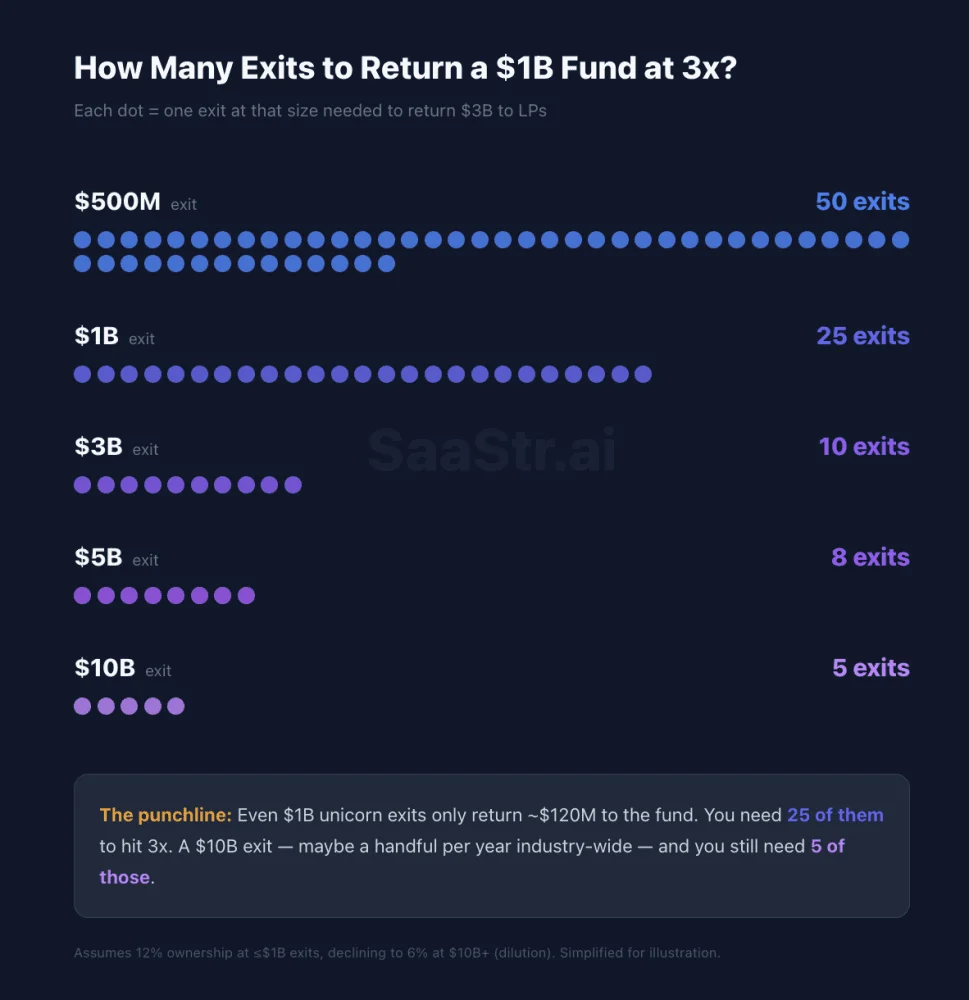
To understand why the "diversification is easy" narrative falls apart, one must look at the cold, hard arithmetic of fund structures. In the current landscape, a billion-dollar exit is often celebrated as a career-defining moment for a startup founder. However, for a mid-to-large-scale VC fund, a $1 billion exit is frequently insufficient to return even 1x of the total fund, let alone the 3x-4x multiples that Limited Partners (LPs) demand.
Consider the math: If a firm holds a 12% stake in a company that exits for $1 billion, the fund realizes $120 million. If that firm is managing a $300 million fund, that $120 million return doesn’t even cover the original capital deployed, much less generate the carry (profit) that partners rely on for their livelihood.
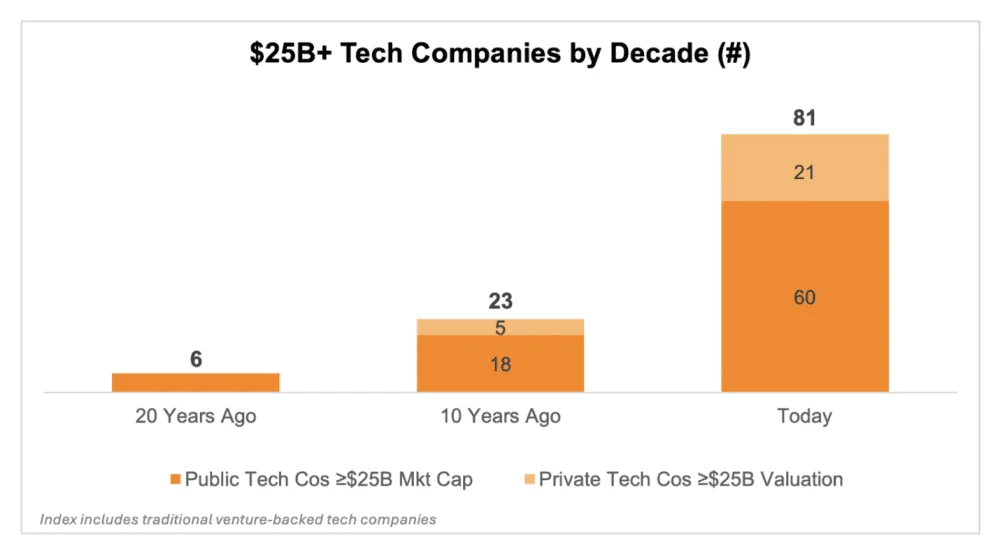
When we shift the scale to $10 billion outcomes—truly generational events that occur only a handful of times globally each year—the pressure remains immense. Even at this massive scale, a large-cap fund may find itself struggling to move the needle on its overall performance metrics. For the uninitiated, it is a jarring revelation: a $10 billion outcome can occur, and the partners of a major fund may still technically be "underwater" on their performance carry.
A Chronology of the DPI Crisis (2017–2025)
The last eight years have served as a stress test for the venture capital model, revealing deep-seated structural vulnerabilities.
- 2017–2018 (The Growth Era): Funds raised during this period were characterized by high valuations and aggressive deployment, predicated on a belief in endless growth.
- 2019–2021 (The Peak): Capital flooded into the market. Managers raised record-breaking funds, assuming the bull market would continue indefinitely.
- 2022–2023 (The Correction): The macroeconomic environment shifted. Interest rates rose, the IPO window slammed shut, and the "exit" mechanism—the heartbeat of the VC flywheel—stalled.
- 2024–2025 (The Reckoning): The industry faced a "DPI (Distributed to Paid-In Capital) Crisis." LPs stopped caring about "paper gains" (TVPI) and began demanding cold, hard cash.
The data from 2025 painted a sobering picture of this timeline. According to Carta’s Q3 2025 report, which analyzed 2,835 funds representing $118 billion in commitments, the median 2017-vintage fund sits at just 1.76x TVPI. This is a stark contrast to the 3x benchmark that LPs traditionally define as excellence. Only the top 10% of those funds reached that threshold. Newer vintages, particularly those from 2019 onward, are struggling to even hit 2x, creating a systemic bottleneck.
Supporting Data: The Flow of Capital Reversed
The most alarming indicator of the industry’s current state is the cessation of cash flow. A majority of funds raised since 2018 have returned exactly $0 in cash to their LPs. As of Q3 2025, only 42% of 2020-vintage funds have generated any distributions at all. For 2021 funds, that figure drops to a meager 25%.
The liquidity gap has widened significantly: since 2022, VC managers have called 1.6x more capital from their LPs than they have distributed back. This is a direct inversion of the prior decade, where the industry maintained a healthy 1.3x distribution-to-call ratio. When the flow reverses, the flywheel seizes. LPs become unable to reinvest, funds cannot raise new vehicles, and the machine effectively grinds to a halt.
Official Industry Responses: The "Movie Studio" Analogy
Industry analysts and veteran GPs have increasingly adopted the "Movie Studio" analogy to explain this phenomenon. Like a major studio, a VC firm can absorb the occasional "flop"—a startup that goes to zero. Diversification provides that defensive layer.
However, the analogy also highlights the offensive burden: just as a studio needs two or three massive blockbusters every year to cover the costs of production, distribution, and overhead, a VC firm requires a continuous pipeline of "hits."
In response to these pressures, the largest firms have engaged in an arms race of scale. In December 2025, Lightspeed closed over $9 billion across six funds—the largest raise in its history. Thrive Capital secured $10 billion for "Thrive X," nearly doubling its previous fund size. The ten largest venture firms captured 43% of all fundraising dollars in 2025. This consolidation represents an official industry response to the crisis: if you cannot be a "pretty good" picker, you must be a "relentlessly, repeatably great" one. The LPs are consolidating capital into these giants, betting that only the massive players can withstand the volatility of the current exit market.
Implications for Founders and the Future of Venture
This mathematical reality dictates the behavior of VCs, often in ways that create friction with founders.
1. The Resistance to "Small" Exits
When a VC pushes back on a $400 million acquisition offer, it is rarely due to ego or simple greed. It is a calculated assessment of the fund’s math. If that $400 million outcome doesn’t move the needle for the fund’s overall DPI, the GP is effectively incentivized to push the founder to "swing for the fences," even at the risk of total failure. To the founder, $400 million is generational wealth; to the fund, it is a rounding error that doesn’t solve the "treadmill" problem.
2. The Desperation for AI
The massive concentration of capital into Artificial Intelligence—$211 billion of the $425 billion in total global venture funding in 2025—is not just tech-optimism. It is a survival strategy. VCs are pouring capital into AI because they are desperate for the kind of category-defining, multi-billion-dollar outcomes that can reset their fund performance. With AI companies accounting for over a third of the $549 billion in total exit value in 2025, the sector has become the industry’s only reliable engine for the liquidity required to keep the lights on.
3. The End of "Easy" Diversification
The era of believing that diversification is a "set it and forget it" strategy is over. The data from 2025 makes it clear: for larger funds, diversification is not a safety net—it is a treadmill that scales with the size of the fund. Every dollar raised increases the amount of exit value required to reach the 3x return mark.
For founders, the implication is profound. The venture capital ecosystem is moving toward a binary outcome model: you are either a hyper-growth, massive-exit-potential company, or you are increasingly irrelevant to the large-cap funds that dominate the industry. The "machine" does not want moderate, sustainable success; it demands a constant stream of massive, liquidity-generating events.
In conclusion, the VC model is not the "lucky" position many imagine. It is a high-stakes, compounding pressure cooker. While they do get multiple at-bats, those at-bats are performed under the constant, heavy scrutiny of LPs who are no longer interested in paper wealth. As the industry moves into 2026, the firms that survive will be those that realize diversification is not an excuse to relax, but a mandate to produce hits with the precision and reliability of a well-oiled machine.