SAN FRANCISCO — For three decades, the prevailing Silicon Valley playbook for scaling a B2B enterprise software titan was remarkably consistent. A technical founder would build the initial product, reach their limits, and hand the reins over to a seasoned corporate operator—the classic "sales-machine" CEO. This executive would install a relentless go-to-market engine, pump capital into worldwide sales organizations, and ride a predictable wave of quotas, pipelines, and enterprise licenses to an Initial Public Offering (IPO) and a multi-billion-dollar valuation.
This archetype is best embodied by Frank Slootman, the legendary leader who took three separate enterprise software companies—Data Domain, ServiceNow, and Snowflake—public, generating a combined peak market capitalization exceeding $200 billion.
Yet, as the technology landscape undergoes a generational shift catalyzed by artificial intelligence, that twenty-year-old archetype is rapidly fading into obsolescence. Today, a new paradigm has emerged. The fastest-growing B2B and AI-native companies in the world—including Databricks, Replit, Harvey, Fireworks AI, Sierra, Decagon, Abridge, and OpenEvidence—are bucking traditional wisdom. They are led not by career enterprise salespeople or hired-gun operators, but by technical founders, computer scientists, researchers, and domain experts who view product development, model evaluation, and commercial strategy through an engineering lens.
Chronology of an Archetype: The Rise and Evolution of the Enterprise Operator
To understand the magnitude of the current shift, it is necessary to examine how the traditional corporate scaling model was built and where its mythology diverges from reality.
- 1993–2003 (The Operator’s Ascent): During his formative years in the tech industry, Frank Slootman built a reputation as the ultimate commercial scaling agent. However, a close look at his resume reveals a surprising detail: Slootman never actually "carried a bag" as a field sales representative. He worked as a product manager at Compuware, managed UNIFACE in Amsterdam, directed the EcoSystems division in Campbell, and served as Senior Vice President of Products at Borland—running engineering and product management just one year before securing his first CEO seat at Data Domain. The "sales" reputation was forged through the aggressive operational environments he created, not his personal origins in outbound sales.
- The Benioff Standard: Marc Benioff, founder of Salesforce, fit the classic mould more closely. Spending 13 years at Oracle—where he was named Rookie of the Year at 23 and became the youngest Vice President in company history—Benioff balanced heavy sales execution with profound technical fluency, having programmed Atari games at age 15 and written assembly code for Apple’s Macintosh division during college.
- The 2010s Shift: For over twenty years, boards reflexively ousted visionary technical founders as soon as companies crossed the $50M to $100M revenue threshold, bringing in veteran P&L managers to install repeatable sales machines. This script yielded giants like ServiceNow and Snowflake, but it also siphoned strategic vision away from the product core.
- 2016 (The Databricks Divergence): In January 2016, Databricks faced a severe existential crisis. Having raised roughly $174 million at a $1 billion valuation with virtually no meaningful revenue, the company was being squeezed as cloud giants like Amazon Web Services (AWS) and Cloudera absorbed Apache Spark into their own ecosystems. Founding CEO Ion Stoica stepped aside to return to his Berkeley professorship. While conventional Silicon Valley wisdom dictated bringing in a seasoned enterprise operator (the path Snowflake successfully walked), Databricks’ co-founders gambled on Ali Ghodsi—then Vice President of Engineering and a career academic who had never run a commercial business.
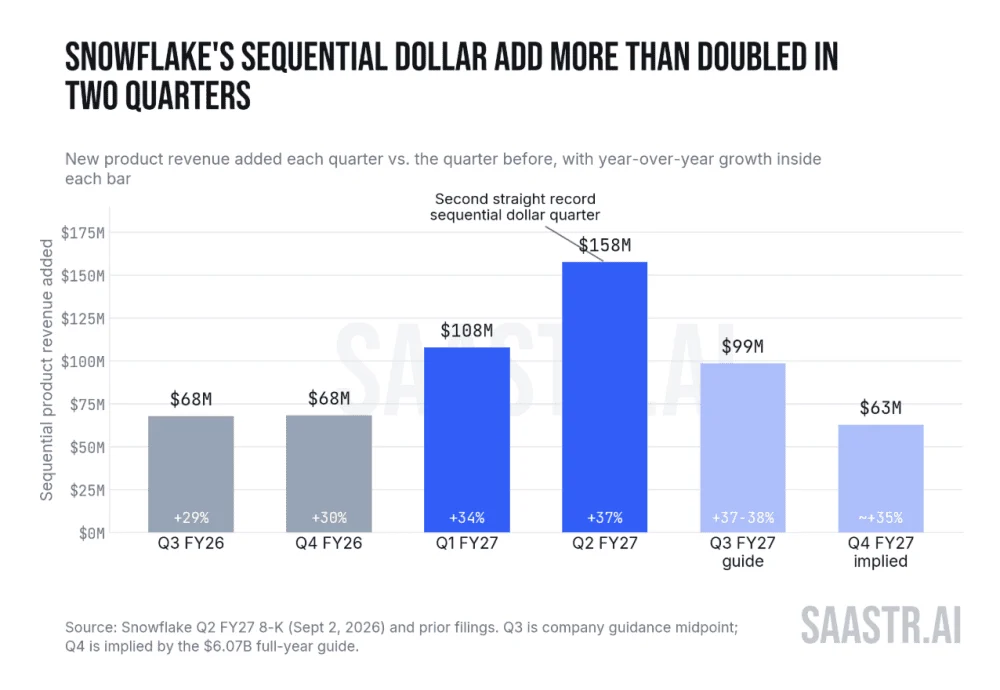
- 2024–Present (The AI Inversion): Snowflake shocked the markets on February 28, 2024, by announcing that Slootman was retiring and handing the CEO role to Sridhar Ramaswamy, a computer scientist who previously scaled Google’s advertising business from $1.6 billion to over $100 billion. Despite an initial 20% stock drop driven by investor anxiety over the loss of a "sales-guy," Ramaswamy treated the go-to-market structure as an engineering problem. Under his leadership, Snowflake achieved some of the strongest sequential growth in its history, proving that technical leaders could successfully command complex commercial ecosystems.
Supporting Data: The Metrics Reshaping the C-Suite
Recent empirical research underscores a massive systemic shift in who gets to lead high-growth software and AI startups. Data compiled by Leonis Capital, which indexed more than 10,000 AI startups between 2022 and 2025, reveals staggering disparities when compared to previous generations of technology giants.
1. The Technical Dominance Index
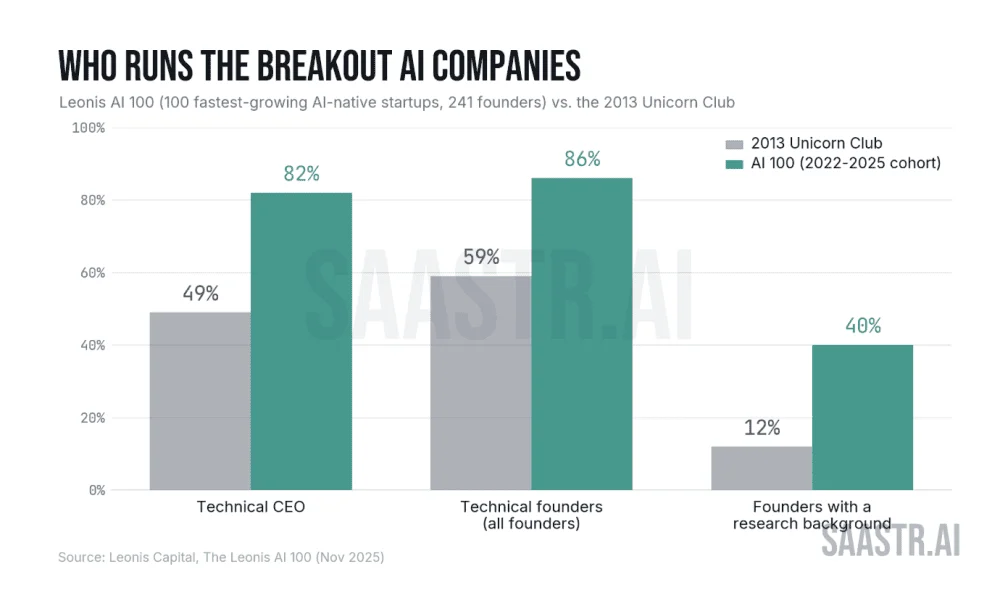
- 82 of 100: Among the 100 fastest-growing AI-native companies today, 82 are led by technical CEOs.
- 86%: Across those same 100 companies, 208 out of 241 founders possess deep technical backgrounds.
- The Comparison Set: In Aileen Lee’s original "Unicorn Club" index from a decade prior, only 49% of companies featured a technical CEO, and just 59% of founders were technical.
- Research Pedigree: Forty percent (40%) of AI 100 founders emerge directly from elite research backgrounds (such as Berkeley PhDs, OpenAI and DeepMind alumni, and Olympiad medalists), compared to a mere 12% in the historic Unicorn Club. Furthermore, 58% of these modern companies boast at least one co-founder rooted directly in academic or corporate research.
2. Velocity and Adaptation Metrics
- Age at Founding: The median age of founders in the current AI cohort is 29, compared to 34 in the previous cycle. The single most common founding age sits at 26 or 27, meaning these leaders transition straight from labs to boardrooms without spending a decade climbing traditional corporate ladders.
- Pivot Speed: Two-thirds of the AI 100 cohort have executed at least one major strategic pivot, compared to 54% in the Unicorn Club. Crucially, companies led by technical CEOs execute these pivots in a median timeframe of 12 months, whereas companies with non-technical leadership take a sluggish 27 months—a fatal delay in markets where foundational model capabilities evolve every few quarters.
Official Responses and Industry Perspectives
The friction between traditional sales-driven operations and product-first technical leadership has drawn commentary from some of the most influential venture capitalists and enterprise leaders in the global technology ecosystem.
Ben Horowitz, co-founder of Andreessen Horowitz and an early board member at Databricks, initially balked at the appointment of Ali Ghodsi in 2016, questioning the logic of replacing one founder-professor with another. The board ultimately agreed to a one-year trial. Years later, Horowitz has openly declared Ghodsi to be the single best CEO across the entirety of Andreessen Horowitz’s vast portfolio, which spans hundreds of category-defining companies.
By August 2026, Databricks announced a staggering $5 billion funding round at a $190 billion valuation, expanding at over 80% year-over-year with more than 1,000 customers spending in excess of $1 million annually.
Conversely, defenders of the commercial executive playbook point to enterprises like ServiceNow. In July 2026, ServiceNow—led by seasoned sales executive Bill McDermott, whose career spans leadership roles at Xerox, Siebel, and SAP—reported an extraordinary quarter. Subscription revenues hit $3.877 billion (up 24.5% year-over-year), remaining performance obligations (RPO) climbed 21% to $29 billion, and AI annual contract values crossed the $1 billion threshold.
McDermott dismissed market anxieties with characteristic commercial bravado, telling Fortune: "We are who we said we were."
Even Frank Slootman himself has tacitly acknowledged the shifting winds. Rather than opposing the technical wave, Slootman has taken on the role of an angel investor in Fireworks AI—a company founded by the former head of PyTorch at Meta. As industry observers note, the legendary operator is no longer fighting the engineering-first shift; he is capitalizing on it.
Implications for Founders, Boards, and Enterprise Leaders
The structural transformation from sales-led operators to technical and domain-expert CEOs forces a wholesale re-evaluation of three critical pillars within the modern technology ecosystem:
1. For Founders: The Cost of Isolation from the Core Technology
The 15-month gap in pivot speed between technical and non-technical CEOs highlights a fundamental operational reality. In an era where foundation models and machine learning architectures dictate product viability, a CEO who cannot evaluate a model release firsthand is functionally blind. Relying on commissioned studies or delayed reports leaves leadership woefully behind the curve. Founders must either retain deep technical proximity to the product roadmap or empower technical co-founders with total strategic authority.
2. For Boards: Rewriting the CEO Transition Playbook
The empirical successes of Databricks and Snowflake prove that modern boards do not necessarily need to import an outside sales operator to achieve hyper-growth. Promoted leaders who understand the core technology deeply—such as Ali Ghodsi and Sridhar Ramaswamy—have demonstrated that technical fluency does not excuse an executive from commercial accountability. Both leaders mastered revenue execution by treating go-to-market strategies as complex engineering problems, seamlessly integrating sales enablement with product architecture.
3. For Sales Leaders: Redefining the Path to the Corner Office
The traditional career path of carrying a quota and ascending directly to the CEO chair has narrowed significantly. While world-class go-to-market organizations remain vital—evidenced by the massive scaling of sales teams at companies like Anthropic and OpenAI—the executive running the sales apparatus typically reports to a technical CEO who understands underlying model dynamics. Aspiring chief executives should take note of the genuine paths walked by leaders like Slootman and Benioff: spending formative years owning product lines, managing engineering functions, and mastering the creation of the underlying technology before scaling its distribution.