Main Facts
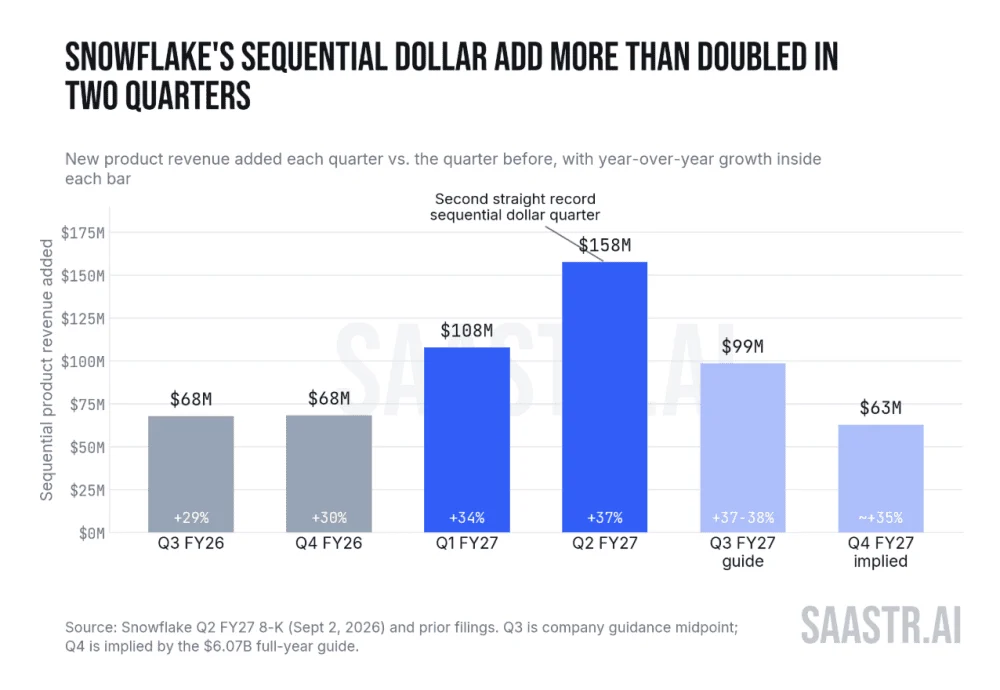
Snowflake released its fiscal Q2 2027 financial results on September 2, delivering a performance that significantly outperformed expectations. Operating at an enterprise scale near a $6 billion annual product revenue run rate, Snowflake achieved a rare feat: clear, measurable revenue reacceleration. Product revenue growth across fiscal 2026 hovered steadily at 26%, 32%, 29%, and 30%, before climbing to 34% in the previous quarter, and reaching 37% in Q2 2027.
The quarter was defined by five core dynamics:
- Accelerating Dollar Additions: Snowflake experienced its largest sequential net new product revenue increase in company history for the second consecutive quarter.
- The AI Engine: Roughly half of the acceleration was driven directly by native AI products (CoCo, CoWork, AI functions, and the Cortex AI Gateway), with the remaining half generated by these tools pulling core platform consumption alongside them.
- Strategic Margin Trade-off: Management willingly absorbed a minor drop in gross margins due to AI inference costs, offsetting it with disciplined headcount management to raise operating margin guidance.
- RPO Dynamics: Total Remaining Performance Obligations (RPO) grew 30% to $9.00 billion, while Current RPO surged 42%, reflecting consumption models burning through capacity faster than initially booked.
- NRR and Enterprise Concentration: Net Revenue Retention (NRR) ticked upward to 126%, driven heavily by existing Global 2000 accounts expanding usage rather than relying on massive waves of new logo acquisitions.
Chronology and Context: The Path to Reacceleration
For the past two years, public market sentiment surrounding Snowflake was dominated by a singular narrative: that the structural rise of artificial intelligence—specifically large language models and alternative data architectures—would disrupt or bypass traditional data warehousing. This skepticism weighed heavily on the company’s valuation, driving the stock as low as $118 over the prior twelve months.
However, management systematically dismantled that narrative throughout fiscal 2026 and into fiscal 2027. Rather than treating AI as an external threat, Snowflake embedded AI infrastructure directly into its existing consumption architecture.
When CEO Sridhar Ramaswamy and CFO Brian Robins took to the earnings call on September 2, they outlined how this strategy materialized over the preceding months. The progression from 30% to 34% and finally 37% product revenue growth did not happen by accident; it was the cumulative result of rolling out tools like the Cortex AI Gateway and coding assistants (CoCo and CoWork) directly onto the customers’ existing data governance and storage layers. By avoiding separate SKUs or isolated sales motions, Snowflake eliminated friction, allowing enterprise adoption to scale rapidly.
Supporting Data: Deep Dive Into the Numbers
The underlying metrics from the fiscal Q2 2027 report provide a granular look at how Snowflake achieved its historic performance at scale.
1. Revenue Growth and Sequential Adds
At a $6 billion run rate, percentage growth can easily be distorted by easy year-over-year comparisons. However, Snowflake’s absolute dollar additions silence that concern. The company generated a record sequential dollar add for the second consecutive quarter.
- Full-Year Guide Caveats: Approximately one point of the full-year growth guidance stems from the Observe acquisition, placing organic growth closer to 35%.
- Conservative Forward Guidance: Implied Q3 product revenue is projected between $1.588 billion and $1.593 billion (a sequential add of roughly $99 million), with Q4 adding roughly $63 million (bringing Q4 growth back near 35%). Because Snowflake has consistently beaten and raised its guidance throughout the year, analysts view these projections as conservative.
2. The AI Adoption Curve
Management reported that approximately 60% of the account base is actively touching Snowflake’s coding agent (measured across capacity and on-demand accounts over the final four weeks of the quarter). Notably, one of the top ten most-utilized skills within the CoCo coding assistant is cost management—a tool designed to help customers spend less on Snowflake. Rather than cannibalizing revenue, building trust through efficiency optimization led customers to expand their overall project pipelines, driving a 7-point acceleration in consumption growth.
3. Margin Mechanics: Gross vs. Operating
Non-GAAP product gross margin dropped to 74.7%, down from 76.4% in the prior-year period, with full-year guidance adjusted down to 74.0%. CFO Brian Robins attributed this directly to the higher revenue mix of fast-growing AI workloads, which carry heavier inference and computation costs. This trend mirrors broader industry adjustments seen at companies like Figma and Canva.

Despite the gross margin compression, Snowflake expanded its profitability:
- Operating Margins: Non-GAAP operating margin reached 15.3%, an expansion of more than 400 basis points year-over-year. Full-year operating margin guidance was upgraded from 13.5% to 14.5%.
- Expense Discipline: While revenue grew 35%, total operating expenses grew by just 17% across a workforce of approximately 9,250 employees. In short, Snowflake traded two points of gross margin for four points of operating margin and seven points of growth.
4. RPO and Deferred Revenue
- Total RPO: Stood at $9.00 billion (up 30% year-over-year), down from $9.77 billion at the close of fiscal 2026.
- Current RPO: Approximately 54% of total RPO is expected to be recognized over the next twelve months, representing a 42% year-over-year surge in current RPO.
- Net Revenue Retention (NRR): Rose to 126% (up from 125% at fiscal year-end).
- Customer Concentration: The count of customers generating over $1 million in product revenue grew by 49 net new accounts. Because Snowflake’s 733 enterprise accounts (those over $1 million) already represent roughly 68% of total product revenue, the vast majority of growth is driven by heavy expansion within existing Global 2000 accounts rather than raw customer acquisition volume.
Official Responses and Executive Commentary
During the earnings call, CEO Sridhar Ramaswamy emphasized that the acceleration was broad-based rather than reliant on a speculative bubble of AI-native startups.
"Roughly half of the acceleration came directly from our AI products, while the other half came from those same products pulling core platform consumption right along with them," Ramaswamy explained.
He highlighted the strategic choice of keeping AI capabilities on the same consumption meter as core data warehousing:
"Every AI query runs on data already stored and governed securely inside Snowflake. That is why the financial impact shows up seamlessly in our primary revenue line rather than fragmenting into a separate product silo."
CFO Brian Robins addressed the intentional sacrifice in gross margins head-on:
"We knew entering this fiscal year that scaling AI workloads would introduce near-term friction to our gross margins due to inference costs. However, our ability to keep operating expense growth tightly controlled at 17% while revenue scales by 35% allows us to deliver superior operating leverage to our shareholders."
Implications for the Broader Software and Cloud Industry
Snowflake’s Q2 2027 report carries profound implications for the enterprise software sector, data infrastructure markets, and the broader SaaS ecosystem:
- The End of the AI Cannibalization Myth: For years, software bears argued that AI tools would either diminish enterprise data storage needs or eat software margins without generating reciprocal revenue. Snowflake has proven that AI acts as a high-octane accelerant for core database consumption. When AI agents query structured and unstructured data at scale, they require massive underlying data pipelines—directly benefiting platform providers like Snowflake.
- The Economics of Inference: Snowflake’s willingness to absorb lower gross margins to capture dominant market share sets a standard for infrastructure providers. Companies that own the data layer and govern the enterprise workflow can successfully subsidize inference costs by tightly managing internal headcount and operating expenditures.
- Valuation and Market Realities: Comparing Snowflake’s public valuation to private competitors highlights shifting market dynamics. While private data competitors like Databricks report staggering growth figures (such as $7 billion in ARR growing over 80% at a $190 billion private valuation, roughly 27x forward multiples), Snowflake trades at approximately 21x forward metrics while securing a highly resilient 36% growth rate at a $6 billion public scale. The market continues to reward predictable, highly profitable public execution with robust capital allocation strategies.
Ultimately, Snowflake has successfully transitioned from a defensive posture against AI disruption to an aggressive offensive posture, proving that enterprise data platforms are uniquely positioned to capture the economic value of the artificial intelligence revolution.