Introduction: A Moment of Unprecedented Convergence
In a display of political theater and corporate influence rarely seen on the tech conference circuit, Nvidia CEO Jensen Huang found himself at the center of a geopolitical firestorm on Monday. During his keynote address at the All-In Conference in Los Angeles, Huang was interrupted by a live phone call from former President Donald Trump.
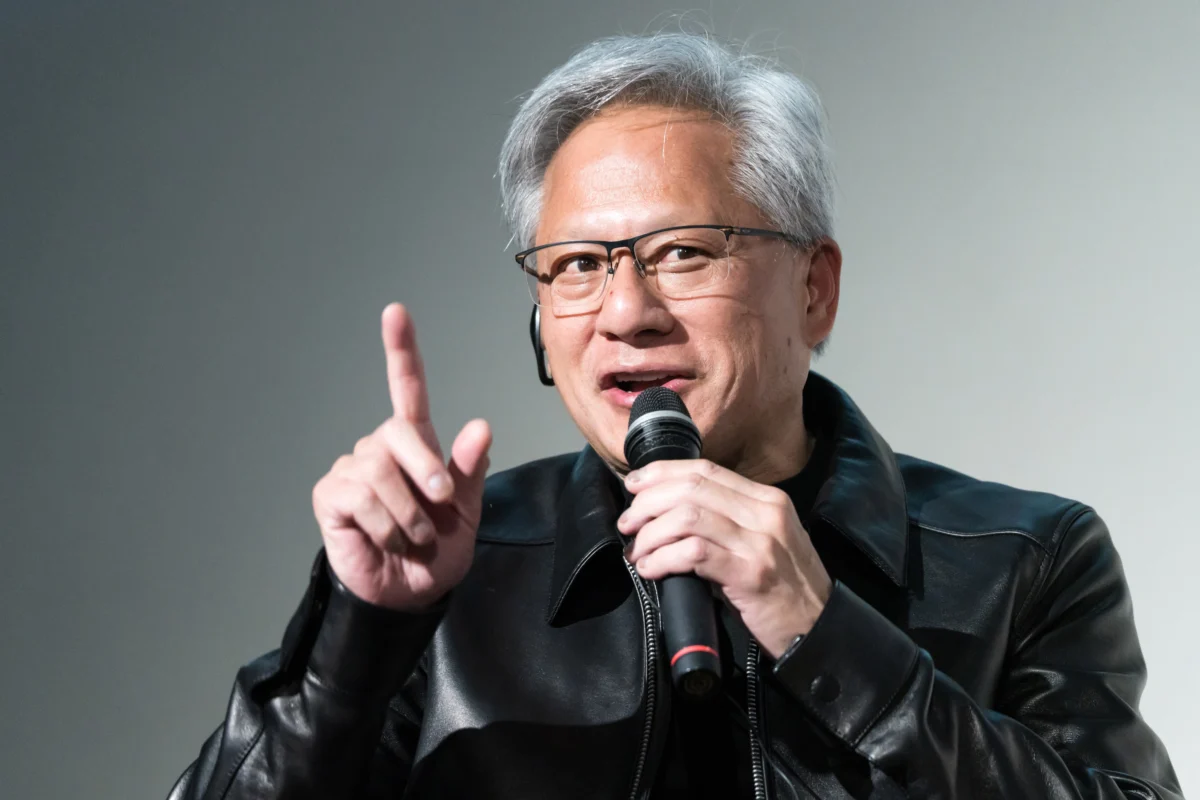
The moment, which has since ricocheted across global financial markets and policy circles, served as a symbolic intersection between the world’s most powerful semiconductor executive and the American political establishment. Dressed in his trademark alligator-skin leather jacket—a sartorial signature that has become synonymous with the current boom in artificial intelligence hardware—Huang was handed a foldable mobile device to facilitate the call. While an initial report erroneously identified the device as an Apple iPhone Duo, subsequent corrections clarify that Huang was utilizing a different foldable model, a detail that shifts the focus back to the weightier matter at hand: the accelerating race for artificial intelligence supremacy.
The Chronology of the Call
The event, which took place on September 14, 2026, began as a standard industry keynote. Huang was discussing the aggressive scaling of Nvidia’s Blackwell and Rubin architecture chips when the interruption occurred.
- The Interruption (6:50 PM PDT): As Huang stood on stage, the conference proceedings were paused to accommodate the incoming call. The audience, largely comprised of venture capitalists and tech industry leaders, watched as the Nvidia CEO engaged in a high-profile dialogue with the former President.
- The AI Safety Debate: The conversation centered on the intensifying global discourse surrounding AI safety. Trump dismissed the mounting concerns regarding "existential risks" associated with advanced AI, labeling the movement a "hoax."
- The Geopolitical Frame: Trump positioned the development of AI as a zero-sum game, arguing that current efforts to regulate or slow down AI progress in the United States would ultimately benefit China and "political people" who seek to impede American innovation.
- The Public Reaction: Huang facilitated the conversation for the live audience, noting, "Did you hear that? Thousands of people are clapping," effectively acting as a bridge between the former President’s populist rhetoric and the industry’s desire for deregulation.
Supporting Data: The Economic Engine of AI
To understand why this conversation carries such gravity, one must look at the fiscal reality of the current AI cycle. Nvidia, under Huang’s stewardship, has become the most critical infrastructure provider for the digital age.
The Market Context
Despite the volatility triggered by the conference—where Nvidia’s stock experienced a modest dip—the company remains a titan of the modern economy. Nvidia has seen a 33% increase in its valuation over the past twelve months. This growth is directly tied to the massive capital expenditures (CapEx) of hyperscalers like Microsoft, Google, Meta, and Amazon, all of whom are purchasing Nvidia’s GPUs at an unprecedented rate.
The Scale of the Technology
During the call, Trump remarked that the technology is "bigger than the internet." While hyperbolic, the sentiment aligns with data from the semiconductor sector. We are currently witnessing a shift in global power dynamics where the ability to train large language models (LLMs) is becoming the primary metric of national strength. If the "AI slowdown" movement were to gain traction—whether through executive orders or international treaties—it would represent an immediate threat to the revenue models of the entire tech sector.
Official Responses and Industry Sentiment
The public response to the Trump-Huang dialogue has been polarized, reflecting the deeper divide in the tech industry regarding the future of artificial intelligence.
The Investor Perspective
Investors have largely interpreted the exchange as a "deregulation signal." By aligning with the former President’s dismissal of AI fears, Huang signaled to his shareholders that Nvidia is prioritizing speed and market expansion over the cautionary approach advocated by some AI researchers and safety organizations.

The Regulatory Landscape
Critics of the conversation argue that such a public endorsement of a "no-slowdown" policy ignores the genuine risks associated with autonomous systems, including cybersecurity vulnerabilities, bias in algorithmic decision-making, and the potential for mass labor displacement. However, industry insiders at the All-In conference suggested that the regulatory environment in Washington is shifting toward a "pro-innovation" stance, regardless of which political party holds power, due to the perceived necessity of beating international rivals.
Implications: A New Era of Corporate Diplomacy
The implications of the Monday event are profound, suggesting that the era of tech CEOs remaining neutral in political debates is effectively over.
The "Nvidia-First" Strategy
Nvidia’s business model is tethered to the belief that the "frontier" of AI must be pushed as quickly as possible. For Huang, slowing down is not merely a policy preference; it is a financial impossibility. If he were to pivot toward supporting AI regulation, he would risk losing the support of the very labs and companies that sustain his market dominance. Consequently, the call with Trump serves as a strategic reinforcement of the "fast-forward" narrative.
The Geopolitical Trap
Trump’s framing of the issue as a choice between American dominance and Chinese victory creates a "national security" imperative that makes it difficult for any U.S.-based tech firm to advocate for safety-related pauses. By framing AI safety as a "hoax" that aids foreign adversaries, the political discourse effectively insulates companies like Nvidia from the pressures of ethical oversight.
The Future of Hardware Integration
The device in Huang’s hand—the foldable phone that became a minor footnote in this saga—is a metaphor for the industry itself: high-tech, expensive, and constantly evolving. The shift toward specialized hardware, whether it is for smartphones or data centers, is the foundation upon which the next decade of American economic policy will be built.
Conclusion: The Path Forward
As we move further into late 2026, the intersection of political power and technical capability will only become more crowded. The call between Jensen Huang and Donald Trump serves as a milestone, signaling that the debate over AI is no longer happening in academic papers or quiet regulatory hearings—it is now occurring on the main stages of high-profile conferences, mediated by the leaders of the world’s most valuable companies.
For the tech industry, the message is clear: the race for AI supremacy is the defining challenge of the era, and there is no appetite for a slow-down. As Huang continues to steer Nvidia toward ever-greater hardware milestones, the world will be watching to see if the technology that is "bigger than the internet" can be managed with the same level of oversight as its predecessor, or if the "hoax" narrative will successfully strip away the guardrails, for better or for worse.