By The WP Tavern News Desk
Published in partnership with the Jukebox Podcast
For decades, the conversation surrounding web accessibility has focused primarily on moral obligations and legal compliance. Developers and designers have long viewed the Web Content Accessibility Guidelines (WCAG) as a regulatory checkbox—an arduous technical hurdle to clear before hitting the "publish" button.
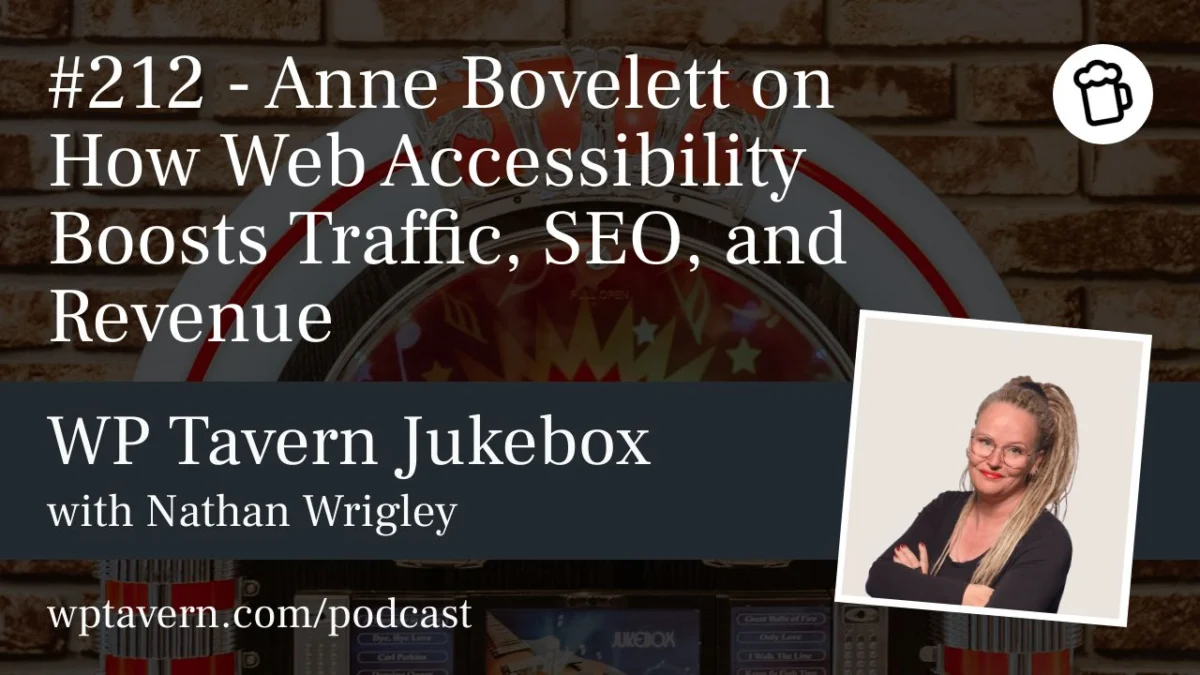
However, a paradigm shift is quietly reshaping the digital landscape. Seasoned accessibility strategist Anne Bovelett argues that viewing accessibility solely through an ethical or legal lens is missing the forest for the trees. According to recent empirical research, ignoring universal design is not just a social oversight; it is a catastrophic financial misstep.
As digital ecosystems evolve toward 2026, forward-thinking businesses are beginning to realize that web accessibility is a powerhouse driver of organic traffic, keyword ranking authority, and untapped revenue.
The Main Facts: More Than Just a Compliance Checkbox
At its core, web accessibility ensures that websites, tools, and technologies are designed and developed so that people with disabilities—ranging from visual and auditory impairments to motor and cognitive challenges—can perceive, understand, navigate, and interact with them.
Yet, industry data reveals a stark disconnect between web development practices and human realities. A landmark study conducted by Semrush in collaboration with AccessibilityChecker.org analyzed 10,000 websites and delivered a staggering verdict: 70% of digital platforms remain non-compliant.
More importantly, the study quantified the penalties of this neglect. Compliant websites demonstrated an average 23% increase in organic traffic, a 27% expansion in organic keyword rankings, and a phenomenal 90% boost in overall authority scores.
Rather than viewing accessibility as an expensive remediation project or a tedious compliance burden, industry leaders are beginning to reframe it as a high-return marketing and infrastructure investment.
Chronology: From Semantic Roots to JavaScript Mazes
To understand how the web became so inaccessible, one must look back at the historical trajectory of web development.
The Early Web and Semantic HTML
In the foundational days of the internet, when browsers were primitive and design options were limited, developers relied strictly on semantic HTML. While early websites were visually basic, the underlying structure of the code was inherently accessible. Screen readers and alternative assistive technologies could easily parse semantic elements like headers, lists, and form buttons.
The Era of Over-Engineering
As the internet matured, the industry sought to make development faster and visually richer. Developers began creating frameworks that relied heavily on generic, non-semantic tags like <div> and <span>.
While these elements allow for immense visual flexibility, they act as functional chameleons for assistive technologies. Without extensive, error-prone JavaScript interventions, a generic <div> styled to look like a button does not behave like a button to a screen reader. Over time, the industry traded native semantic clarity for over-engineered frameworks, inadvertently locking millions of users out of the digital economy.
Supporting Data: The Economics of Inclusivity
The financial argument for accessibility is supported by massive economic studies. One of the most cited frameworks, the United Kingdom’s Click Away Pound Report, attempted to quantify the revenue lost when disabled consumers encounter inaccessible e-commerce sites.
- 2016: The estimated "click-away pound" stood at £11.75 billion.
- 2019: That figure ballooned to £17 billion.
Analysts suggest that if a contemporary study were conducted today—amid the rise of complex, JavaScript-heavy architectures and unoptimized AI tools—the figures would be unprecedented.
The Consumer Response: Voting With Their Wallets
The economic penalty of inaccessible websites is exacerbated by consumer behavior. Studies indicate that 75% of disabled consumers have willingly paid higher prices to purchase products from accessible websites rather than struggle through a cheaper, inaccessible competitor.
For businesses, this reveals a harsh reality: consumers will not waste time deciphering broken user journeys, dealing with unoptimized multimedia, or battling confusing layouts when alternative vendors offer frictionless experiences.
Official Perspectives: Shifting the Corporate Mindset
Despite these compelling statistics, convincing corporate C-suites to prioritize accessibility remains an uphill battle. Anne Bovelett points out that corporate structures often discourage long-term strategic investments.
"No matter what, people will always think with their wallet today and tomorrow. They’re not thinking about next week," Bovelett notes, reflecting on discussions with top-tier enterprise executives.
In large corporations, mid-level managers are frequently caught in a cycle of immediate risk management and internal departmental silos. Design teams rarely communicate effectively with development teams, and content creators operate in isolation. This structural fragmentation virtually guarantees that accessibility falls through the cracks.
Furthermore, Bovelett argues against the common practice of placing the entire burden of accessibility onto a single "compliance officer." Tasking one individual with policing an enterprise platform of thousands of pages is a recipe for professional burnout. Instead, organizations must cultivate an internal culture where design, development, and content teams share a unified vocabulary around universal human-centric design.
Implications for the Future of SEO and E-Commerce
The convergence of accessibility, search engine optimization (SEO), and artificial intelligence represents the next major frontier for digital businesses.
Search Engines Favor Humanity
Modern search engine algorithms are increasingly sophisticated, mirroring human intent rather than relying solely on keyword stuffing. Google and other search engines prioritize websites that offer exceptional user experiences, clear content hierarchies, and robust technical structures.
Because search engine crawlers and screen readers evaluate websites using similar parsing logic, an accessible website is inherently easier for search engines to index. This explains the direct correlation between accessibility compliance and spikes in organic traffic and keyword rankings.
AI Integration and the Risk of "Vibe Coding"
As businesses increasingly turn to artificial intelligence to summarize, parse, and interact with web content, accessibility flaws are compounding. AI models trained on inaccessible, poorly structured code struggle to interpret modern web applications. If an AI agent cannot navigate a website due to poor semantic markup, potential customers relying on AI-driven search tools will simply never see that business.
Reducing Support Costs
Beyond boosting revenue and traffic, accessible design yields immediate operational savings. When websites are intuitive, transparent, and accommodating to diverse user needs—including aging populations, individuals with temporary injuries, or those managing cognitive differences like ADHD—customer support requests plummet.
Empowering users to successfully complete transactions, submit forms, or find information independently reduces ticket volumes and slashes operational overhead.
Conclusion: Seizing the Advantage
The message from digital strategists like Anne Bovelett is clear: web accessibility is no longer a niche philanthropic concern. It is a fundamental commercial strategy.
For WordPress site owners, developers, and digital business leaders, the roadmap is straightforward. By abandoning the bare minimum compliance mindset and embracing universal design, businesses can unlock millions in untapped revenue, future-proof their SEO strategies, and expand their reach to an overlooked global audience.
To listen to the full conversation with Anne Bovelett, search for the Jukebox Podcast on WP Tavern or visit wptavern.com to access the complete episode, transcripts, and resource links.