Introduction: The Surveillance-Like Shadow of the EU AI Act
A new regulatory push by the European Union to make artificial intelligence content transparent and easily identifiable is inadvertently establishing a surveillance-like infrastructure. While framed as a consumer protection and anti-deception measure, Regulation (EU) 2024/1689—informally known as the E.U. AI Act—requires "synthetic" content to be machine-detectable.
This legislative mandate has immediate, sweeping consequences. By forcing AI models to embed hidden markers into their output, the regulation provides digital platforms, search engines, and governments with the technical capacity to segregate, filter, and censor text based entirely on its origin rather than its substantive quality.
Industry leaders are already bending to the law. In response to the mandate, AI pioneer Anthropic announced that all future iterations of its Claude models will incorporate identifiable, text-based watermarks. With competitors anticipated to follow suit, the digital landscape is bracing for a paradigm shift. For marketers, copywriters, and ecommerce enterprises relying on generative AI to scale operations, this unseen digital fingerprint could transform from a regulatory compliance check into a systemic penalty box.
Chronology of a Regulatory Shift: From Generative Boom to Mandatory Fingerprints
To understand how the digital ecosystem arrived at machine-detectable text, it is necessary to trace the rapid evolution of generative AI and the regulatory panic that followed.
The Generative Explosion (2022–2023)
When OpenAI launched ChatGPT in late 2022, followed rapidly by Anthropic’s Claude and Google’s Gemini, the commercial world underwent a seismic shock. Content marketers, small business owners, and enterprise copy teams quickly adopted Large Language Models (LLMs) to draft blog posts, product descriptions, and email campaigns. For small teams, generative AI acted as an equalizer, leveling the playing field against corporate giants with massive marketing budgets.
The Misidentification Panic (2023–2024)
As AI-generated text flooded the internet, educators, publishers, and regulators scrambled to identify it. Early attempts at detection were amateurish and fraught with error. Skeptics pointed to stylistic tics—such as the overuse of em dashes (—), colons (:), or words like "delve" and "testament"—as sure signs of artificial origin.
However, these heuristic guesses proved deeply flawed. Punctuation marks and vocabulary choices have histories far predating modern LLMs. Furthermore, as AI models evolved, their writing styles became deliberately more human-like, rendering static style-matching databases obsolete almost overnight. Guessing what an AI wrote became an exercise in statistical guesswork.
The EU AI Act and the Turn Toward Cryptographic Watermarks (2024)
Unsatisfied with vague estimations, European lawmakers codified transparency mandates into Regulation (EU) 2024/1689. To enforce the rule that artificial intelligence outputs must be machine-readable, tech companies had to move beyond human style analysis and implement programmatic tracking.
This pivot led directly to Anthropic’s adoption of Google-developed text-watermarking frameworks, such as SynthID-Text. By baking the detection mechanism directly into the generation process, the tech industry provided regulators and platforms with the exact infrastructure needed to spot machine-authored material reliably and at scale.
Supporting Data: How Text-Based Watermarking Works
To the naked human eye, watermarked AI text looks entirely normal. There are no corrupted characters, no visible codes, and no discernible patterns. The watermark exists purely in the statistical probabilities of how words are chosen.
The Concept of the "Next Token"
In generative AI terminology, a "token" is a bite-sized chunk of data—ranging from parts of words and punctuation marks to whole numbers and complete words. When an LLM is prompted to compose a message (such as a product description or an email blast), it begins with an initial token and then predicts the subsequent token based on context.
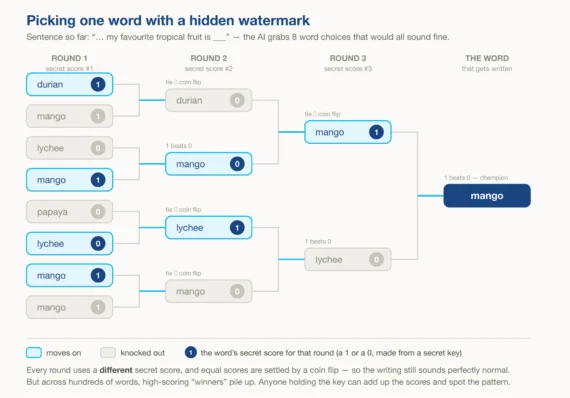
For instance, consider a sentence beginning with the phrase: "My favorite tropical fruit is…"
An advanced model like Google Gemini does not simply pick a single pre-determined word. Instead, it applies statistical probability across a vast vocabulary. It might assign high probabilities to words like mango, papaya, pineapple, or durian.
The "Tournament" Method (Google SynthID-Text)
To embed a hidden watermark without degrading text quality, developers use a probabilistic tournament system during generation:
- Candidate Pool Generation: For every new token in a sequence, the model generates multiple viable candidates.
- The Tournament Bracket: Much like a sports tournament, candidate words are pitted against one another using a pseudo-random seed function unique to the model.
- Secret Scoring: Words undergo secret scoring rounds based on cryptographic rules tied to the model’s generation parameters.
- The Winning Token: A winning word emerges—for example, mango. However, mango does not win every time; it might triumph in one sentence and lose in the next.
- Pattern Accumulation: One tournament proves nothing. But after hundreds of sequential token tournaments, a watermarked passage contains a statistically anomalous concentration of seed-influenced choices compared to ordinary human writing.
This accumulated statistical pattern forms the invisible watermark.
Detection Mechanisms
A dedicated "detector" algorithm equipped with the model’s secret key can ingest a passage of text, break it down into its underlying tokens, and reconstruct the tournament scores.
- High Confidence in Length: Longer passages provide robust statistical evidence. While one or two winning tokens could appear by chance in human writing, hundreds of correlated choices cross the detection threshold with mathematical certainty.
- Diminished Evidence in Factual or Constrained Text: Highly factual passages, code blocks, or text heavily edited through iterative user feedback yield less watermarking evidence because the model has fewer acceptable token alternatives.
Despite its mathematical elegance, the system is fundamentally probabilistic. If detection thresholds are set too low, false positives will inevitably flag human-written text as AI-generated.
Official Responses and Industry Stakeholders
The intersection of regulatory mandates and proprietary AI development has triggered sharp divisions among policymakers, AI developers, and commercial platforms.
The European Union: Transparency as a Safeguard
E.U. officials defend Regulation (EU) 2024/1689 as an essential measure against misinformation, deepfakes, and automated fraud. By ensuring that consumers always know when they are interacting with an artificial intelligence, the Union aims to preserve public trust in digital media. Proponents argue that transparency is a democratic right and that machine-detectability is the only scalable way to enforce it.
AI Developers: Compliance Through Innovation
Companies like Anthropic and Google have positioned their adoption of tools like SynthID as a proactive commitment to responsible AI deployment. By building watermarking directly into the generation pipeline, these firms satisfy E.U. legal requirements while maintaining text fluency. Rather than fighting regulation, major players are standardizing the infrastructure of detection.
Platforms and Publishers: The Silent Enforcement
While search engines, social networks, and email providers have been cautious about officially declaring war on AI content, their underlying policies increasingly penalize it. Pinterest, for instance, has already adjusted distribution algorithms to suppress content identified as synthetic. Other platforms are quietly exploring similar filtering pipelines, treating watermarked data as a liability rather than an asset.
Implications for Marketers: The Threat of Algorithmic Censorship
For digital marketers and ecommerce brands, the implementation of mandatory AI watermarking carries profound existential risks. The ability to identify AI-generated text easily and with high confidence transforms the digital ecosystem.
1. Watermarking as a Proxy for Quality
For years, search engine optimization (SEO) experts debated whether search algorithms could effectively spot and penalize AI-generated content. With programmatic watermarks, that debate is rendered moot. Search engines will no longer need to guess; the metadata or statistical signature will tell them instantly.
Consequently, search engines may discount AI-aided pages, large language models may bypass watermarked sites as training sources, and social media platforms may throttle distribution.
2. The Email Inbox Crackdown
Email marketing remains a vital channel for ecommerce conversions. However, if major email clients (such as Gmail or Outlook) deploy watermark detection algorithms, AI-generated promotional copy could face severe filtration. Messages drafted with the assistance of LLMs risk being automatically routed to spam folders or segregated into a designated "Likely AI" tab, eviscerating open rates.
3. Destruction of the Small-Team Advantage
Generative AI has served as a great equalizer for lean marketing teams. A solo entrepreneur or a two-person startup could previously generate professional-grade product descriptions, landing page copy, and ad variations in minutes.
If platforms systematically suppress watermarked content, small businesses will lose their competitive edge. They will be forced to hire large writing staffs or spend exorbitant hours manually rewriting AI drafts to scrub out statistical watermarks—defeating the core efficiency of automation.
4. The Rising Specter of False Positives
Because detection algorithms rely on statistical probabilities rather than absolute proof, false positives are inevitable. If a human writer happens to write in a style that correlates with a model’s seed parameters, their work could be incorrectly flagged as synthetic. Without transparent appeals processes, innocent creators could find their content suppressed by opaque, algorithmic censors.
Conclusion
Regulation (EU) 2024/1689 was designed to bring light and accountability to the dark corners of generative artificial intelligence. However, by legally mandating machine-detectable watermarks, the European Union has unwittingly built the scaffolding for widespread digital segregation and censorship.
As Anthropic, Google, and other industry giants operationalize text watermarking, the internet is dividing into two tiers: human-authored and machine-traceable. For ecommerce marketers, the coming years will require a delicate balancing act. They must navigate an ecosystem where the tools that drive operational efficiency are simultaneously tracked, marked, and potentially marginalized by the very platforms upon which modern commerce depends.