The modern public software market operates on a razor-thin margin of error. For high-growth SaaS leaders, particularly those commanding premium valuations as category-defining vertical platforms, missing future expectations is treated as an existential threat. No company learned this lesson more painfully than ServiceTitan, the preeminent "Vertical SaaS for the Trades" platform.
On September 8, 2026, ServiceTitan reported its fiscal second-quarter 2027 financial results for the period ending July 31, 2026. On paper, and by traditional financial standards, the quarter was an unmitigated success. The company beat its own revenue and earnings guidance, expanded its operating margins by over 300 basis points, generated record free cash flow, and maintained a robust Net Dollar Retention (NDR) rate comfortably above 110%.
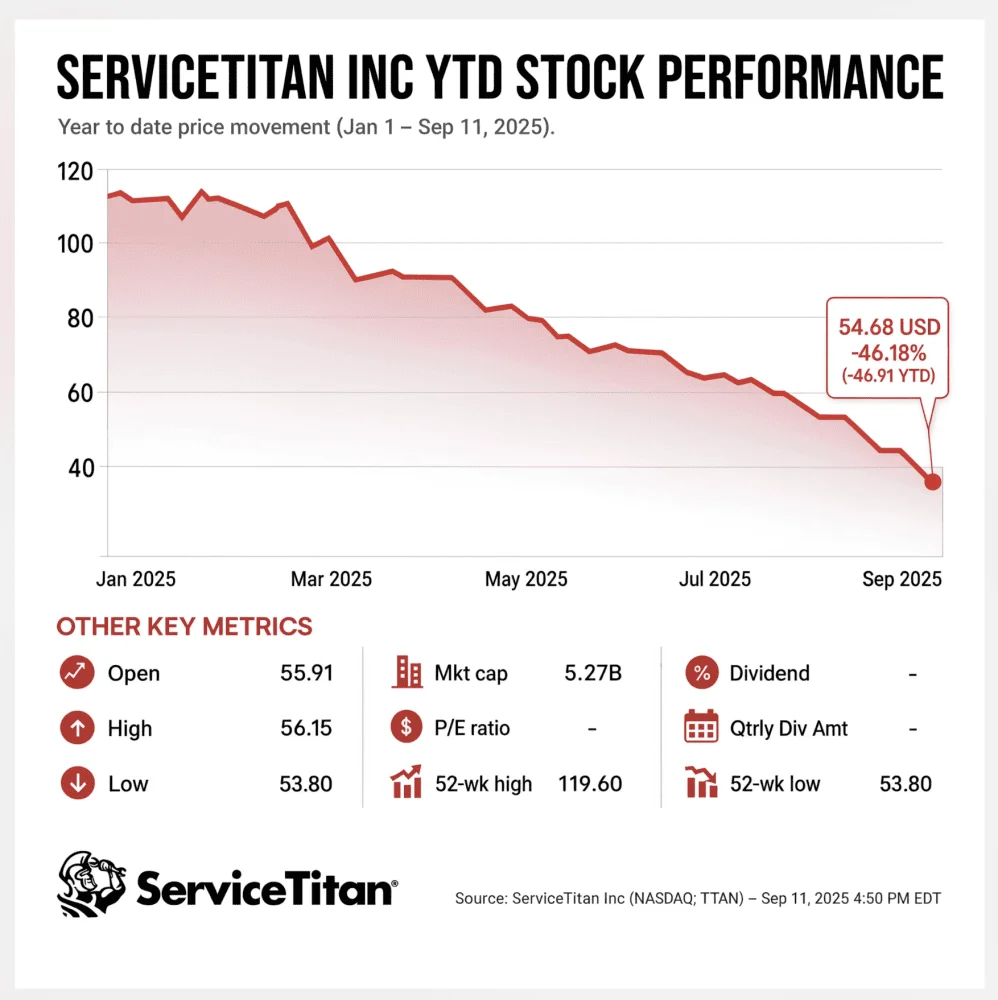
Yet, the market’s verdict was swift and unforgiving. The following trading session, ServiceTitan’s stock cratered by 30%, wiping out more than $2 billion of market capitalization in a single day. By the end of the week, the stock had plummeted to a 52-week low of $54.16—representing a staggering 52% decline over the past year.
This deep dive explores the chronology of the crash, the underlying financial and operational mechanics that triggered it, official reactions from Wall Street, and the broader implications for the broader enterprise software and vertical SaaS landscape.
Main Facts: A Strong Beat Overshadowed by Deceleration
To understand the market panic, one must first examine the divergence between ServiceTitan’s recent operational performance and its forward-looking guidance.
- Strong Top and Bottom Line Beats: ServiceTitan reported Q2 revenue of $292.8 million, marking a 21% year-over-year increase. This comfortably outperformed the company’s internal guidance of 18% and surpassed Wall Street consensus estimates by roughly $8 million. Non-GAAP earnings per share (EPS) came in at $0.40, beating expectations of $0.36.
- Margin Expansion and Cash Generation: Non-GAAP operating margins expanded by 310 basis points year-over-year. Free cash flow reached historic highs, nearly doubling off its previous small base, while Net Dollar Retention remained healthy above 110%.
- The Catalyst—Forward Guidance: Despite beating every metric for the quarter just ended, management guided third-quarter revenue to approximately $286 million—a sequential decline in absolute dollars compared to Q2. Furthermore, the back half of fiscal year 2027 was guided to a mid-teens growth rate (roughly 15%), a steep drop from the 25% growth recorded in the back half of the previous fiscal year.
- The Market Reaction: Wall Street institutions rapidly repriced the stock. Within 24 hours of the earnings release, at least seven major financial firms slashed their price targets by 20% to 30% (e.g., TD Cowen cut from $125 to $100; BMO dropped from $103 to $90).
Chronology: From Earnings Beat to Historic Sell-Off
The sequence of events leading to ServiceTitan’s historic drawdown highlights how quickly sentiment can shift in a growth-obsessed macroeconomic climate.
Pre-Earnings Optimism
Heading into the September 8 earnings report, ServiceTitan was navigating a complex transition. As a platform powering residential and commercial contractors—primarily in the HVAC, plumbing, and electrical trades—the company had spent quarters successfully cross-selling high-value add-on products and scaling its gross transaction volume (GTV).
The Earnings Drop (September 8, After Market Close)
Management released the Q2 FY27 results alongside news of leadership changes, notably appointing Rikus Pretorius as the new Chief Revenue Officer. The headline numbers were strong, and management even raised the full-year revenue guidance slightly by $4 million (bringing the full-year expectation to roughly $1.14 billion).
The Black Tuesday Massacre (September 9)
When markets opened the following morning, investors zeroed in not on the historical performance, but on the trajectory of the future P&L. The realization that revenue growth was slowing down for four consecutive quarters—culminating in a guided Q2-to-Q3 absolute revenue dip—triggered automated and institutional sell-offs. The stock closed down $24.46 (30%), obliterating over $2 billion in shareholder value in a single trading session.
The Institutional Repricing (September 10–11)
Throughout the rest of the week, equity research analysts scrambled to adjust their models. While almost all major firms maintained their "Buy" ratings, they aggressively lowered their price targets. By Friday, September 11, the stock touched a new 52-week low of $54.16, cementing the reality that the market was no longer willing to pay a premium for past execution when forward momentum was decelerating.
Supporting Data: Dissecting the Numbers
A granular look at ServiceTitan’s financial architecture reveals the specific levers that caused the disconnect between the company’s internal targets and the public market’s expectations.
1. GTV Growth and Macro Pressures
ServiceTitan’s monetization model is fundamentally tied to its customers’ business health. The company operates on a Gross Transaction Volume (GTV) basis, taking approximately a penny of every dollar (roughly 1.09% revenue take-rate) that contractors invoice through its platform.
In Q2, GTV growth slowed to 17%, down from 23% in Q1, totaling $26.8 billion. Management attributed this deceleration to a broader industry soft patch in lead and job volumes during May and June—particularly within the HVAC sector. Although usage-based revenue grew 24% (outperforming GTV and proving that monetization efforts were working), the underlying volume drop directly depressed the headline revenue growth rate from the 25% range down to 21%.
2. The AI Transition Headwind: "Max"
At the heart of ServiceTitan’s long-term strategy is Max, its agentic artificial intelligence operating system designed to optimize contractor workflows and dramatically improve technician-to-admin ratios. Adoption metrics for Max are surging: locations using the system jumped from just over 100 at the end of Q1 to a projected 700+ by the end of the fiscal year.

However, Max is currently acting as a severe near-term revenue suppressant. To reduce friction on complex change-management enterprise sales, ServiceTitan waived billing for the first quarter of the contract for early adopters. This customer-friendly strategy, combined with a strategic mix shift, created an immediate $4 million to $5 million revenue headwind. While early adopters are reportedly seeing revenue growth exceeding 45%, the AI transition introduces a painful 4-to-6-quarter trough in reported revenue before expansion tailwinds materialize.
3. Resource Reallocation and Trade Deferrals
To aggressively fund the development and deployment of Max and internal software engineering initiatives, ServiceTitan made a calculated strategic choice: it deferred its planned expansion into new commercial and residential exterior trades.
This reallocation shifted operating expenses away from aggressive geographic and trade acquisition and toward deepening engagement within the existing customer base. While defensible from a product-focus standpoint—especially with an NRR above 110%—it removed vital growth vectors from the forward-looking model just as core trade volumes experienced cyclical softness.
Official Responses and Management Commentary
During the earnings call, CEO and management executives defended their long-term strategic pivot, emphasizing that the investments being made today are foundational for the next decade of vertical software dominance.
Management addressed the HVAC volume slowdown transparently, noting that lead generation softened in May and June due in part to an early cooling season that pulled demand forward into Q1. While lead volumes stabilized somewhat through July, leadership declined to declare the macroeconomic headwinds entirely over.
Regarding the aggressive rollout of Max and the deliberate decision to offer introductory billing grace periods, executives stressed that removing friction is essential for category-defining AI adoption. They argued that short-term revenue sacrifices are a necessary price to pay to secure long-term platform lock-in and drive structural efficiency for contractors.
Furthermore, the simultaneous appointment of Rikus Pretorius as Chief Revenue Officer was framed as a strategic alignment to optimize sales execution through the next phase of the company’s evolution, even if pairing a leadership change with a lower growth guide created a turbulent communication cycle with the market.
Implications: The Broader Lessons for the SaaS Ecosystem
ServiceTitan’s harrowing post-earnings crash offers critical lessons for both public and private software companies navigating the macroeconomic and technological shifts of 2026.
1. Model the Trough of Your AI Transition
Companies rushing to package and sell generative AI or agentic workflows must carefully calculate the billing implications. Whether through deferred implementation fees, consumption-based pricing models, or outcome-based billing, AI transitions frequently shift recognized revenue into future periods. If a company fails to price this revenue trough into forward guidance, the public markets will ruthlessly reprice the equity.
2. Growth Rate Still Trumps Margin Expansion
In the current market environment, growth velocity remains the absolute sovereign metric for SaaS valuations. ServiceTitan’s achievements—expanding operating margins by 310 basis points, growing free cash flow by 47%, beating earnings consensus, and raising annual guidance—were treated as complete non-factors compared to the deceleration of forward growth from 25% to 15%. Ten points of growth deceleration proved to be vastly more damaging than stellar operational efficiency.
3. The Perils of Strategic Deferrals
When a company pulls back on expansion vectors (such as ServiceTitan pausing new trade expansion) to fund internal bets like AI, it alters the external growth narrative. Management must weigh whether internal resource optimization justifies the loss of top-line growth optionality that institutional investors rely upon to project long-term compounding.
Conclusion
ServiceTitan remains a gold standard in the realm of vertical SaaS. With a $1.17 billion run rate, 21% top-line growth, an NDR above 110%, 81% platform gross margins, and nearly $480 million in cash, its underlying business is exceptionally healthy.
Yet, the events of September 2026 stand as a stark reminder of the modern market’s uncompromising mandate: Grow or Die. By guiding forward growth down into the mid-teens, ServiceTitan exposed itself to a brutal market re-valuation. For every other enterprise software leader watching from the sidelines, the message is clear—when navigating the treacherous waters of technological transition, protecting and communicating the forward growth trajectory is the only defense that truly matters.