The digital freelance economy is undergoing a massive structural transformation. For more than a decade, platforms like Upwork served as the lifeblood for independent developers, agencies, and digital consultants worldwide. Among the most popular tech stacks on these marketplaces was WordPress, powering everything from brochure websites to complex enterprise applications.
However, a recent viral LinkedIn post by veteran WordPress developer Adrian Sticea has brought a hard truth to light: the steady stream of high-value WordPress projects on Upwork has effectively dried up.
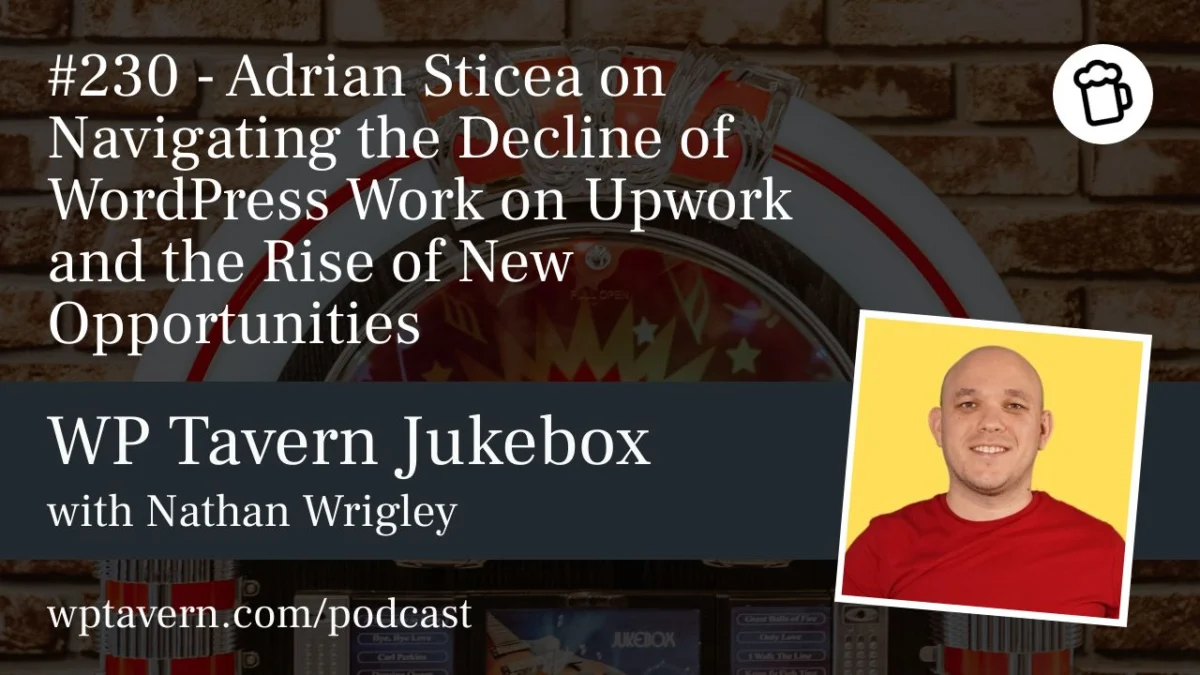
In a recent episode of the Jukebox Podcast from WP Tavern, host Nathan Wrigley sat down with Sticea to unpack his data-driven LinkedIn post. The conversation sheds light on a broader industry shift, exploring how artificial intelligence, economic pressures, market saturation, and changing client expectations are forcing independent professionals to rethink how they source work.
Main Facts: The Disappearance of Upwork WordPress Leads
The core revelation of Sticea’s viral post centers on a stark line graph illustrating his annual project volume sourced through Upwork.
From 2015 through 2020, Upwork was a reliable, near-endless fountain of project leads for Sticea. During several of those years, the platform accounted for 95% to 100% of his freelance revenue. But then the trajectory reversed dramatically:
- 2022: Upwork projects dropped by 20% (down to 80% of his total pipeline).
- 2023: A steeper decline sliced volume down to 60%.
- 2024–2025: Volumes dwindled further to 40%.
- 2026: The line hit zero—marking a complete departure from the platform.
Despite this dramatic drop on Upwork, Sticea’s overall business revenue remained unaffected. The phenomenon points not to a collapse of his personal business, but to a fundamental decoupling of the WordPress freelance market from traditional gig-economy marketplaces.
Simple, presentation-style website builds still occasionally surface on platforms like Upwork, but complex, developer-centric projects—such as custom plugin development, legacy code refactoring, and enterprise-level architecture—have largely migrated elsewhere.
Chronology: Adrian Sticea’s Path Through the WordPress Ecosystem
To understand how marketplace dynamics have shifted, it helps to examine Sticea’s professional evolution within the WordPress space over the last decade:
- 2013: Sticea began his career as a WordPress developer, working for small local companies providing web development and customer support.
- 2015–2016: Transitioned into full-time freelancing, utilizing platforms like Upwork as his primary lead generation tool to avoid traditional, in-person networking.
- 2016: Relocated to the United States and spent over a year working as a dedicated WordPress developer for a digital marketing agency.
- 2018: Joined IBM to work on one of the tech giant’s largest internal WordPress platforms—a massive educational portal teaching programming and technology courses. This marked his entry into high-end enterprise projects.
- End of 2020 – 2023: Left IBM and returned to independent freelancing for three years, relying primarily on Upwork to supplement enterprise-grade contracts.
- 2023–2024: Joined StellarWP as a web engineer in their marketing department, working there for a year and a half while observing the shifting digital landscape.
- Early 2025 – Present: Returned to full-time freelancing, officially cutting ties with Upwork and pivoting completely to LinkedIn networking, direct agency partnerships, and temp agencies.
Supporting Data and Underlying Causes: Why Did Upwork Dry Up?
While Sticea’s graph paints a dramatic picture, the underlying causes are multifaceted. When evaluating why the WordPress pipeline on Upwork evaporated, several compounding factors emerge:
1. The Rise of AI and Developer Efficiency
Artificial intelligence has fundamentally altered the programming landscape. Rather than replacing clients outright, AI tools have made developers significantly more efficient. A task that once took a developer four hours can now often be completed in one. Consequently, the raw volume of hours companies need to buy has decreased. Furthermore, AI has commoditized basic programming, driving down the perceived value of routine coding tasks.
2. Post-Pandemic Tech Sector Corrections
The massive boom in digital infrastructure demand during the remote-work era of 2020–2022 led to massive over-hiring. When market conditions tightened and tech sector layoffs surged, companies reined in budgets. AI served as an accelerator for these layoffs, allowing lean teams to handle workloads that previously required larger headcounts.
3. Market Saturation and Alternative Builders
The sheer number of developers flooding platforms like Upwork created intense competition, driving rates down and making it difficult for top-tier talent to justify the platform’s constraints. Meanwhile, non-technical clients seeking simple brochure websites increasingly bypassed WordPress entirely in favor of turnkey solutions like Wix, Squarespace, and Framer.
4. Migration to Vetted Platforms and Agencies
Clients seeking complex WordPress work (such as custom plugins or enterprise maintenance) have shifted away from open-bidding marketplaces like Upwork. Instead, they lean on pre-vetted ecosystems like Toptal and Codeable, or they utilize tech recruitment firms and temp agencies (such as Robert Half) that pre-screen developers before introducing them to clients.
Official Responses and Industry Perspectives
The viral nature of Sticea’s LinkedIn post struck a nerve because his experience is not an isolated anomaly. Conversations sparked by the post revealed that agency owners who previously relied on Upwork for the bulk of their pipeline are experiencing the exact same drought.
According to Sticea, agency owners report that even minor rate increases on Upwork result in complete radio silence, highlighting a marketplace increasingly sensitive to cost and saturated with lower-cost alternatives.
Furthermore, industry veterans emphasize the psychological trap of marketplace dependence. Platforms like Upwork offer a frictionless environment for introverted developers who prefer text-based communication over handshakes and networking events. However, this convenience comes at a severe long-term cost: isolation from the referral ecosystem.
When a project is completed through an opaque marketplace interface, clients rarely generate word-of-mouth referrals. The relationship terminates with a platform review, leaving the freelancer perpetually hunting for new leads rather than building a compounding network of trusted peers.
Implications: The Pivot to Long-Term Relationships
For independent WordPress professionals facing similar declines in marketplace lead generation, the implications are clear: The era of passive, platform-dependent freelancing is giving way to active relationship-building.
Sticea’s successful pivot offers a blueprint for adaptation:
- Leveraging LinkedIn for Content and Networking: Sharing authentic professional insights, data-backed experiences, and technical commentary can organic-ally attract high-value clients and spark viral discussions that lead to direct inquiries.
- Direct Agency Outreach: Establishing B2B relationships with digital marketing and development agencies that lack in-house resources for complex plugin work, custom integrations, or legacy code refactoring creates a steady stream of recurring sub-contract work.
- Partnering with Tech Recruiter Networks: Registering with specialized temp agencies and tech recruiters allows developers to position themselves as pre-vetted, high-trust assets for corporate clients who value security and human accountability over the lowest bid.
- Playing the Long Game: Sustainable freelancing requires moving away from the "one-off, here-today-gone-tomorrow" transactional model. Cultivating long-term client relationships naturally loops professionals back into cycles of recommendations and repeat business.
Conclusion
The decline of WordPress work on Upwork is not a sign that WordPress is dying—nor is it a sign that skilled developers are obsolete. Rather, it marks the end of an algorithmic shortcut.
As artificial intelligence matures and macroeconomic pressures reshape the tech sector, the market is demanding higher accountability, deeper technical expertise, and genuine human connection. For those willing to step away from the keyboard, leave the gig-economy platforms behind, and invest in real-world professional relationships, the future of WordPress consulting remains as lucrative as ever.