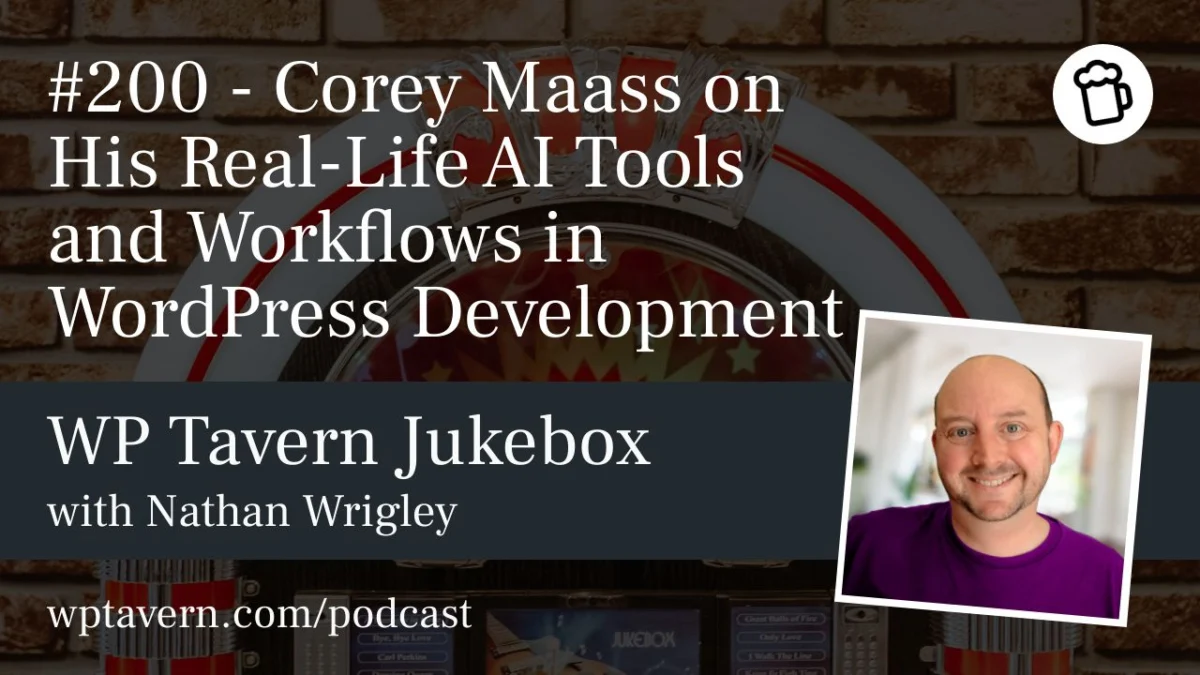
In the rapidly evolving landscape of web development, few technologies have caused as much disruption—or offered as much potential—as generative AI. While the industry spent 2024 and 2025 wrestling with the philosophical implications of artificial intelligence, pragmatic developers were already busy integrating these tools into their daily production workflows.
Corey Maass, a veteran developer with roots stretching back to the late 1990s, recently joined the WP Tavern Jukebox Podcast to discuss how he has moved beyond the "hype phase" of AI. For Maass, the transition from manual coding to an AI-assisted workflow represents one of the most significant shifts in his three-decade career, fundamentally changing how he builds, manages, and thinks about software.
The Evolution of the Tech Stack: From Tables to LLMs
Maass’s career is a microcosm of the web’s own history. He began in 1997, designing layouts in Photoshop, slicing them into HTML tables, and eventually mastering JavaScript, ASP Classic, and PHP. By 2010, he had firmly planted his flag in the WordPress ecosystem.
"I’ve been building for the web since the late nineties," Maass notes. "Back in the day, it was all about Photoshop and tables. Then I fell into WordPress around 2010, and it’s been a joyous rollercoaster ever since."
However, 2025 marked a departure from that traditional path. Maass currently employs a sophisticated, multi-layered stack designed to maximize efficiency without sacrificing code quality:
- IDE: Cursor, which Maass uses as his primary environment.
- Core Logic: Claude Code, which he uses via terminal integration for the bulk of his coding tasks.
- Quality Assurance: GitHub Copilot, which he utilizes specifically for automated code reviews.
This layered approach—using one model to generate code and another to audit it—highlights a maturing strategy in the developer community: moving away from blind reliance on a single AI and toward a "human-in-the-loop" verification system.
Chronology of a Workflow Transformation
The journey to an AI-first workflow was not an overnight transition. Maass traces the turning point to a trip to Thailand in early 2025. With time on his hands and a desire to modernize his legacy projects, he committed to a deep-dive experiment with AI tools.
Phase 1: The "Granular" Experiment
Initially, Maass treated AI like a junior developer, providing hyper-specific, granular instructions. He found that while this saved time, it often limited the creative potential of the models. By forcing the AI to strictly follow his legacy patterns, he wasn’t leveraging the model’s ability to conceptualize better solutions.
Phase 2: The "Sounding Board" Shift
Over the following months, Maass transitioned from using AI as a "typing companion" to using it as a "creative sounding board." He began experimenting with randomness—asking models to rewrite copy in different personas or translate code across languages—to break out of his own cognitive ruts.
Phase 3: Collaborative Systems
By late 2025, Maass began working with colleagues to implement professional development standards, such as full-suite testing and pull requests, even for smaller freelance projects. This, he argues, is the next frontier: using AI to automate not just the code writing, but the process of professional software engineering.
Supporting Data: Efficiency and the "Half-Budget" Paradigm
One of the most compelling insights from Maass’s experience is the economic impact of AI integration. During the podcast, Maass revealed that he recently took on a client project that, under traditional development constraints, would have been over-budget.
By utilizing AI to accelerate the build, Maass estimated he was able to deliver the software for roughly 50% of the cost in terms of billable hours. Crucially, the client did not demand an explanation of how the code was built; the primary requirement was functionality.
"I told her, I think we can build this for half the price if we use AI," Maass explained. "She didn’t care who wrote the code or what language it was in. She just needed it to work."
This highlights a growing trend: the "value" for the client is shifting away from the billable hours of a developer typing code and toward the developer’s role as an architect, project manager, and quality control expert.
The Human Element: When to Use AI and When to Refuse
Despite his bullish stance on AI, Maass maintains a clear boundary between tasks that benefit from automation and those that require a human soul.
The Music Production Benchmark
Maass is also a music producer, and he uses this as a litmus test for "authentic creativity." While he utilizes AI to help him mix audio frequencies—a task where there is a scientifically "correct" way for a track to sound—he refuses to let AI write his music. "It won’t scratch that itch for me," he says. "It’s not about the output; it’s about the human struggle of creation."
The "Point" of the Project
This distinction—the "point" of the project—is central to Maass’s philosophy.
- SaaS and Web Apps: If the "point" is utility, reliability, and speed, AI is the ideal partner.
- Art and Music: If the "point" is human expression, connection, and the narrative of struggle, AI is an intrusion.
Implications for the Future of WordPress
As we look toward 2026, Maass sees the WordPress ecosystem reaching a critical juncture. The platform is inherently visual and "click-heavy," which presents a challenge for current AI agents that struggle to navigate complex admin UIs.
The "Stack-Friendly" Future
Maass predicts that the winning plugins and themes of the future will be those that provide clear, AI-readable APIs. He suggests that developers will eventually choose their tech stack based on "AI-friendliness" as much as performance.
"If Beaver Builder leans into enabling AI to interact with its interface, that becomes a massive competitive advantage," he notes. "We’re going to see a shift where site creators choose tools not just because they look good, but because they can be easily maintained by an AI agent on behalf of the client."
The Ethical and Philosophical Horizon
The interview concluded with a sobering reflection on the nature of reality. As AI-generated images and code become indistinguishable from human work, the burden of verification falls squarely on the developer. Maass acknowledges the risks—hallucinations, bias, and the erosion of "real" expertise—but remains optimistic.
"We are currently in the phase of learning how to steer the ship," Maass says. "We are no longer the ones doing the rowing, but we are definitely still the ones responsible for where the boat ends up."
Conclusion
Corey Maass’s journey serves as a blueprint for the modern developer. By embracing AI not as a replacement for human intellect, but as an extension of it, he has managed to increase his productivity while maintaining the critical, skeptical oversight that defines a senior professional. For the WordPress community, the message is clear: the robots are here, they are capable of writing great code, but they still need a human to tell them where the files should go.