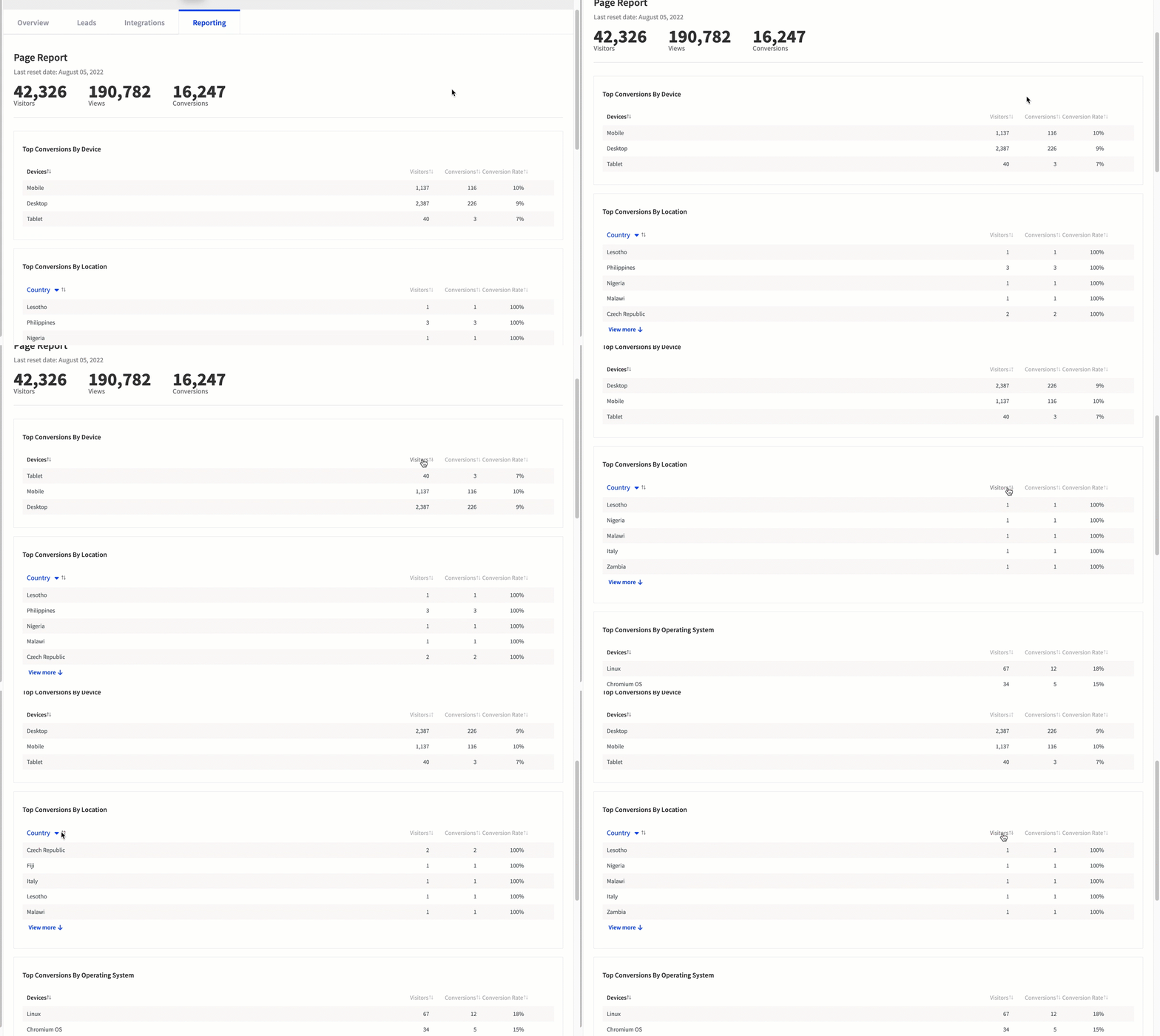
In the high-stakes world of digital marketing, there is a pervasive myth that growth is synonymous with volume. For years, businesses have funneled massive budgets into advertising, social media campaigns, and SEO, all with the singular goal of driving more eyeballs to their websites. However, a new paradigm is shifting the focus from the quantity of traffic to the quality of engagement.
This is the age of conversion marketing—a strategic discipline that recognizes a harsh reality: traffic is just a vanity metric if it doesn’t result in action. In an era where customer acquisition costs (CAC) are skyrocketing, businesses are finding that the most effective way to grow isn’t necessarily to find more customers, but to ensure that the ones they already have actually stick around to make a purchase, book a demo, or sign up for a service.
The Core Philosophy: Maximizing Existing Assets
At its simplest, conversion marketing is the systematic process of turning passive website visitors into active customers. It involves optimizing every digital touchpoint—landing pages, forms, calls-to-action (CTAs), and site architecture—to minimize friction and maximize the probability of a conversion.
Unlike traditional traffic-acquisition models, which treat marketing as a top-of-funnel endeavor, conversion marketing operates on the principle of "optimization over amplification." If a website receives 10,000 visitors per month with a 1% conversion rate, the business secures 100 conversions. If that business doubles its traffic, it achieves 200 conversions. However, if that same business improves its conversion rate to 2% through strategic design and psychological targeting, it reaches the same 200 conversions without spending an additional cent on paid advertising.
The Evolution of Conversion Metrics: A Chronological View
The transition toward conversion-centric strategies has been driven by the increasing sophistication of data analytics. Over the past decade, the industry has moved through three distinct phases:
- The "Click-Through" Era (2010–2015): Marketing was dominated by the sheer volume of clicks. Success was measured by traffic surges, regardless of whether that traffic was qualified or ready to buy.
- The "Bounce Rate" Awareness Phase (2016–2020): Analytics tools became more accessible, revealing the uncomfortable truth that most visitors were leaving within seconds. This forced companies to look at page load times and mobile responsiveness as critical business issues rather than just IT concerns.
- The "Intent-Based" Optimization Era (2021–Present): Today, marketers use AI-driven tools, heatmaps, and behavioral analysis to understand why users act. It is no longer just about getting someone to the door; it’s about ensuring the room is arranged to keep them inside.
Supporting Data: Why Conversion Optimization Wins
The financial implications of ignoring conversion rates are severe. According to industry research, the average conversion rate for websites across various sectors hovers between 2% and 4%. A slight bump in this percentage can lead to exponential growth in net profit.
- Friction and Abandonment: Research consistently shows that form length is a primary driver of abandonment. Studies indicate that up to 27% of users abandon forms because they are too long or contain unnecessary, intrusive questions.
- The Power of Speed: A mere one-second delay in page load time can lead to a 7% reduction in conversions. In the mobile-first landscape, usability is not merely a design preference; it is a financial necessity.
- Customer Lifetime Value (CLV): By focusing on conversion, companies also tend to attract more engaged, "high-intent" visitors, which has been shown to increase customer lifetime value by up to 30% when compared to broad, untargeted traffic.
The Pillars of Conversion Psychology
Why do visitors convert? It is rarely an accident. Successful conversion marketing leverages human psychology to overcome the hesitation inherent in every digital transaction.
The Value Proposition
The value proposition is the "beating heart" of the landing page. It must be an instantly understandable statement that answers the visitor’s primary question: "What’s in it for me?" If a user has to work to understand your service, they will simply click away.
The Role of Trust Signals
In the digital marketplace, trust is the primary currency. Social proof—in the form of testimonials, case studies, and industry certifications—acts as the digital equivalent of a personal recommendation. Crucially, the most effective trust signals are specific. A testimonial that claims, "This software saved our team 15 hours per week," is infinitely more persuasive than a generic statement like "This product is great."
Urgency and Incentives
Human decision-making is heavily influenced by the fear of missing out (FOMO). By utilizing genuine urgency—such as time-sensitive offers or limited-stock alerts—marketers can push a visitor from consideration to action. However, professionals warn that "fake" urgency, such as perpetual countdown timers, can erode brand integrity and ultimately damage conversion rates in the long run.
Strategic Tactics: Turning Insights into Action
To implement a conversion marketing strategy, organizations must move from raw data to actionable experimentation.
1. A/B Testing: The Scientific Method for Marketing
A/B testing allows marketers to strip away assumptions. By testing two versions of a page—altering only one variable, such as a headline or a button color—marketers can scientifically determine what resonates with their audience. The golden rule here is to test one element at a time to ensure that the results are statistically significant and attributable to the change made.

2. Behavioral Heatmaps
Tools like Hotjar or Microsoft Clarity provide a visual representation of how users interact with a page. By identifying where users click, scroll, and stop, companies can identify "conversion bottlenecks." If heatmaps show that users are consistently ignoring a crucial CTA, the solution is often a design adjustment rather than a change in the ad spend.
3. Customer-Centric Feedback Loops
Perhaps the most underutilized data source is the support and sales team. These employees are on the front lines, hearing the exact objections and fears of potential customers. By creating a feedback loop between support and marketing, businesses can preemptively address these objections on their landing pages through better FAQs or clearer product copy.
Implications for the Future: The AI Revolution
The landscape of conversion marketing is currently being reshaped by Artificial Intelligence. Smart traffic tools can now automatically route visitors to the specific landing page variant that is statistically most likely to convert based on their previous behavior. This "dynamic optimization" ensures that every visitor receives a bespoke experience, significantly increasing the probability of a conversion.
Furthermore, as privacy regulations tighten and third-party cookies become less reliable, the ability to convert existing traffic becomes even more critical. Companies can no longer rely on tracking users across the web; they must instead rely on the strength of their own site experience to capture information and build relationships.
Conclusion: A Shift in Mindset
Conversion marketing is not a one-time project or a "quick fix" for a struggling website. It is a fundamental shift in mindset—a commitment to continuous improvement, rigorous experimentation, and an obsession with the user experience.
For the modern enterprise, the goal is clear: stop buying traffic that doesn’t stay, and start building experiences that encourage users to take the next step. By prioritizing the "conversion" over the "visit," businesses can build a more sustainable, profitable, and customer-focused digital presence. Whether you are a solo entrepreneur or a large-scale SaaS company, the principles of conversion marketing offer the most reliable path to maximizing your digital investment. As the digital economy continues to mature, the companies that thrive will be those that realize that every visitor is a potential partner—if only they are given the right reasons to say "yes."