In the modern business landscape, sales and marketing misalignment rarely presents itself as an overt, dramatic failure. It doesn’t usually arrive as a sudden staff walkout or a catastrophic product recall. Instead, it manifests in the subtle, creeping friction of daily operations: "qualified" leads that sales teams treat with skepticism, campaign messaging that lands on deaf ears, and a pipeline that looks deceptively robust on a dashboard but produces a trickle of closed revenue.
According to a comprehensive new report from Unbounce, which surveyed over 500 go-to-market (GTM) professionals, the stakes for solving this issue have never been higher. While 87% of teams identify better alignment as a primary driver for lifting performance, only 56% describe their organizations as "highly aligned." This persistent gap reveals that for many small-to-medium-sized businesses (SMBs), alignment remains an aspirational goal rather than an operational reality.
The Anatomy of the Misalignment Gap
The report, 2026 Anatomy of Aligned Go-to-Market Teams, suggests that the failure to align is fundamentally a misunderstanding of what "alignment" actually entails.
Many leadership teams mistake a calendar invite for a strategic breakthrough. They believe that by scheduling a recurring weekly sync or establishing a basic definition for a "lead," they have achieved harmony. However, the data indicates that these superficial measures are merely a "meeting-cadence layer." True alignment—the kind that moves the needle on revenue—requires an overhaul of the underlying operating model.

When organizations fail to move beyond the meeting-cadence layer, they create a "false sense of alignment." In these environments, teams may communicate more frequently, but they continue to disagree on the foundational metrics of success. Marketing counts the lead, sales counts the close, and because their definitions of a "quality lead" or "conversion credit" are disparate, the numbers never reconcile.
The Perception Gap: A Tale of Two Tiers
One of the most alarming findings in the report is the structural disconnect between leadership and the front lines. There is a clear "perception gap" regarding the health of GTM operations: 69% of executives report strong sales and marketing alignment, while only 47% of non-executives share that sentiment.
This discrepancy isn’t just a matter of opinion; it is a symptom of information asymmetry. Executives often view alignment through the lens of strategy decks and high-level goals. Meanwhile, the teams executing the work experience the friction firsthand. Non-executives are forced to navigate the barriers that leadership often underreports, including data inconsistencies, siloed departments, and a lack of clear communication. This "information lag" tends to compound as the organization grows, creating a widening rift between the vision of the boardroom and the reality of the CRM.
The Cost of Disconnected Operations
Misalignment is often dismissed as a "culture issue," but the data confirms it is, first and foremost, an operational tax. The cost manifests in three primary ways: employee frustration, wasted budget, and a dragging sales cycle.

When marketing generates leads that sales deems irrelevant, the result is more than just a heated meeting. It is a drain on resources. Marketers spend budget on campaigns that don’t convert, and sales reps lose precious time chasing dead ends. This "compounding inefficiency" leads to what the report calls "the pipeline paradox": lead volume appears healthy, but win rates are in decline.
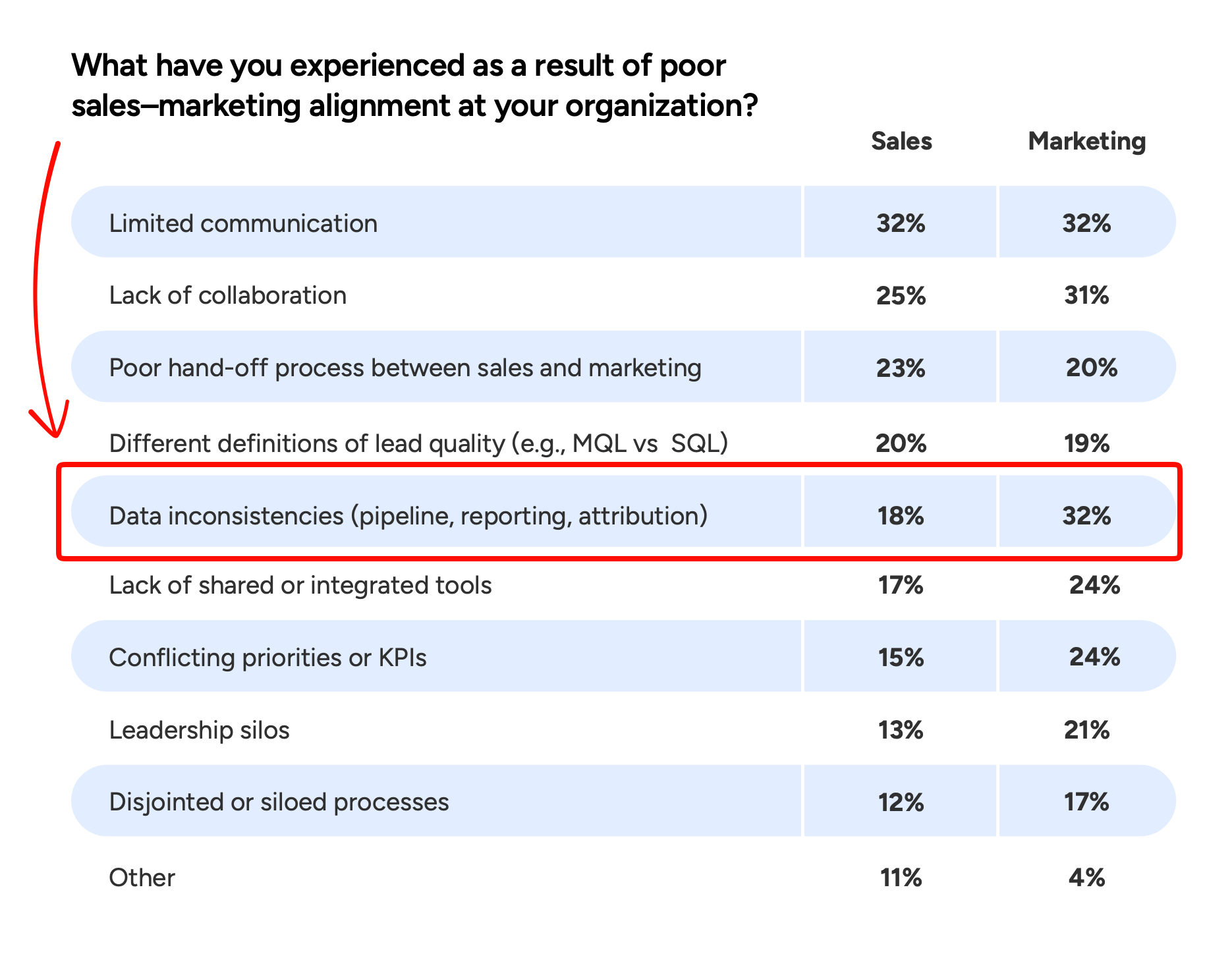
The consequences are felt differently across functions. Marketers report higher levels of frustration regarding unclear target customers (29% vs. 16% for sales), while sales reps struggle more with the fallout of a broken handoff process. When these two realities collide, the result is a "lose-lose" scenario where both departments retreat into their own silos, blaming the other for the lack of revenue growth.
Why "More Meetings" Won’t Fix the Problem
Perhaps the most critical takeaway from the 2026 study is the failure of the "communication-first" approach. Approximately 54% of GTM teams believe that increasing the frequency of communication is the solution to their woes. However, the data suggests that communication is only as effective as the systems supporting it.
Aligned teams don’t just talk more; they operate differently. They prioritize:
- Integrated Workflows: Removing the manual handoff of leads in favor of automated, rule-based systems.
- Shared KPIs: Moving away from department-specific goals toward shared metrics like Customer Acquisition Cost (CAC) and overall conversion rate.
- Unified Data Sources: Ensuring both teams are pulling from the same "source of truth" rather than juggling conflicting spreadsheets.
In short, meetings should be used to make decisions based on shared data, not to debate which set of data is correct.
Root Causes: Data, Tools, and Incentives
The report categorizes the root causes of misalignment into four pillars: operational (53%), goal/incentive (43%), cultural (40%), and structural (34%).
The Data Paradox
While 40% of GTM teams claim to have excellent data sharing, 68% still encounter regular inconsistencies. This is the "data paradox." Marketing teams often rely on attribution signals that don’t match the rep-owned pipeline data used by sales. When a marketing report and a sales spreadsheet tell two different stories, the team is effectively working in two different companies.
The Tool Bloat Trap
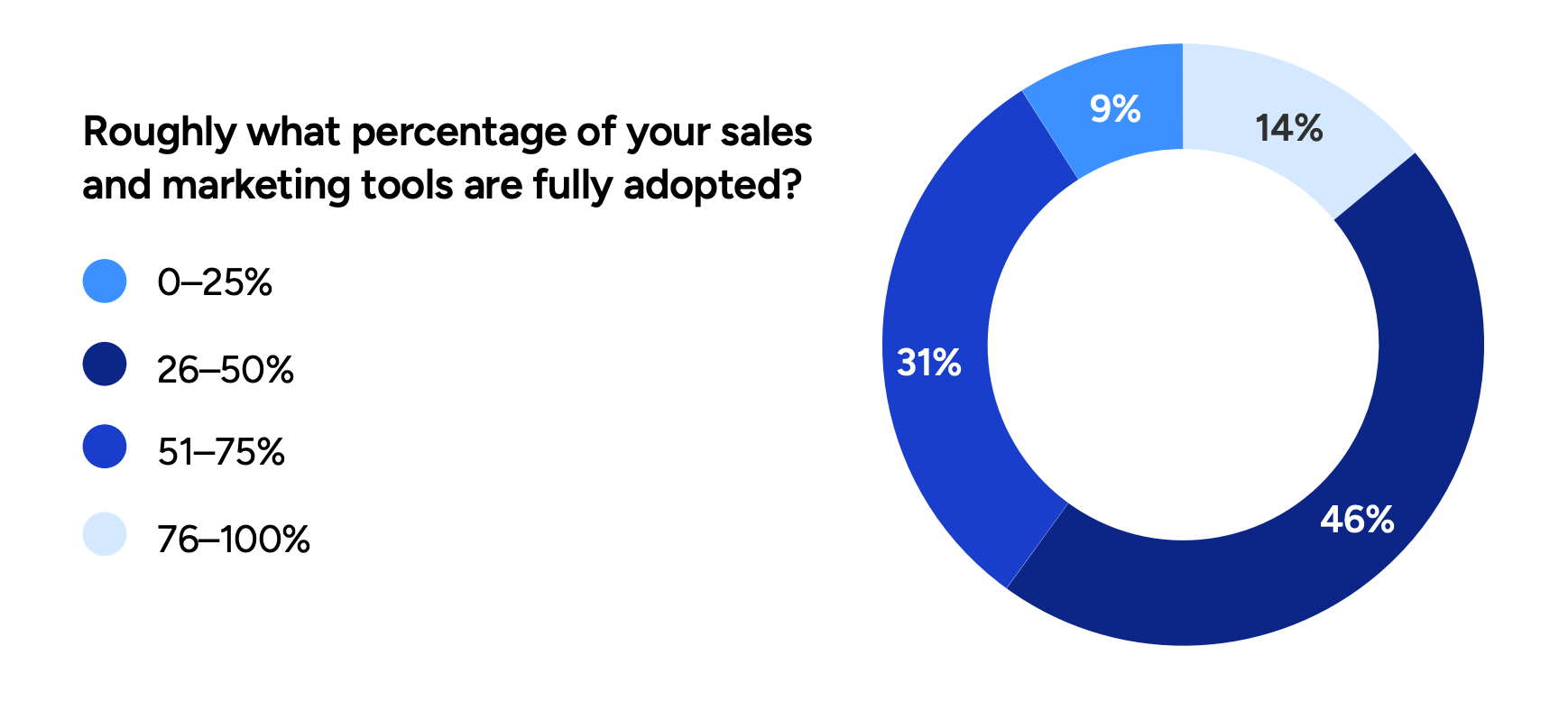
The modern SMB is suffering from "tool bloat." With 56% of professionals citing tool sprawl as an issue, it is clear that many companies are trying to "buy" their way to alignment. However, 60% of these teams use less than half of their available tech stack. A leaner, more focused tech stack—where every tool is integrated and actually used—consistently outperforms a collection of disconnected, "shiny object" platforms.
The Incentive Disconnect
As Charlie Munger famously noted, "Show me the incentive and I will show you the outcome." When marketing is incentivized by lead volume and sales is incentivized by closed revenue, they are structurally designed to be at odds. Without a shared incentive structure, efforts to align the two teams are often nothing more than "philosophical exercises."
Moving the Needle: A Path Forward
To bridge the gap, high-performing teams are taking three concrete actions:
- Joint Persona Development: Moving away from "marketing-only" buyer personas. By bringing sales into the room during the development of these personas, teams can ensure that the language used in marketing campaigns matches the actual objections and pain points sales hears on the phone.
- SLA-Driven Handoffs: Implementing a formal Service Level Agreement (SLA) that dictates not just when a lead is passed, but what information must be included. This removes the ambiguity that leads to "ignored" leads.
- Consolidated Reporting: Forcing both teams to report on the same primary metrics. When both the CMO and the VP of Sales are responsible for the same CAC and conversion targets, they are incentivized to collaborate on improvements rather than point fingers.
Implications for the Future
The path to alignment is not through more meetings or more software, but through better operational design. The teams that successfully navigate this divide are those that view the buyer’s journey as a single, unified narrative rather than a handoff between two separate entities.
As the B2B landscape continues to evolve, the distinction between "sales" and "marketing" is becoming increasingly blurred. The companies that thrive will be those that dismantle the silos and build a cohesive, data-driven GTM engine that treats the entire revenue cycle as a single, shared responsibility. For the 87% of teams currently seeking better alignment, the data is clear: stop buying tools, start fixing processes, and align the incentives. The revenue—and the culture—will follow.