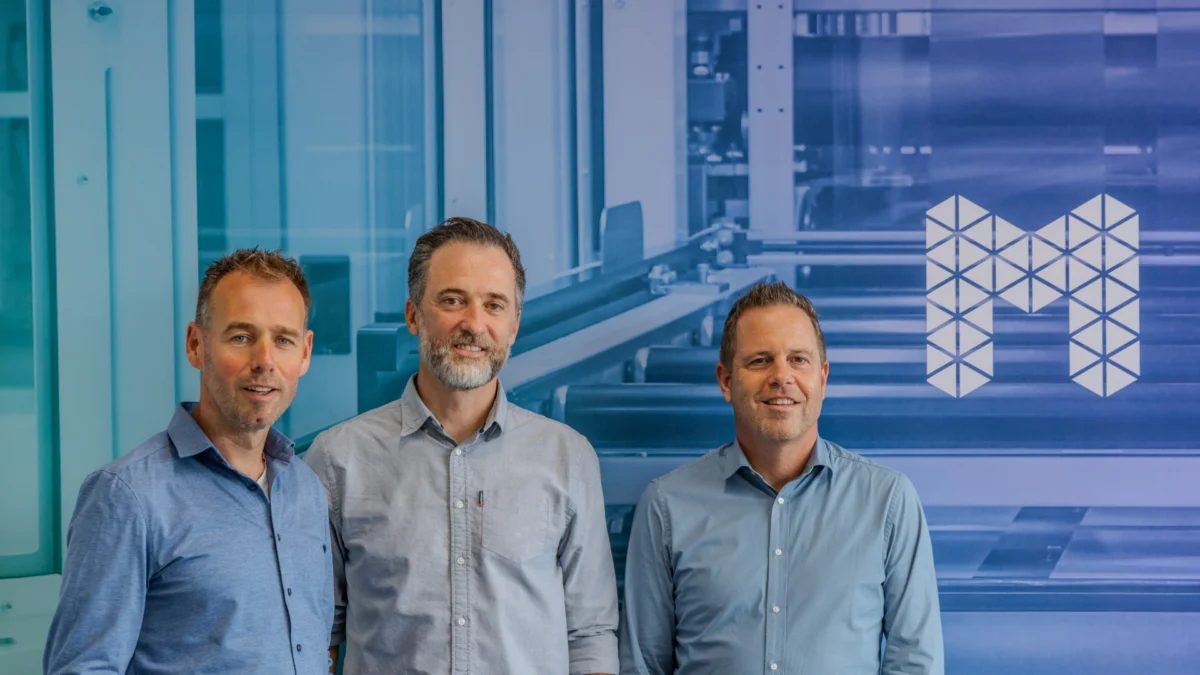
In the high-stakes world of semiconductor manufacturing, the Netherlands is widely recognized as the global epicenter of lithography. While the industry giant ASML dominates the headlines with its massive extreme ultraviolet (EUV) machines that etch the world’s most advanced processors, a smaller, highly specialized Dutch firm is quietly revolutionizing the "other" side of light-based manufacturing.
Morphotonics, a pioneer in nanoimprint lithography (NIL), has spent the last 12 years operating largely under the radar. By specializing in the fabrication of optics for augmented reality (AR) and, more recently, high-speed data centers, the company has carved out a critical niche in the global supply chain. This week, the company announced a €40 million funding injection, a signal that its long-gestating technology is finally ready for mass-market adoption.
The Core Technology: Mastering the Art of the Stamp
At the heart of Morphotonics’ business is a process distinct from traditional photolithography. While ASML’s machines use light to project intricate patterns onto silicon wafers, Morphotonics utilizes a "stamp-and-repeat" methodology.
Nanoimprint lithography works by creating a high-precision physical master—or stamp—that is pressed into photosensitive polymers. Once cured, these materials retain the nanometer-scale patterns of the stamp. This process is essential for creating "waveguides," the ultra-thin, transparent optical elements that form the display engines of modern smart glasses.
Waveguides function by capturing light from a micro-display and "deflecting" it along a specific, engineered path until it reaches the wearer’s eye. This creates the illusion of digital images overlaying the real world. Without the precision and scalability offered by NIL, the production of these optics would remain prohibitively expensive and inefficient. Morphotonics provides not just the machines, but the end-to-end process expertise, including the chemical formulations required to ensure high-fidelity imprints.
Chronology: A Decade of R&D and Market Maturation
Morphotonics’ journey from a specialized R&D lab to a commercial powerhouse has been a deliberate, twelve-year evolution.
- 2012–2018 (The Foundation): The company spent its early years refining the physics of large-area nanoimprint lithography. During this period, the startup focused on proving that NIL could be scaled beyond small laboratory experiments to accommodate the mass production of consumer-grade displays.
- 2019–2023 (Early Adoption): As the AR sector began to show signs of life with early headsets like Magic Leap and the development of Meta’s smart glasses ecosystem, Morphotonics moved from experimental prototypes to real-world integration.
- September 2024 (Leadership Transition): The arrival of CEO Hugo Da Silva marked a turning point. Under his leadership, the company began aggressive scaling, doubling its workforce from roughly 30 to 60 employees within a single year.
- October 2024 (The €40 Million Infusion): The company officially closed a major funding round backed by 3M Ventures, Innovation Industries, BOM, and Invest-NL, alongside support from the European Innovation Council (EIC) Fund and the European Investment Bank (EIB). This capital is earmarked for scaling production capacity and entering the data center market.
Supporting Data: Why the Market is Pivoting
The surge in interest surrounding Morphotonics is not merely speculative; it is backed by a shift in consumer and industrial hardware trends.
According to data from IDC, shipments of smart glasses featuring integrated displays are projected to skyrocket, reaching 12.2 million units by 2030. This growth is already visible in regional markets. In China, for instance, sales of smart glasses doubled in the first eight months of 2024 alone, signaling a burgeoning consumer appetite for wearable AR.
Morphotonics is positioned to capture this volume. The company’s next-generation machine, currently in the final stages of development and slated for a 2025 release, is designed to produce over 6 million waveguides annually. This represents a massive leap in manufacturing throughput, moving from boutique production to industrial-scale output.
Furthermore, the company’s business model—a hybrid of hardware sales and process licensing—is yielding steady growth. Currently, 90% of revenue is derived from the sale of its NIL systems. With 10 to 15 systems already deployed globally, the company’s goal is to reach 50 deployments within the next 36 months, which will naturally shift a larger portion of their revenue toward long-term service and support contracts.
Official Perspectives: The Strategy of Localized Globalism
For CEO Hugo Da Silva, the success of the company is intrinsically linked to its ability to embed itself within existing manufacturing ecosystems.
"Typically, display manufacturers would acquire our equipment as part of the supply chain, and we integrate it into the entire manufacturing process," Da Silva explained. "We teach them the process, we provide the chemicals, and they can manufacture that."
This "teach-and-integrate" philosophy is why Morphotonics has established a strong presence in the major Asian manufacturing hubs—China, Taiwan, and South Korea—as well as the United States. Da Silva stresses that in the delicate world of nanometer-scale optics, "strong local presence is very important." By placing engineers and support teams directly in the regions where their customers operate, Morphotonics ensures that any issues with the imprint process are resolved in real-time, maintaining high yield rates for the manufacturer.
The company’s decision to tap the European Investment Bank (EIB) and the EIC Fund highlights the strategic importance of this technology to European industrial sovereignty. By nurturing a company that provides the machinery for the next generation of computing, European institutions are ensuring that their domestic industry remains a cornerstone of the global semiconductor and optics supply chain.
Implications: Beyond AR to Data Center Dominance
While smart glasses are the current "engine" of growth, Morphotonics is looking toward a much larger horizon: data centers.
The industry is currently grappling with the limitations of electricity as a medium for moving data within servers. As AI workloads increase, the heat generated by electrical signals becomes a bottleneck. The solution lies in "co-packaged optics"—a technology that uses Photonic Integrated Circuits (PICs) to transmit data using light instead of electricity.
Morphotonics’ NIL technology is uniquely suited for the mass production of these optical components. By leveraging the same imprint process used for AR glasses, the company can produce the intricate photonic structures required for high-speed data transmission at a fraction of the cost of traditional etching. While the company has yet to ship machines specifically for the data center market, it has reported that key industry players have validated its technology.
If successful, this pivot could move Morphotonics from being a "niche provider for wearables" to a "critical infrastructure supplier for the AI era."
Conclusion: The Quiet Giant in the Room
Morphotonics may not yet have the household name recognition of ASML, but its trajectory suggests a company that has mastered a fundamental manufacturing challenge. By solving the scaling problem for nanoimprint lithography, they have effectively become the "enabler" for two of the most significant technological trends of the decade: the ubiquity of augmented reality and the optical revolution in data centers.
As the company prepares to stabilize its headcount at 70 to 75 employees and brings its high-capacity machines to market in early 2025, the industry will be watching closely. In the world of tech manufacturing, the companies that control the "stamp" often end up defining the final product. For Morphotonics, the future is clear: it is written in light, and it is being stamped into place at scale.