For years, digital marketers operating with restricted ad spend enjoyed a well-kept secret in the Google Ads ecosystem. By setting a conservative Target CPA (Cost Per Acquisition) or Target ROAS (Return on Ad Spend) alongside a tightly capped daily budget, campaigns frequently overperformed. A campaign assigned a $10 Target CPA might consistently convert at $5, delivering double the expected volume for the same financial outlay.
Marketers often patted themselves on the back, attributing this outperformance to advanced campaign structuring, exceptional ad creative, or superior optimization skills. In reality, it was none of those things. It was a structural quirk—an algorithmic byproduct of how Google’s Smart Bidding handled constrained budgets.
That quirk is now gone.
Google has officially closed the loophole, shifting how target-based bidding algorithms operate across budget-limited campaigns. As the rollout takes full effect across accounts globally, the digital marketing industry faces an abrupt awakening. Stale targets and "set-and-forget" campaign strategies are no longer buffered by algorithmic leniency. For performance marketers, small-business owners, and agency leads alike, the rules of engagement have fundamentally changed.
Main Facts: What Changed in Google Smart Bidding?
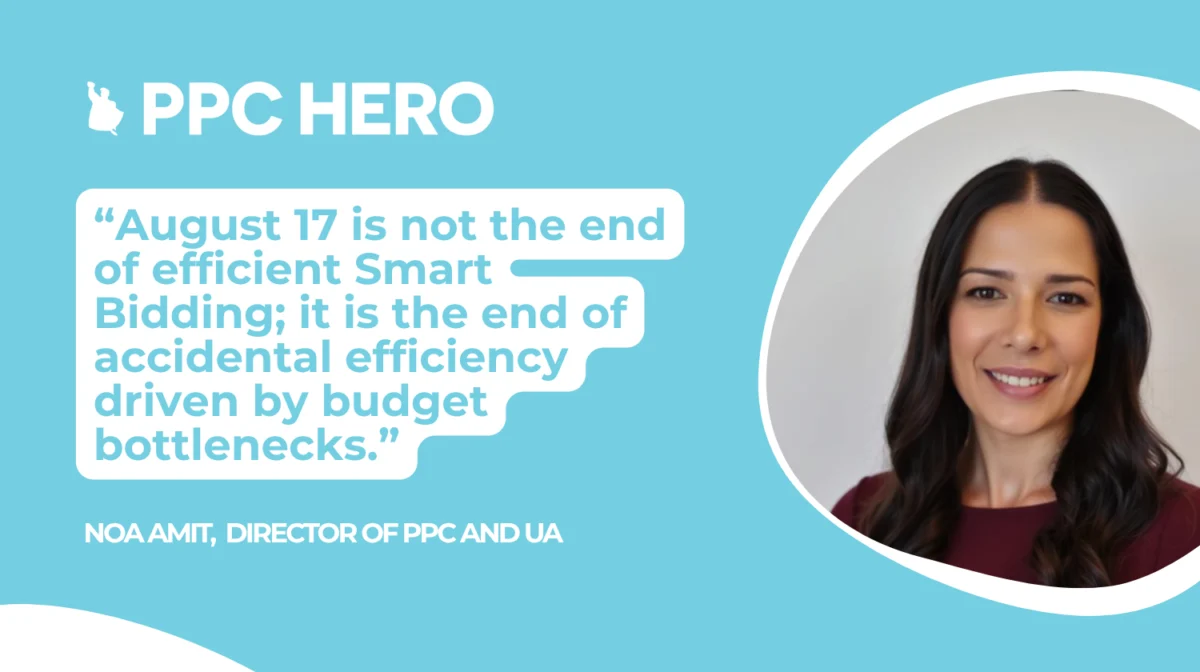
The core mechanic of the update is simple, yet its implications for campaign efficiency are profound. Since August 17, target-based bid strategies on budget-limited campaigns have begun optimizing toward the exact target set by the advertiser, rather than searching for the artificially superior numbers they previously managed to achieve.
To illustrate the shift, consider Google’s own baseline example: prior to the update, a campaign with a $10 Target CPA operating on a restricted budget might have naturally converted at $5 due to how the auction dynamics and delivery pacing interacted with the cap. Following the rollout, that same campaign now “delivers more closely to a $10 actual CPA,” capturing the volume allowed by the budget constraint while hitting the exact efficiency ceiling stipulated in the settings.
Scope of the Update
The algorithmic alteration is sweeping, affecting multiple campaign types across the Google Ads network:
- Included Campaign Types: Search, Shopping, Performance Max, Demand Gen, Display, Hotel, and Travel campaigns.
- Affected Bid Strategies: Target CPA and Target ROAS across all listed networks, alongside Target CPC specifically within Demand Gen campaigns.
- Exemptions: App campaigns and video reach or view campaigns retain their legacy behavioral framework.
Critically, two foundational rules remain unchanged:
- Unconstrained Campaigns: Campaigns that do not hit their daily budget limits were already delivering directly to their stated targets and continue to operate as they always did.
- Budget Respect: Google’s system still respects the hard limits of your daily budget. Daily caps, overall budgets, and the target numbers themselves were never altered by Google—they remain entirely the responsibility of the advertiser.
Chronology: From Legacy Quirks to the August 17 Realignment
Understanding how the ecosystem arrived at this juncture requires a brief look back at the historical relationship between budgets, targets, and machine learning within automated bidding.
The Era of the Algorithmic Loophole (Pre-2026)
For the better part of a decade, Google’s Smart Bidding relied heavily on signal processing that prioritized impression share and conversion volume within the strict confines of a daily budget. When an advertiser set a high Target CPA (meaning they were willing to pay more per conversion than the market actually demanded) while clamping down on the budget, the algorithm faced a mathematical puzzle. To spend the budget efficiently without wasting capital on overly expensive clicks, the system often sought out cheaper, high-converting inventory, resulting in a significantly lower actual CPA.
Marketers treated this as a feature, intentionally setting "lazy" or overly conservative targets knowing the algorithm would overdeliver on efficiency.
The Transition Phase and Rollout (August 17, 2026)
Recognizing that this behavior distorted true market demand and created discrepancies between advertiser inputs and algorithmic outputs, Google initiated a silent recalibration.
The update deployed gradually. While some enterprise accounts and early-adopter profiles noticed immediate shifts in their delivery metrics on day one, others experienced a staggered rollout over subsequent weeks. By late August, the new behavior was active across the board. The grace period for optimization adjustments closed simultaneously with the rollout, leaving marketers with no remaining window to prepare—only a landscape requiring immediate response.
Supporting Data and Sector Impact: Who Gets Hit Hardest?
While enterprise accounts with multi-million-dollar budgets and dedicated optimization teams often have the bandwidth to weather shifts in delivery mechanics, a specific segment of the market bears the brunt of this adjustment: Small and Medium-Sized Businesses (SMBs).
The SMB Vulnerability
In SMB accounts, "Limited by budget" is not a temporary warning—it is a permanent state of being for roughly half of all active campaigns. Small businesses frequently operate on tightly restricted monthly ad spends, forcing them to cap daily budgets aggressively. Furthermore, because internal marketing resources are often stretched thin, SMB accounts are notorious for harboring stale targets set years prior during initial onboarding phases.

When the August 17 update hit, these accounts were the first to register abnormal performance shifts. Campaigns that had quietly coasted on low actual CPAs suddenly saw costs drift upward toward the outdated targets configured years ago.
The "No-Break" Phenomenon
The most insidious aspect of this update is that it does not trigger traditional error notifications within the Google Ads UI.
- Spend remains within the daily budget.
- Conversion tracking remains active.
- Quality scores and ad relevancy metrics remain stable.
Instead, the only metric that changes is cost efficiency. Campaigns that previously beat their targets slowly drift upward to meet them. Because nothing technically "broke," unprepared advertisers often failed to diagnose the root cause of rising acquisition costs, misattributing the efficiency loss to external market shifts, seasonality, or audience fatigue.
Official Responses and Platform Perspective
Google’s structural philosophy behind the change centers on alignment, transparency, and intent. For years, the platform’s automated bidding advocates have argued that targets should act as genuine business boundaries rather than levers for algorithmic manipulation.
By enforcing the literal interpretation of Target CPA and Target ROAS, Google is shifting the paradigm: Targets are now reservation prices, not aspirations.
Platform representatives and industry insiders note that advertisers were effectively asking the system to achieve one thing while giving it parameters that forced another. By aligning delivery directly with stated targets on budget-constrained campaigns, Google’s machine learning models are now executing instructions precisely as written. The underlying message to the digital marketing community is unequivocal: control your efficiency using your targets, control your overall financial exposure using your budgets, and stop treating one mechanism as a substitute for the other.
Implications and Strategic Action Plan
The era of algorithmic charity is over. Advertisers can no longer rely on structural quirks to compensate for lazy target management. To restore campaign efficiency and protect profit margins, digital marketers must immediately execute a comprehensive four-step remediation plan.
1. Conduct an Immediate Budget-Limited Audit
Marketers must dive into their account histories to identify vulnerable structures:
- Filter all campaigns by the “Limited by budget” status.
- Pull performance data comparing the 30-to-90-day window before August 17 against the period since the rollout.
- Isolate campaigns that were previously outperforming their stated targets by a wide margin. These are the assets where the algorithmic correction is currently closing the gap, making them priority targets for immediate intervention.
2. Set Targets You Actually Mean
Google provides three distinct operational paths for campaigns caught in this transition. Advertisers must choose their path deliberately based on overarching business goals:
- Align to Recent Performance: If your goal is to recapture the high-efficiency metrics you enjoyed prior to the update, adjust your stated Target CPA or ROAS downward (or upward, depending on the metric) to match your historical actuals.
- Scale at Stated Targets: If your original target was calculated using strict unit economics, breakeven thresholds, and deliberate margin requirements, leave the target as-is. Accept the higher acquisition cost in exchange for the increased conversion volume now delivered by the system.
- Pivot to Maximize Conversions: For businesses operating under genuinely fixed, non-negotiable budgets where efficiency targets are secondary to sheer volume, drop the target entirely. Switching to Maximize Conversions or Maximize Conversion Value without a target allows the budget to act as the sole constraint—a configuration explicitly recommended by Google for fixed-budget scenarios.
3. Adjust Targets Gradually
Panic-driven, massive shifts in bidding strategy are dangerous. Modifying a target by more than 20% in a single adjustment triggers a fresh machine learning learning period. For a campaign that has just been re-baselined by Google’s update, subjecting it to an immediate algorithmic reset compounds volatility.
- Implement changes in incremental steps (under 20% per adjustment).
- Wait a full conversion cycle between changes to allow the model to stabilize.
- Adhere strictly to these foundational bid strategy hygiene rules to minimize performance turbulence.
4. Decouple Budget Control from Efficiency Control
The ultimate strategic takeaway is a permanent mindset shift. Advertisers must stop using unrealistic efficiency targets as a proxy mechanism for restricting ad spend.
- Budgets dictate how much volume you can buy.
- Targets dictate how efficiently you are willing to buy it.
Treating these two levers as distinct tools ensures that automated bidding engines receive clear, unambiguous instructions.
Conclusion
The recent update to Google Smart Bidding serves as a stark reminder that digital marketing platforms are continuously evolving toward stricter, more literal interpretations of user inputs. The advertisers currently suffering from inflated acquisition costs are rarely those running highly aggressive, meticulously updated targets; rather, they are the practitioners who set a baseline number years ago and allowed it to gather digital dust.
The free lunch in budget-limited campaigns is officially off the menu. It is time to log into your Google Ads account, audit your constraints, and ensure your targets reflect reality.