
In the modern digital landscape, the User Experience (UX) practice has expanded exponentially, growing alongside vital sub-disciplines like content strategy, operations, and user research. As UX research matures as a corporate discipline, scalability has become the defining metric of success. Organizations must now meet the rapid, iterative demands of agile product development without sacrificing the quality of human insight.
While numerous methodologies exist to scale user research—including optimizing researcher-to-designer ratios, leveraging big data, real-time analytics, and research democratization—one approach has emerged as uniquely transformative: the Rapid Research program. By standardizing and templatizing operations, Rapid Research equips teams with quick, actionable insights from end-users at an unprecedented operational speed, seamlessly aligning with agile product sprints.
Main Facts: What Is Rapid Research and Why Is It Essential?
Rapid Research is a structured operational model where traditional user research practices are standardized, templatized, and bound by strict guardrails to deliver a repeatable cadence of insights—often on a weekly cycle. Rather than replacing deep-dive, exploratory research, a Rapid Research program acts as a specialized engine designed to answer tactical, high-priority questions within tight operational windows.
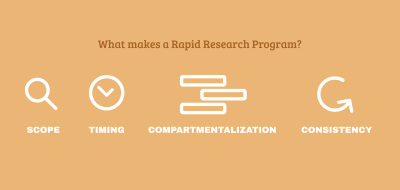
The core framework of a successful Rapid Research program rests on four foundational pillars:

- Scope: Selecting methods (such as streamlined usability tests) that fit within 1- to 2-week increments, managing smaller sample sizes, and targeting easily accessible participant pools.
- Timing: Compressing end-to-end project timelines to drastically outperform traditional studies.
- Compartmentalization: Breaking the research workflow into independent, modular blocks (e.g., separating participant recruitment from discussion-guide creation) to eliminate bottlenecks.
- Consistency: Establishing a predictable cadence so stakeholders know exactly what to expect, ensuring the program remains truly "rapid" over time.
By shifting evaluative tasks into this streamlined ecosystem, organizations free up expert researchers to tackle complex, generative discovery work that drives long-term innovation.
Chronology: The Evolutionary Trajectory of Enterprise UX Research
The necessity for Rapid Research is best understood through the historical evolution of UX teams within large corporations. Tracking this trajectory reveals how traditional research models buckle under the weight of modern agile development, necessitating structural intervention.
Phase 1: Reactive Growth and Bottlenecks
Consider the trajectory of a UX research team at a major US telecommunications provider, which scaled organically from just four practitioners to over 25. Initially, this expansion was celebrated as a victory for human-centric design. However, as product development accelerated, the demand for human insight quickly outpaced supply.
Product teams frequently brought researchers in at the eleventh hour merely to validate pre-existing ideas. Consequently, researchers became trapped in a reactive cycle of purely evaluative work. This dynamic stifled long-term innovation and alienated senior researchers who craved deeper, generative discovery projects.
Phase 2: Diagnostic Auditing and Portfolio Balancing
To resolve this unsustainability, organizational leadership initiated a multi-pronged overhaul of the research portfolio. This included establishing quarterly planning sessions, introducing a democratization program, and launching a dedicated Rapid Research initiative.
Leadership began by auditing the previous year’s research data. They analyzed average timelines, identified the most common methodologies deployed for mid-sized iterative projects, and mapped out primary customer profiles.
Phase 3: Strategic Staffing and Vendor Integration
Lacking an immediate budget to hire junior researchers specifically for the rapid program, the team devised an alternative staffing model. They partnered with an established external research vendor with whom they had multi-year relationships, embedding vendor researchers directly into the rapid cadence. This hybrid model immediately unlocked high-volume throughput without compromising core staff bandwidth.
Supporting Data: The Measurable Impact of Streamlined Insights
Implementing a Rapid Research program yields quantifiable returns across financial, operational, and strategic dimensions. Organizations that successfully stand up these frameworks consistently report the following data-driven impacts:
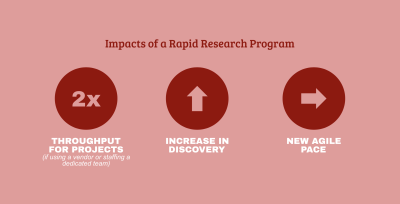
- Doubled Throughput: Utilizing a dedicated team or integrated vendor model can double an organization’s project throughput, allowing teams to deliver more research, more frequently.
- Exponential Cost Savings: Catching usability issues upstream during rapid evaluative cycles saves businesses significant downstream remediation costs. Industry benchmarks suggest that fixing an error post-launch can cost up to 100 times more than addressing it during early iterative design phases.
- Sprint Synchronization: End-to-end research cycles are successfully compressed to fit within standard 2-week agile development sprints.
- Enhanced Generative Capacity: By offloading tactical, evaluative requests to the rapid program, core UX teams reclaim significant bandwidth to focus on strategic, generative discovery.
The Balancing Act: Pros and Cons
| Pros | Cons |
|---|---|
| Delivers actionable insights at unprecedented speeds. | Limited suitability for complex, longitudinal, or deeply exploratory studies. |
| Integrates seamlessly into 2-week agile sprints. | Requires strict initial alignment and upfront infrastructure building. |
| Frees senior researcher bandwidth for generative work. | Risk of participant fatigue or recruiting bottlenecks if profiles are too narrow. |
| Doubles overall organizational research throughput. | Demands rigorous consistency to prevent stakeholder confusion. |
Official Responses and Strategic Frameworks
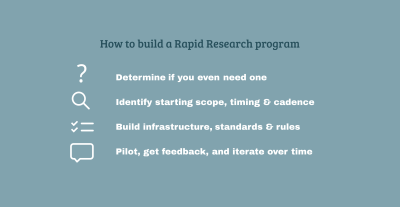
Building a successful Rapid Research program requires rigorous planning, cross-functional buy-in, and a disciplined four-step implementation roadmap. Industry leaders and UX authorities advocate for a methodical approach before committing resources.
Step 1: Determine Program Necessity
Before writing a single template, organizations must evaluate whether a rapid program is actually required. Teams should audit incoming request types, interview product partners, and explicitly define what the program cannot do. Rapid research is fundamentally unsuited for deeply nuanced behavioral studies, longitudinal diary studies, or massive quantitative market sizing.
Step 2: Define Scope, Timing, and Cadence
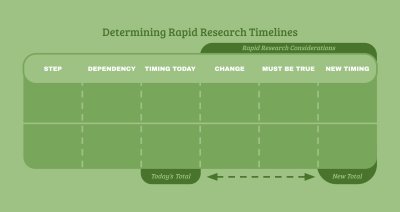
Foundational scope decisions dictate future success. Teams must select participant profiles that strike a careful balance: specific enough to yield relevant data, yet broad enough to recruit effortlessly without stalling project velocity. Furthermore, teams should document their current research workflows—including steps, dependencies, and timelines—and map them against projected efficiencies to ensure the new "rapid" timeline offers a distinct competitive advantage.
Step 3: Build Infrastructure, Standards, and Rules
Infrastructure development requires securing stakeholder buy-in and budget before drafting operational documentation. Key elements include:
- Standardized Templates: Reusable screening surveys, moderation guides, and reporting frameworks.
- Defined Staffing Models: Leveraging dedicated internal headcount, embedded junior researchers, or trusted agency vendors.
- Clear Guidance: Establishing playbooks and SLAs (Service Level Agreements)—such as a 24-hour turnaround for legal and compliance reviews—to educate cross-functional partners on program boundaries.
Step 4: Pilot, Gather Feedback, and Iterate
No program launches flawlessly. Organizations should treat their first series of rapid research projects as live pilots. By partnering closely with trusted stakeholders during this trial phase, teams can collect real-time feedback, identify operational friction points, and iteratively refine their templates and timelines.
Implications for the Future of UX Practice
The institutionalization of Rapid Research carries profound implications for enterprise product development. As markets grow increasingly competitive, the organizations that win will be those that integrate customer feedback into their decision-making loops instantaneously.
Cultural and Operational Shifts
When executed correctly, Rapid Research transforms the relationship between UX practitioners and product development teams. Research ceases to be viewed as a bureaucratic speed-bump or an afterthought used to rubber-stamp completed designs. Instead, it becomes an active, pulsing heartbeat within the product lifecycle, informing every iteration in real time.
Sustainable Scaling
Ultimately, the transition toward rapid, templatized insights ensures that user experience practices can scale alongside corporate growth. By carefully balancing scope, timing, compartmentalization, and consistency, organizations can future-proof their research ecosystems.
As the industry continues to evolve, companies that embrace Rapid Research will unlock untapped ROI opportunities, empower their talent to focus on high-impact innovation, and deliver digital experiences that precisely and continuously resonate with their users’ changing needs.