PARIS — France’s premier data protection authority, the Commission Nationale de l’Informatique et des Libertés (CNIL), has officially closed its compliance order against Solocal Marketing Services. The decision marks the final chapter in a high-profile enforcement action that began earlier this year when the digital marketing firm was slapped with a staggering €900,000 fine for orchestrating unauthorized email and SMS marketing campaigns.
The closure, formalized in a decision dated September 17 and publicly released by the CNIL on September 24, highlights a rare regulatory milestone: a major data protection agency explicitly validating a specific methodology for vetting third-party lead generation. While the fine stands as a stark reminder of corporate accountability under European Union data protection laws, the subsequent resolution provides a practical blueprint for companies relying on purchased consumer data.
However, legal experts and compliance professionals warn that the ruling comes with a heavy caveat. Rather than offering a loophole for list brokers, the CNIL’s decision reinforces the strict doctrine that responsibility for consumer consent can never be outsourced.
Main Facts: The Anatomy of a €900,000 Enforcement Action
At the core of the dispute is Solocal Marketing Services, a prominent French digital marketing enterprise that specializes in outsourced electronic prospecting. Unlike companies that cultivate their own proprietary marketing lists through direct customer interactions, Solocal operates primarily as an intermediary. It acquires consumer contact profiles en masse from external data brokers, online prize competition portals, and product-testing platforms. Leveraging these acquired databases, Solocal executes large-scale SMS and email marketing campaigns on behalf of third-party corporate advertisers.
The enforcement saga commenced in May 2025, when the CNIL published findings from an extensive investigation into Solocal’s data acquisition practices. The regulatory body discovered a systemic failure in how consent was being harvested by Solocal’s upstream partners. Specifically, the CNIL determined that the sign-up forms utilized by the data brokers were artfully engineered to mislead consumers.
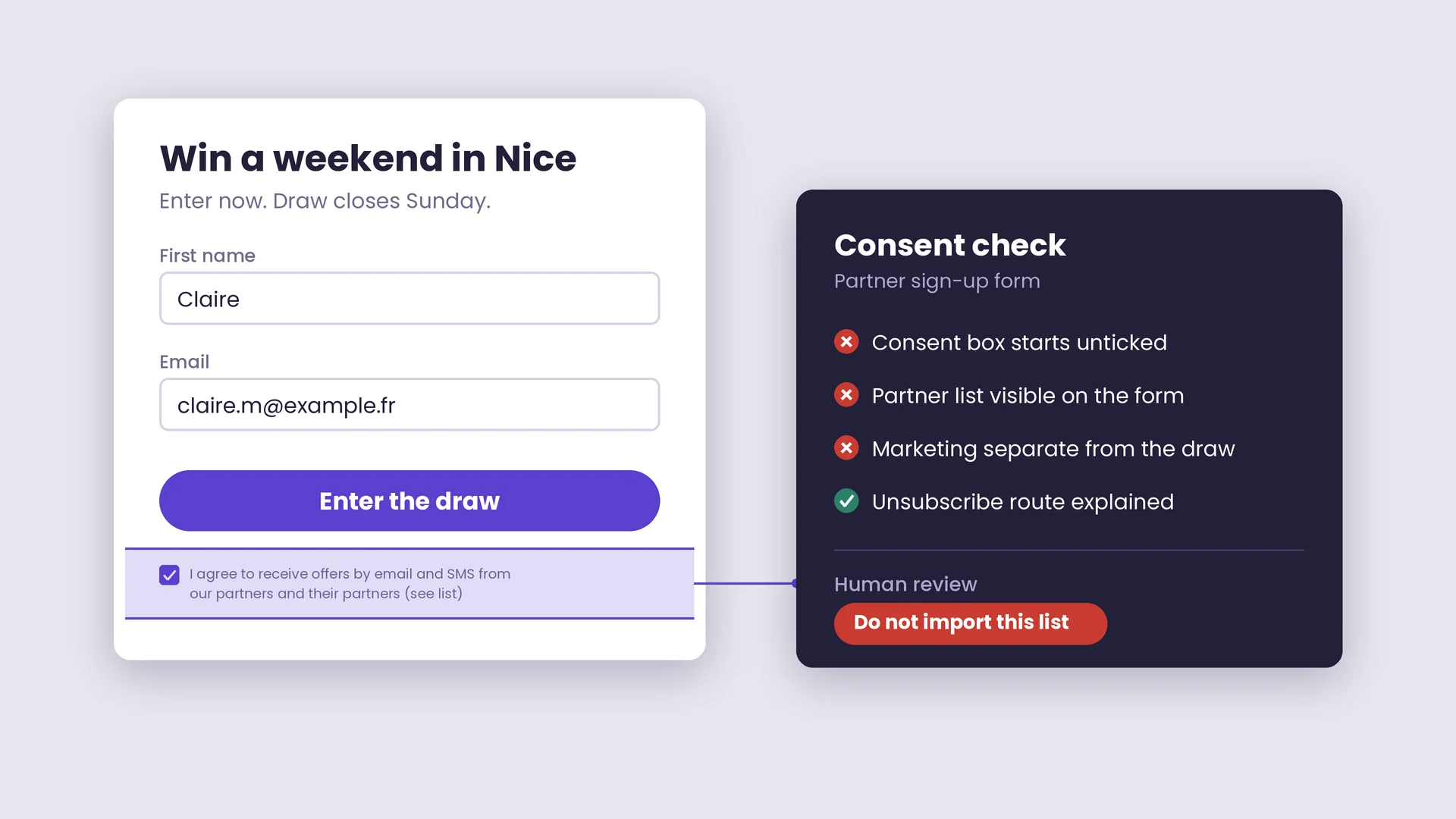
Under the stringent requirements of the General Data Protection Regulation (GDPR) and the European Union’s ePrivacy Directive, valid consent must be freely given, specific, informed, and unambiguous. The CNIL found that the forms utilized by Solocal’s suppliers failed these tests miserably, often relying on pre-ticked boxes, hidden opt-outs, or deceptive phrasing that tricked users into unknowingly subscribing to third-party marketing lists.
Because the foundational consent was legally void, Solocal possessed no valid legal basis under Article 6 of the GDPR to bombard those consumers with commercial communications. Consequently, the CNIL imposed a €900,000 financial penalty. More critically for the company’s ongoing operations, the regulator issued a formal injunction giving Solocal a strict nine-month deadline to completely overhaul its data intake procedures and halt all electronic prospecting derived from invalid consent. To enforce compliance, the CNIL attached a punitive daily fine of €10,000 for every day the company remained in violation past the expiration of the grace period.
Chronology of the Case: From Regulatory Sanction to Compliance Validation
The timeline of the Solocal enforcement action illustrates the aggressive posture European regulators are taking against illegal commercial prospecting, as well as the rapid operational shifts required of targeted enterprises.
- May 2025: The CNIL publicly releases its sanction decision, levying a €900,000 fine against Solocal Marketing Services. Alongside the financial penalty, the regulator issues an injunction requiring the company to achieve full compliance regarding its consent-gathering mechanisms within nine months, backed by a €10,000 daily default penalty.
- May 2025 – January 2026: Facing the existential threat of compounding daily fines and reputational ruin, Solocal undertakes a comprehensive restructuring of its data procurement and verification pipeline. The company develops and implements a dual-layer auditing system designed to inspect the actual web forms used by its data suppliers rather than merely accepting contractual assurances.
- September 17, 2025: Following submissions from Solocal detailing its newly implemented technical and human verification protocols, the restricted formation of the CNIL evaluates the remedial measures. Finding them satisfactory, the regulator formally signs a decision to close the injunction order.
- September 24, 2025: The CNIL officially publishes the closure notice on its website, confirming that Solocal successfully met the compliance deadline and that the potential daily penalties have been entirely waived.
Supporting Data and Remedial Mechanics: How Solocal Fixed the Problem
The most remarkable aspect of the Solocal case lies in the specific mechanism the company devised to satisfy the French regulator—and the CNIL’s willingness to accept it.
Typically, data protection regulators worldwide maintain an arms-length relationship with the regulated community. Agencies excel at identifying compliance failures, detailing statutory breaches, and issuing penalties, but they rarely offer prescriptive solutions. Companies are usually left to guess at the precise technical controls required to satisfy regulatory expectations, often learning whether their fixes are legally sound only through subsequent audits or repeat fines.
In Solocal’s case, however, a clear, repeatable methodology was established and endorsed. To prove that the contact lists it purchased complied with GDPR consent standards, Solocal instituted a rigorous vetting protocol:
- Automated Software Analysis: Solocal deployed specialized compliance software designed to crawl, scan, and analyze the digital sign-up forms utilized by its network of data brokers and partner websites. This technology inspects the layout, language, and mechanics of the data-collection interfaces.
- Human Review and Verification: Recognizing that automated tools can miss contextual nuances or deceptive visual cues, Solocal instituted a mandatory human review layer. Compliance officers manually assess the software’s findings, verifying that the user experience on the partner’s site genuinely meets the high bar for "freely given and unambiguous" consent.
When presented with this dual verification framework, the CNIL accepted it as an adequate control mechanism. Because Solocal demonstrated that it had successfully audited its supply chain and purged non-compliant lead sources prior to the deadline, the regulator waived the accumulating daily penalties and officially closed the case file.
Official Responses and Regulatory Guidance
The CNIL’s official statements accompanying the closure of the injunction offer critical insights into the regulatory mindset governing data brokers and list buyers. While the agency acknowledged Solocal’s proactive pivot, its closing notes served as a stern warning to the broader direct-marketing industry.
The regulator emphasized that the implemented checks are only effective if they are applied with absolute, unyielding scrupulousness. The CNIL’s enforcement posture makes it clear that Solocal remains legally and entirely responsible for every single piece of consumer consent collected by its partners on its behalf. Implementing an automated scanning tool does not grant a company immunity; if a poorly designed, deceptive sign-up form slips past Solocal’s internal controls and results in an unauthorized text message or email, Solocal remains fully liable for the GDPR violation.
In its public commentary, the regulator reiterated a fundamental principle of European data privacy law: Buying a database does not buy you out of the consent problem.
Data brokers frequently sell comprehensive compliance guarantees, contractually indemnifying buyers against regulatory action. However, the CNIL’s position reinforces the reality that private contracts between commercial entities cannot override statutory obligations under European law. A broker’s contractual promise that data was "opt-in" holds zero legal weight before a data protection authority if the underlying collection mechanism violates the GDPR.
Implications for European Digital Marketing and Data Brokers
The ramifications of the Solocal case extend far beyond French borders, carrying profound implications for digital marketers, email service providers (ESPs), and lead-generation brokers across the entire European Economic Area (EEA).
The Death of Blind Trust in Data Brokers
For years, many digital marketing agencies operated under a convenient fiction: that acquiring contact lists from third-party brokers insulated the mailer from consent obligations. The logic was that the broker, as the collector of the data, bore the primary responsibility for securing valid opt-ins.
The CNIL’s enforcement action—and its subsequent conditional acceptance of Solocal’s vetting method—shatters this assumption. Under the GDPR and the ePrivacy rules, the legal responsibility for consent rests squarely on the shoulders of the entity that initiates the commercial communication. The sender is the beneficiary of the marketing campaign, and therefore the sender must verify the pedigree of every address on the list. The CNIL has effectively established that while a broker’s word is worthless as a defense, auditing the broker’s forms yourself just might save you from a ruinous fine.
Technical and Operational Realities for Senders
For legitimate senders operating within the EU, the Solocal precedent introduces both a path forward and a significant operational burden. Companies that rely on co-registration or external lead generation must now invest heavily in compliance infrastructure. Simply trusting an upstream partner is no longer legally tenable; businesses must deploy software tools and dedicate human compliance personnel to continuously audit external data collection points.
Yet, many industry veterans argue that purchased data was already a dying asset. Long before regulatory bodies like the CNIL began issuing six-figure fines for co-registration abuses, the technical realities of email deliverability had already rendered purchased lists toxic.
Purchased databases are notoriously rife with:
- Spam Traps: Hidden email addresses planted by mailbox providers and anti-spam organizations specifically to catch senders who harvest or buy lists without permission. Hitting a spam trap can catastrophically damage a sender’s domain reputation, instantly tanking inbox placement rates.
- High Complaint Rates: Because recipients on purchased lists do not remember signing up—often because the original sign-up form was buried in fine print or deceptive prize-draw mechanics—they immediately mark incoming messages as spam. High complaint volumes alert Internet Service Providers (ISPs) to block the sending infrastructure.
- Inactive and Invalid Addresses: Data rotting degrades purchased lists rapidly, resulting in high bounce rates that signal poor list hygiene to major inbox providers like Gmail, Microsoft, and Yahoo.
Consequently, most reputable, enterprise-grade Email Service Providers (ESPs) and marketing automation platforms banned the use of purchased lists years ago as a matter of standard platform policy.
A Clear Signal to the Industry
The Solocal case serves as a watershed moment for European data privacy enforcement. It demonstrates that regulators are willing to recognize and accept genuine, proactive compliance efforts by corporations caught in regulatory crosshairs. However, it simultaneously closes off any remaining ambiguity regarding outsourced data collection.
For digital marketers, the message from Paris is unambiguous: compliance cannot be outsourced, consent cannot be assumed based on a broker’s contractual guarantee, and every digital touchpoint must withstand rigorous regulatory scrutiny. Companies wishing to utilize external data sources must adopt the rigorous audit standards validated by the CNIL—or face the inevitable financial and operational consequences.