In the modern digital landscape, the success of a product is rarely dictated solely by the technical brilliance of its code or the individual talent of its designers. Instead, industry experts increasingly point to a broader, more systemic driver of success: UX maturity.
Defined as the presence, depth, and sophistication of user experience (UX) practices within an enterprise, organizational maturity goes far beyond individual skill sets. It encompasses the underlying processes, corporate philosophies, and operational tools that shape product development and business strategies.
As noted by UX scholars Chapman and Plewes, achieving exceptional design is not simply a function of individual talent; it is an organizational characteristic. For UX professionals, this reality introduces a profound mandate: being exceptional at one’s daily tasks is no longer enough. Practitioners must step into the roles of advocates and educators, working strategically to cultivate UX maturity across their entire enterprise.
The Core Concept: Understanding UX Maturity
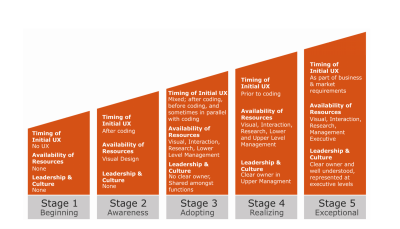
UX maturity models provide a crucial framework for organizations to evaluate where they stand and map out where they need to go. While various frameworks exist—cataloged extensively by researchers like Natalie Hanson—Chapman and Plewes’ five-stage model remains a benchmark for the industry. These stages range from "Beginning" (where UX is virtually non-existent) to "Exceptional" (where user-centricity is fully embedded into business processes, adequately resourced, championed by leadership, and supported by a thriving corporate culture).

While many modern organizations have graduated past Stage 1, countless others find themselves lingering in the early "awareness" phases. In these environments, product teams often operate in silos, leadership views design as an afterthought, and budgets for user research are the first to be slashed during financial contractions.
To break free from this cycle, practitioners must move beyond theoretical frameworks and deploy actionable tactics. Successfully navigating this challenge requires two foundational strategies particularly suited for organizations with low initial maturity: identifying and leveraging UX champions and demonstrating clear Return on Investment (ROI).
Tactic 1: Cultivating and Empowering UX Champions
In large organizations, driving cultural or structural change from the bottom up can feel like an uphill battle. Innovation diffusion research has long demonstrated that overcoming institutional, social, and political barriers requires a vital catalyst: the champion.
Identifying the Right Advocates
Champions are individuals within an organization who enthusiastically support the growth of a new idea or innovation. Crucially, UX champions do not need to be practicing designers or researchers. Rather, they are key stakeholders positioned across various departments who recognize the value of user-centricity and possess the network and social capital to advocate for it.
When looking to cultivate a UX champion, practitioners should ask targeted filtering questions:
- Who willingly spends time and energy on ideas they believe in?
- Who manages a product or service that would see an immediate benefit from improved UX?
- Who has a proven ability to build and maintain cross-functional networks?
- Who has expressed frustration with current, broken development workflows?
Case Study: Logistics Transformation
Consider the experience of a consultant brought into a major international logistics company undergoing a massive backend technology transformation. Despite corporate claims of being "customer-first," the enterprise lacked a unified UX process, treating user research as an ad-hoc afterthought.
Instead of targeting executive leadership immediately, the consultant identified a key product owner during preliminary stakeholder interviews. This individual was highly motivated, well-connected, and managing a product critical to the company’s overarching goals. Though lacking executive title power, this champion possessed the intrinsic traits of an innovation leader: they opened doors, integrated usability testing into active workflows, and connected the design team with key decision-makers.
Within three months, this partnership established a formal repository of research reports, embedded a repeatable UX integration process, and ultimately secured permanent, dedicated UX headcount for future product cycles.

Tactic 2: Demonstrating the Tangible ROI of UX
While user advocates are vital for cultural momentum, executives and financial decision-makers ultimately look through the lens of profit, loss, and operational efficiency. To secure long-term buy-in, UX practitioners must master the art of demonstrating Return on Investment.
Overcoming the Myths of UX Metrics
The Nielsen Norman Group outlines several persistent myths that prevent organizations from calculating UX ROI—chief among them the belief that user experience is inherently "too subjective" to measure. In reality, ROI extends far beyond direct monetary calculations. Depending on the industry and product type, organizations can leverage a wide array of Key Performance Indicators (KPIs):
- Efficiency Metrics: Task completion time and learning curves for internal tools.
- Support Metrics: Volume of calls routed to customer service help desks.
- Engagement Metrics: App store ratings, review platform scores, and cart abandonment rates.
By establishing clear benchmarks—even if measured mid-project rather than retroactively—teams can construct compelling business cases that speak directly to the C-suite’s priorities.
Case Study: Navigating Insurance Platform Rollouts
A large medical insurance provider acquired multiple smaller companies over a decade, resulting in a fragmented ecosystem of internal agent tools. To streamline operations, the provider initiated a phased rollout of a unified platform without allocating any budget for UX oversight.

The rollout hit an immediate wall. Independent agents abandoned the software in droves, and exclusive agents flooded call centers with frantic requests for assistance on basic tasks like generating quotes. The company paused subsequent releases.
Brought in to establish a usability workstream, the UX team immediately conducted user interviews and usability tests to identify friction points. To justify continued funding to the executive committee, the project leaders collaborated with the UX team to establish a metrics dashboard tracking user satisfaction, quote volumes, and call center ticket frequencies.
By comparing the struggling Phase 1 rollout against the newly optimized Phase 2 release, the team provided undeniable proof that UX intervention directly reduced support costs and accelerated agent productivity. The executive committee subsequently approved ongoing funding, cementing user research as a mandatory component of all future digital initiatives.
Implications and the Road Ahead
Increasing UX maturity is a shared responsibility that yields dividends for organizations, product teams, and end users alike. As the case studies demonstrate, successfully scaling UX maturity requires deliberate action: identifying influential internal allies and grounding design arguments in hard, quantifiable data.

Cultivating organizational maturity is rarely a linear journey. It demands persistence, strategic communication, and a willingness to speak the language of business. By leveraging champions and proving financial and operational value, UX practitioners can transform their organizations from reactive environments into mature, truly customer-centric enterprises.
This article is the first in a three-series exploration into scaling UX maturity. Subsequent installments will examine internal documentation, mentorship structures, and enterprise-wide UX education.