Introduction
As artificial intelligence continues its relentless march across the technological landscape, the conversation surrounding its implementation has often been characterized by fatigue. Industry professionals are bombarded daily with exaggerated claims, fragmented updates, and an unrelenting stream of buzzwords. For WordPress agency owners and freelancers, the noise can be overwhelming.
However, beneath the surface-level chatter about automated content generation and rapid site deployment lies a much more profound and practical transformation. AI is quietly reshaping the backbone of WordPress agencies—not just by altering how websites are built, but by fundamentally transforming internal processes, standard operating procedures (SOPs), customer communication, and service offerings.
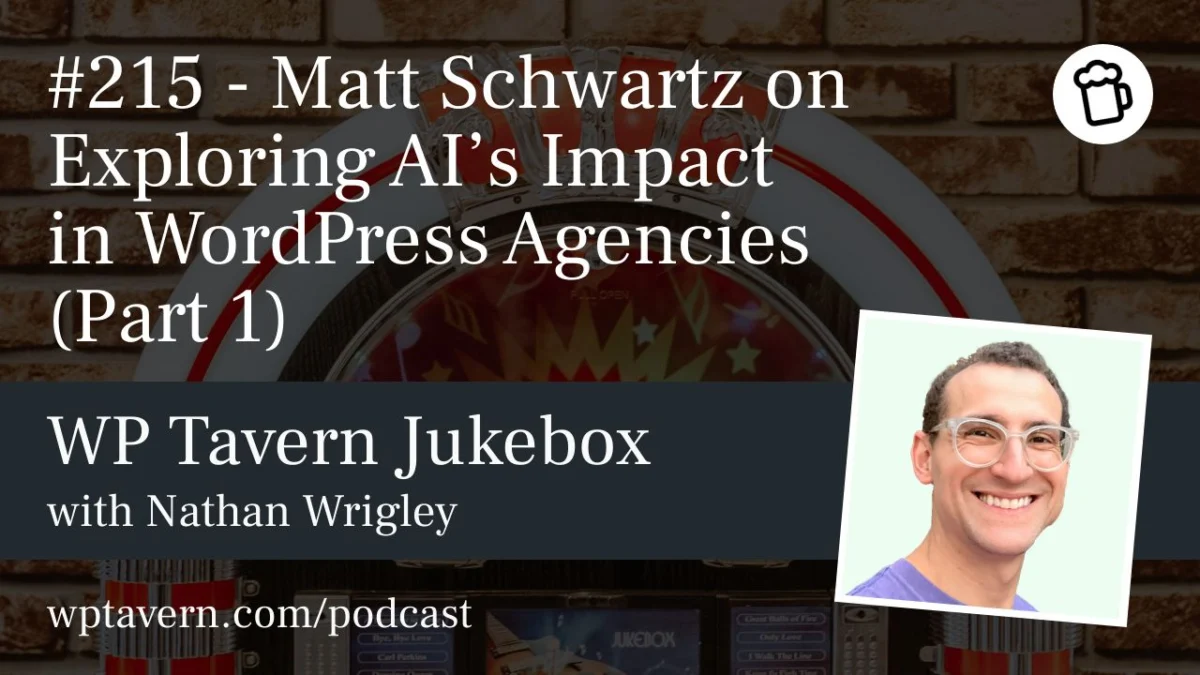
In a recent episode of the Jukebox Podcast from WP Tavern, host Nathan Wrigley sat down with Matt Schwartz, founder of Inspry, an Atlanta-based WordPress and WooCommerce agency established in 2011. Schwartz, who also manages the WordPress testing product CheckView, offered a grounded, strategic perspective on how agency owners can navigate the AI landscape intentionally. Rather than focusing solely on visual execution, Schwartz and Wrigley explored the behind-the-scenes integration of AI, offering a blueprint for agencies looking to stay competitive as the floor of execution rises.
Main Facts
- The Evolving Agency Landscape: Execution is rapidly becoming a commodity in the web design industry. Basic brochure sites can now be spun up in minutes, raising client expectations and forcing agencies to shift focus toward high-level strategy and operational value.
- Process Over Pixels: The most effective use of AI in a modern WordPress agency is not necessarily in building the front-end interface, but in streamlining back-end workflows, client touchpoints, and operational efficiency.
- The AI Vision Document: Agency leaders are encouraged to establish a formal "AI Vision Document" to set clear guardrails, outline permitted use cases, and define boundaries for employees and contractors.
- Expanding Service Offerings: AI allows agencies to offer advanced services—such as deep data analysis, automated workflows, and lightweight internal applications—at price points that were previously inaccessible to small and medium-sized businesses.
- The Human-in-the-Loop Imperative: Despite vast improvements in debugging and automated support, critical agency moments still demand human oversight to maintain ethical standards, brand reputation, and quality control.
Chronology of the Conversation: From Early Days to the AI Shift
The dialogue between Wrigley and Schwartz traced a familiar path for many veteran web professionals, highlighting how the industry has evolved over the past decade.
Stumbling into Web Design
Reflecting on their origins, both Wrigley and Schwartz shared similar entry points into the digital space. Schwartz began building websites as a middle schooler, experimenting with HTML and managing early web templates. What started as a childhood hobby—building sites for school clubs and eventually landing his first paid gig for a local dentist—evolved into a lifelong career.
Graduating with a degree in Information Systems during the peak of the Drupal era, Schwartz ultimately chose to stick with web development rather than traditional consulting. Like many solo operators and agency founders, this trajectory meant learning the business on the fly. Without corporate playbooks or pre-established SOPs, early web designers had to invent their own pricing models, email templates, and project pipelines.
The Seismic Shift of AI
For the first two decades of modern web development, technological advancements were largely incremental. Software-as-a-Service (SaaS) platforms improved gradually, and project management tools evolved in predictable steps.
However, the past three to four years have shattered that incremental pace. The introduction of generative AI and intelligent agents has compressed timelines that once took weeks into mere minutes. This compression has altered the fundamental calculus of client expectations. Where a $5,000 brochure site might once have required weeks of manual wireframing and discovery, clients are increasingly aware that foundational execution can be accelerated drastically through automation.
Supporting Data and Operational Insights
As execution becomes commoditized, agencies are forced to examine where true value lies. Schwartz emphasizes that clients rarely notice the technical underpinnings of a website outside of its design; instead, they judge an agency based on its workflow, responsiveness, and overall touchpoints.
The AI Vision Document: Bringing Intentionality to Operations
To combat reactionary, ad-hoc adoption of AI tools, Schwartz introduces the concept of an AI Vision Document. Rather than blindly injecting AI into every facet of a business, agency owners should audit their time-tracking software (such as Everhour) and historical task data to identify repetitive bottlenecks.
An AI Vision Document serves multiple purposes:
- Defining Guardrails: It establishes clear boundaries regarding where AI is permissible (e.g., drafting proposals, meeting summaries) and where it is strictly prohibited (e.g., unverified code deployment, final client-facing support interactions).
- Mitigating Risk: It protects the agency’s reputation by preventing unmonitored AI outputs from reaching clients.
- Team Alignment: It ensures that all employees and contractors operate under the same standardized guidelines.
Transforming Support Workflows
Support desks represent some of the most sensitive touchpoints in agency-client relationships. While tools powered by platforms like n8n can ingest error logs, server APIs, and historical ticketing data to suggest rapid resolutions, caution is paramount.
Introducing poorly implemented automation during a moment of client frustration can quickly escalate dissatisfaction. The goal of AI in support should be to equip human support teams with comprehensive context and rapid diagnostic insights, rather than replacing the human element entirely.
Official Perspectives and Industry Implications
The conversation highlighted a broader philosophical question facing digital agencies: How do you position your business when the tools to build websites become universally accessible?
AI as a Core Service Offering
Rather than viewing AI as a threat, forward-thinking agencies are packaging their AI expertise as a distinct service offering. By utilizing automation tools and advanced data analytics, agencies can offer services that were previously too labor-intensive for smaller budgets.
For instance, analyzing a client’s historical customer service logs to build targeted buyer personas or deploying lightweight internal applications can completely transform a client’s business efficiency. By focusing on business outcomes—saving clients money, streamlining internal workflows, and optimizing sales funnels—agencies shift the conversation away from the subjective value of a standard brochure site.
WordPress as the Ultimate Scaffolding
On the technical front, the WordPress ecosystem has made significant strides in preparing for an AI-driven future. Core development teams are actively building foundational capabilities that allow external agents and internal tools to interact seamlessly with the WordPress REST API and block editor.
Rather than trapping users inside a rigid administrative interface, WordPress is evolving into a reliable infrastructure upon which AI agents can operate. Developers and agency owners can leverage tools like Claude and specialized third-party debugging agents to troubleshoot complex PHP issues and manage content updates more efficiently than ever before.
Conclusion: Balancing Innovation with Human Oversight
As this first part of the discussion demonstrates, the integration of AI into WordPress agencies is no longer a futuristic concept—it is an operational reality. However, the most successful agencies are those that approach AI with strategic intent rather than blind enthusiasm.
By establishing clear vision documents, streamlining internal processes, enhancing support workflows with caution, and expanding service offerings into high-value automation, agency owners can thrive amidst rapid industry changes. Yet, as Schwartz aptly noted, the underlying rule remains unchanged: until AI can be trusted implicitly, the human-in-the-loop is non-negotiable.
Stay tuned for Part Two of this conversation, where Matt Schwartz and Nathan Wrigley dive deeper into the ethical considerations, advanced development workflows, and the future outlook for WordPress agencies.