Executive Summary: The Narrative Shift
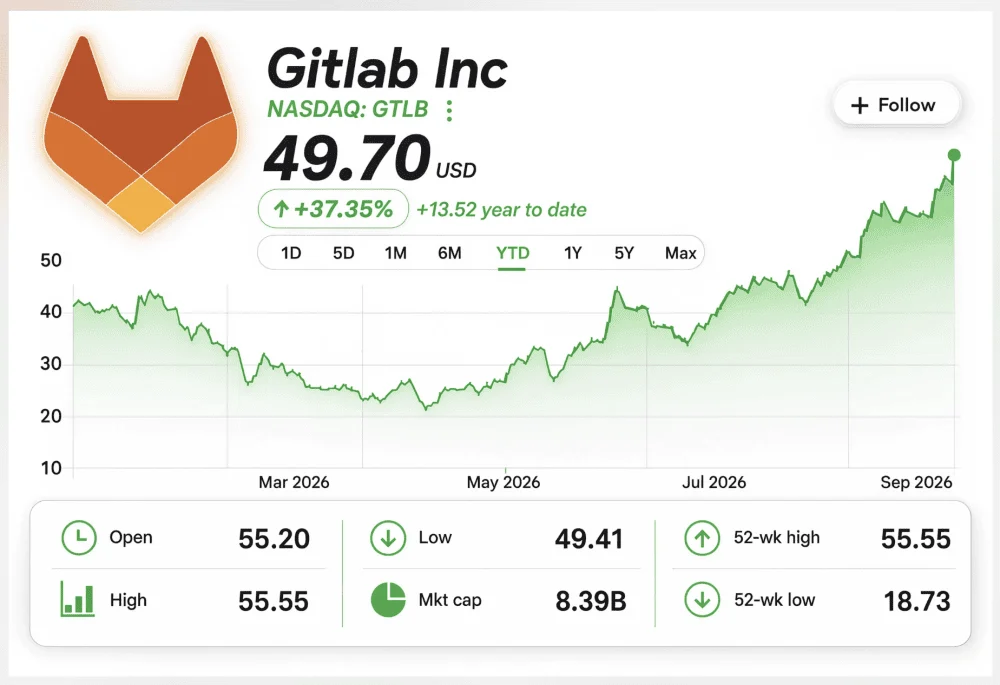
Just four months ago, market sentiment viewed GitLab as a prime candidate for disruption—a classic casualty in the public B2B software sector threatened by the rapid democratization of AI-driven coding assistants. However, the release of GitLab’s Q2 FY27 financial results after the market close completely upended that narrative.
While top-line reported revenue growth of 21% initially caught the eye, a deeper inspection revealed a much more aggressive undercurrent: calculated billings surged by 24% (doubling the prior quarter’s 12%), gross bookings reached an all-time company record, and management simultaneously issued a conservative Q3 revenue guide that sits below Q2 actuals.
For founders, operators, and public market investors alike, understanding how these seemingly contradictory financial indicators coexist offers a masterclass in modern SaaS business model transformation, revenue recognition mechanics, and the heavy price of scaling enterprise artificial intelligence.
Main Facts: The Numbers That Matter
At first glance, GitLab’s Q2 performance presents a labyrinth of contrasting growth metrics. Dissecting the core financials clarifies the actual health of the underlying business:
- Reported Revenue: Reached $286.3 million, marking a 21% increase from $236.0 million in the same period last year.
- Calculated Billings & Bookings: Calculated billings jumped 24% year-over-year, a massive acceleration from the 12% recorded in Q1. Furthermore, gross bookings hit the highest mark in the company’s history.
- The Q3 Guidance Paradox: Management guided Q3 revenue to a range of $281 million to $283 million—technically below the $286.3 million printed in Q2. This represents a projected 15% to 16% year-over-year growth rate against the 21% just delivered.
- Net ARR Growth Misinterpretations: Both the CEO and CFO frequently cited a "net ARR" growth figure of 42% during the earnings call, leading many market observers to mistakenly assume total ARR was growing at 42%. In reality, this metric refers to net new ARR booked in the quarter—an incremental performance indicator showing that the quarterly addition was 42% larger than the year-ago quarter’s addition.
- Customer Base & Enterprise Expansion: The number of customers generating over $5,000 in ARR ticked up 8% to 11,114. More importantly, enterprise deals valued at over $500,000 skyrocketed by 150%, demonstrating that the product is extracting significantly more value from its largest accounts.
- Margins and Profitability: Non-GAAP operating margin stood at a healthy 15% with non-GAAP net income at $42.1 million ($0.24 per share). Conversely, GAAP results showed a stark operating loss of $56.9 million (a negative 20% operating margin), heavily impacted by stock-based compensation and restructuring charges.
Chronology & Context: From AI Panic to the Launch of "Flex"
To fully appreciate the significance of GitLab’s Q2 report, one must look backward over the preceding quarters.
The Winter of AI Skepticism (Early 2026)
Earlier in the year, consensus opinion pinned GitLab against a wall. Wall Street analysts questioned whether proprietary Large Language Models (LLMs) and code-generation agents would render traditional developer operations platforms obsolete. The stock traded under a cloud of existential dread, with investors fearful that seat-based licensing models were on the brink of structural obsolescence.
The Strategic Pivot: Introducing GitLab Flex
Recognizing the limitations of the traditional seat-based model in an AI-dominated ecosystem, GitLab introduced GitLab Flex just six weeks prior to the Q2 earnings release.
Flex was designed to decouple software monetization strictly from headcount. It offers an annual dollar commitment covering Premium and Ultimate seats, GitLab Credits for agent consumption, and new platform capabilities. Crucially, customers can dynamically adjust their monthly product mix without executing contract amendments.
The Q2 Inflection Point (September 1, 2026)
When GitLab reported Q2 FY27 results, it proved that the enterprise transition to consumption-based mechanics was not only viable but moving at an unprecedented pace. In just six weeks on the market, Flex captured over 130 enterprise customers and secured more than $20 million in commitments. This structural shift, however, introduced significant accounting complexities that temporarily depressed headline revenue visibility.
Supporting Data & Financial Mechanics
The mechanical friction between GitLab’s record bookings and its conservative forward-looking revenue guidance boils down to one primary factor: revenue recognition rules under the Flex model.
1. The Accounting Reality of Flex vs. Self-Managed
Under GitLab’s traditional self-managed model, approximately 15% of a contract’s value represents the license, which is recognized upfront in the first quarter, while the remainder is recognized ratably over time.
Under the new Flex model, the license component is recognized smoothly over the contract term because customers dynamically re-elect their product mix every month. According to GitLab’s internal modeling, for every $50 million of self-managed contracts available to renew that convert to Flex in FY27, roughly $5 million of revenue shifts out of FY27 and into future fiscal periods.
The CFO noted that the full-year maximum estimated impact sits around $13 million. Total cash collections, billings, and actual bookings remain entirely unaffected; only the timing of GAAP revenue recognition changes. Furthermore, management noted that this potential headwind has not yet been factored into the newly raised full-year guidance of $1.129 billion to $1.133 billion.

2. Gross Margin Compression and the True Cost of AI
Non-GAAP gross margin dropped to 86% (down from 90% a year prior), while GAAP gross margin fell to 84% from 88%.
The subscription cost of revenue surged by 76%—jumping from $21.8 million to $38.3 million—significantly outpacing the 21% top-line revenue growth. This compression is a direct result of two factors: the mix shift toward SaaS and the heavy infrastructure investments required to power AI consumption products like the Duo Agent Platform.
Across the software industry, companies are handling AI inference costs in vastly different ways:
- Inference Buyers (like GitLab): Purchasing third-party compute via partners like Amazon Bedrock, Google Vertex, and Anthropic’s Claude models maps directly into COGS, permanently compressing gross margins.
- Infrastructure Builders: Capitalizing compute expenses onto the balance sheet, which protects gross margins in the short term via multi-year depreciation schedules.
- Governance Sellers: Focusing strictly on management layers built on top of external compute, leaving gross margins virtually untouched.
Despite dropping 400 basis points over two years, an 86% gross margin remains an elite benchmark for a company actively scaling high-compute agentic AI products.
3. Cash Flow and Working Capital Dynamics
Operating cash flow swung into negative territory at negative $3.1 million (compared to positive $49.4 million in the prior-year period). Adjusted free cash flow slumped to $9.8 million (a 3% margin) down from $46.5 million (a 20% margin).
This temporary cash flow trough was driven by a $57.3 million swing in accounts receivable and $14.0 million in one-time payments associated with unwinding the JiHu joint venture. Despite these working capital headwinds, GitLab aggressively returned capital to shareholders, repurchasing approximately 3.5 million shares for $104.6 million during Q2 ($154.7 million total in the first half of the year) while maintaining a cash and investments war chest of roughly $1.3 billion.
Official Responses & Management Commentary
Management was explicit during the earnings call about shifting investor focus away from traditional backward-looking metrics and toward leading indicators of consumption.
- Tracking Paid Consumption Run Rate: CEO and CFO alike urged analysts and investors to monitor Paid Consumption Run Rate as the true heartbeat of the business. Defined as the sum of GitLab Credit commitments, Flex commitments, and paid on-demand consumption (excluding promotional trials), this metric exited Q1 at $15 million and surged past $40 million exiting Q2. Management has set an aggressive target to scale this figure past $100 million by the end of the fiscal year.
- The Duo Agent Trajectory: Highlighting the adoption of next-generation developer tooling, paid consumption for the Duo Agent Platform alone expanded by roughly 50% sequentially quarter-over-quarter.
- Enterprise Commitment to Ultimate: Ultimate tiers now represent 59% of total ARR and are growing at approximately 35% year-over-year. Highlighting strong upmarket pull, 8 out of GitLab’s 10 largest Q2 deals were closed on the Ultimate tier.
Strategic Implications for the B2B SaaS Ecosystem
GitLab’s Q2 earnings report serves as a critical case study for B2B software companies transitioning their business models in the age of artificial intelligence. Three vital takeaways emerge for founders, CFOs, and industry operators currently evaluating their own go-to-market and pricing architectures:
1. Transparency Defuses Revenue Deceleration Panic
By openly publishing the mechanical revenue recognition math behind the Flex transition—complete with illustrative contract breakdowns, forward-looking headwind estimates, and clear categorization of deferred revenue buckets—GitLab ensured that Wall Street understood the deceleration before panic could set in. Presenting the deceleration alongside the structural accounting explanation in the same presentation is vastly superior to reporting a surprise top-line miss and scrambling to explain it later.
2. Consumption Run Rate Must Replace Traditional Seat Metrics
When transitioning a business model away from traditional headcount-based seats, companies must establish and publish alternative leading indicators that prove the new consumption model is actually working. GitLab’s ability to point to a leap from $15 million to $40 million in Paid Consumption Run Rate gave institutional investors a reliable anchor while reported GAAP revenue temporarily flattened out.
3. AI COGS is an Architectural Decision
The choice of how to deliver AI capabilities is, fundamentally, an accounting destiny. Whether a company chooses to buy third-party inference (compressing gross margins permanently via COGS), build internal infrastructure (shifting costs to multi-year capex depreciation), or sell pure governance layers will dictate its public market valuation profile for years. Once baked into the product architecture, these unit economics cannot be easily unwound.
Conclusion
GitLab’s Q2 FY27 earnings report definitively shatters the notion that legacy B2B developer tools are bound to lose out to AI. By proactively redesigning its pricing structure around consumption flexibility, absorbing the immediate gross margin and revenue recognition friction, and proving massive enterprise demand for AI agents, GitLab has successfully transitioned from an AI casualty to a structural pioneer.