In the modern media landscape, sports stands as the final bastion of collective, live television viewing. While streaming platforms have fragmented audience attention across thousands of niche content channels, sports remains a monolithic force. Data from the previous year reveals that nearly every top 50 telecast in the United States was tied to sports, with only a handful of cultural anomalies—such as the 97th Oscars, the 50th anniversary of Saturday Night Live, and the 67th Grammys—breaking the streak. Even the 27th most-watched broadcast, an "NFL Weather Delay," underscores a cynical yet profound truth about modern media consumption: audiences will watch almost anything if it carries the "sports" designation.
This cultural hegemony explains the aggressive pivot by streaming giants to acquire high-stakes broadcast rights. For marketers, the opportunity seems self-evident. Corporations are pouring billions into team sponsorships, jersey patches, stadium naming rights, and high-production paid media. Yet, beneath the veneer of VIP hospitality suites and celebrity handshakes, a critical question is finally reaching the boardroom: Does a $38 million investment in sports sponsorship actually drive tangible business results, or is it merely an expensive exercise in corporate vanity?
The Illusion of Visibility: Understanding Marketing Fundamentals
Before addressing the complexities of measurement, it is imperative to acknowledge that sports marketing is not exempt from the universal laws of advertising. If a brand’s creative fails to capture attention within the 1.2-second window of a TikTok scroll, the same creative will inevitably fail when plastered on a stadium back panel or an athlete’s jersey. In many cases, the sports context actually exacerbates this failure; because the primary intent of the viewer is to watch the game, the brand’s logo is often relegated to the status of visual noise.
A classic example of this is the Super Bowl-winning Seattle Seahawks. Despite their massive reach and global fanbase, the team has featured only one corporate logo on their uniforms for decades. Most fans, despite seeing the jersey thousands of times, likely cannot identify it immediately. This illustrates the "spike and silence" phenomenon: unless a brand can achieve a consistent "spike and sustain" frequency—typically a minimum of three exposures per user, per week—the organic placement will be ignored. Reliance on a sports star to "carry the water" through an occasional social media post is similarly ineffective, as organic social reach continues to decline for even the most massive influencers.
The Hierarchy of Measurement: From Vanity to Value
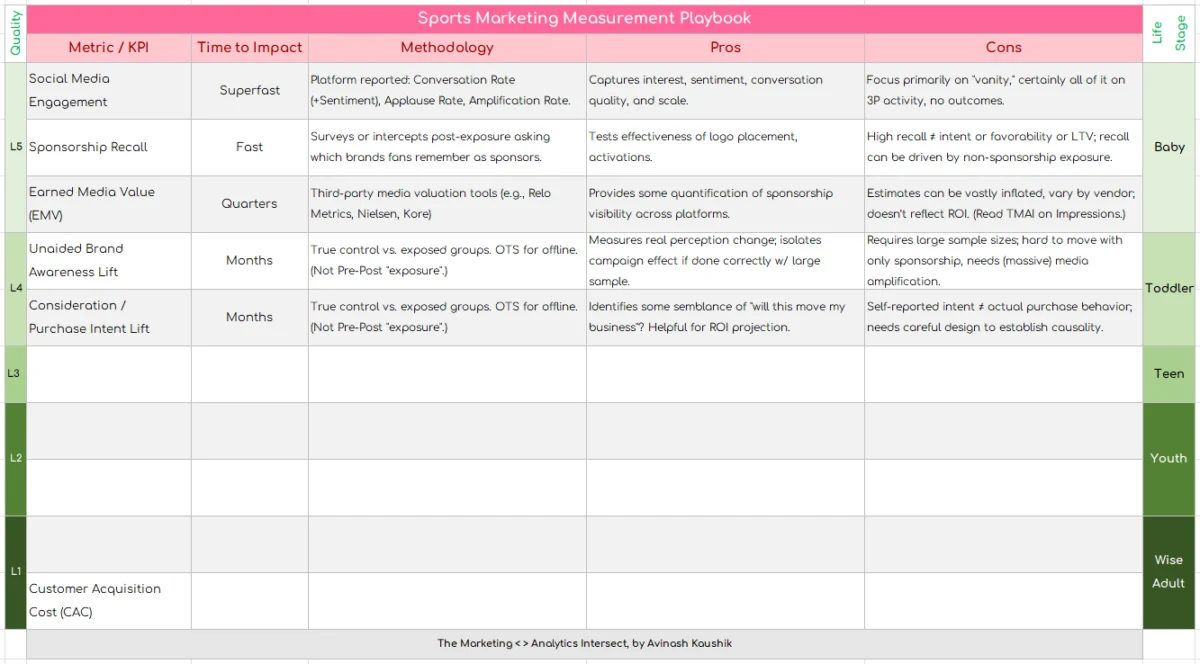
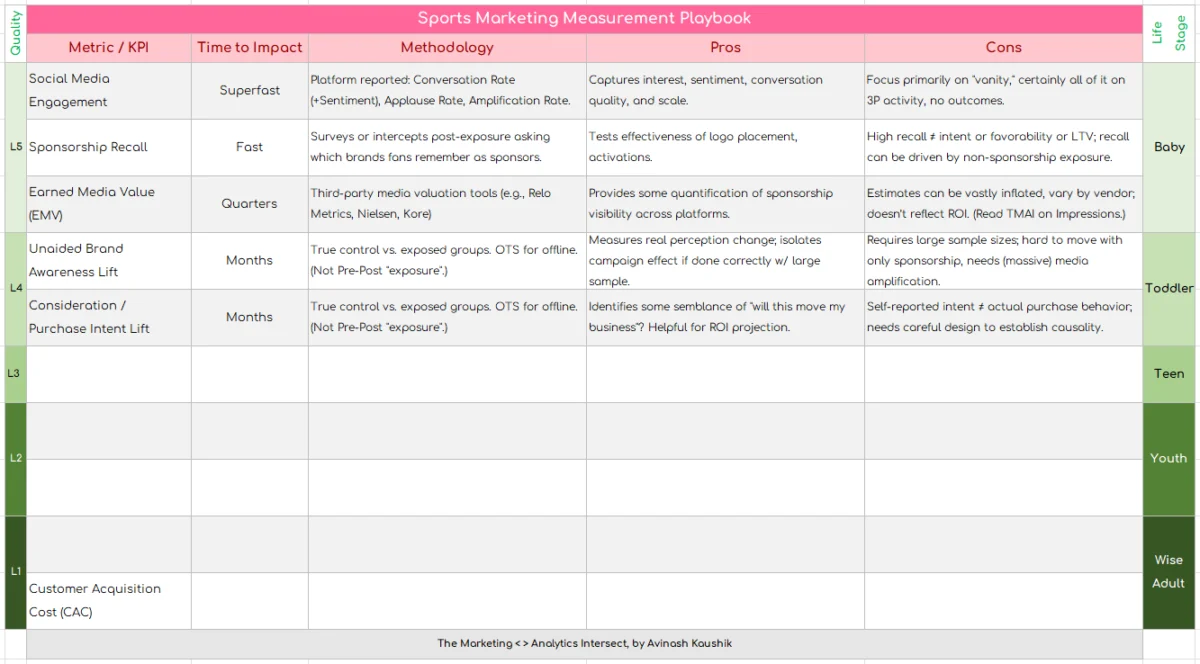
For organizations looking to move beyond "hospitality ROI"—where the primary metric is the happiness of the CEO’s mother-in-law—a rigorous measurement framework is required. This framework, categorized by "Impact Intelligence Scores" (IIS), transitions from basic visibility metrics to sophisticated financial incrementality.
Level 5: The Opening Gambit (Vanity Metrics)
Most brands begin their journey at Level 5, the realm of "Big Numbers." This level is defined by vanity metrics—impressions, social media engagement (applause, conversation, and amplification rates), and Ad Value Equivalency (AVE).
AVE, often championed by agencies, is widely considered a "con" by rigorous analysts. It calculates the cost of an ad if the brand had paid for the screen time of their logo, ignoring the reality that a fleeting logo placement is not the same as a dedicated, persuasive marketing message. While these metrics can establish a baseline for reach, they offer zero insight into causality or financial outcomes. They measure the noise, not the impact.
Level 4: The Quest for Brand Impact
At Level 4, organizations shift their focus to the human element. This requires moving away from pre-post surveys toward true test-versus-control methodologies. The goal is to answer a fundamental question: Did the sponsorship shift how the target audience thinks and feels about the brand?
Key metrics at this stage include:
- Unaided Brand Awareness (UBA) Lift: A long-term revenue driver that, while difficult to move, serves as a cornerstone of brand health.
- Consideration and Purchase Intent: When these metrics shift, the CFO takes notice. Measuring these requires sophisticated survey instruments that compare "exposed" groups (those who viewed the sports content or associated ads) against a control group of similar individuals who were not exposed.
Propensity score matching is essential here to ensure that the test and control groups are truly comparable. By accounting for external variables—such as concurrent product launches or competitor activity—brands can begin to isolate the specific impact of their sports investment.
The Strategic Implications for Modern CMOs
The move toward higher-level measurement—Levels 3, 2, and 1—represents the shift toward "nirvana" in marketing analytics. These levels delve into heart-and-mind influence, digital traces, and ultimately, proof of incrementality.
When a company decides to outsource its storytelling to a sports entity, it is making a high-stakes bet that the values of the athlete or the sport will successfully transfer to the brand. This can be immensely profitable—as seen in the long-standing, symbiotic relationship between Rolex and professional tennis. However, this transfer of value must be a conscious decision, not a byproduct of a lack of creative strategy.
The Financial Imperative
For the Chief Marketing Officer, the implication is clear: stop sponsoring in the dark. If a brand cannot prove through Marketing Mix Modeling (MMM) that their sports marketing is driving incremental profitability, the budget is likely being wasted.
The most successful companies treat sports marketing as a force multiplier for paid media. By using the sports association to generate high-quality, emotionally resonant creative, and then applying a consistent frequency strategy, brands can transcend the clutter. They no longer rely on the passive hope that a logo on a scoreboard will trigger a purchase. Instead, they use the sports platform as the engine for a comprehensive, data-driven customer acquisition strategy.
Conclusion: Turning the Lights On
Sports marketing remains one of the few vehicles capable of capturing mass attention in an increasingly fragmented world. However, the days of justifying these expenditures through luxury suite access and vanity impressions are coming to an end.
As analytics technology matures, the "dirty little secret" of the industry—that much of sports marketing lacks a direct line to revenue—is being exposed. To survive and thrive, brands must treat their sports sponsorships with the same level of analytical rigor as their digital performance marketing. By adopting a tiered measurement framework, moving from basic activity reporting to advanced incrementality testing, CMOs can finally provide their boards with the proof they deserve. The goal is no longer just to be present in the stadium; it is to ensure that every dollar spent translates into a measurable, long-term shift in market position.
In a world where sports is the last great shared experience, the brands that win will be those that stop counting eyeballs and start counting impact.