By [Author Name]
Published in Business & Technology Insights
Main Facts
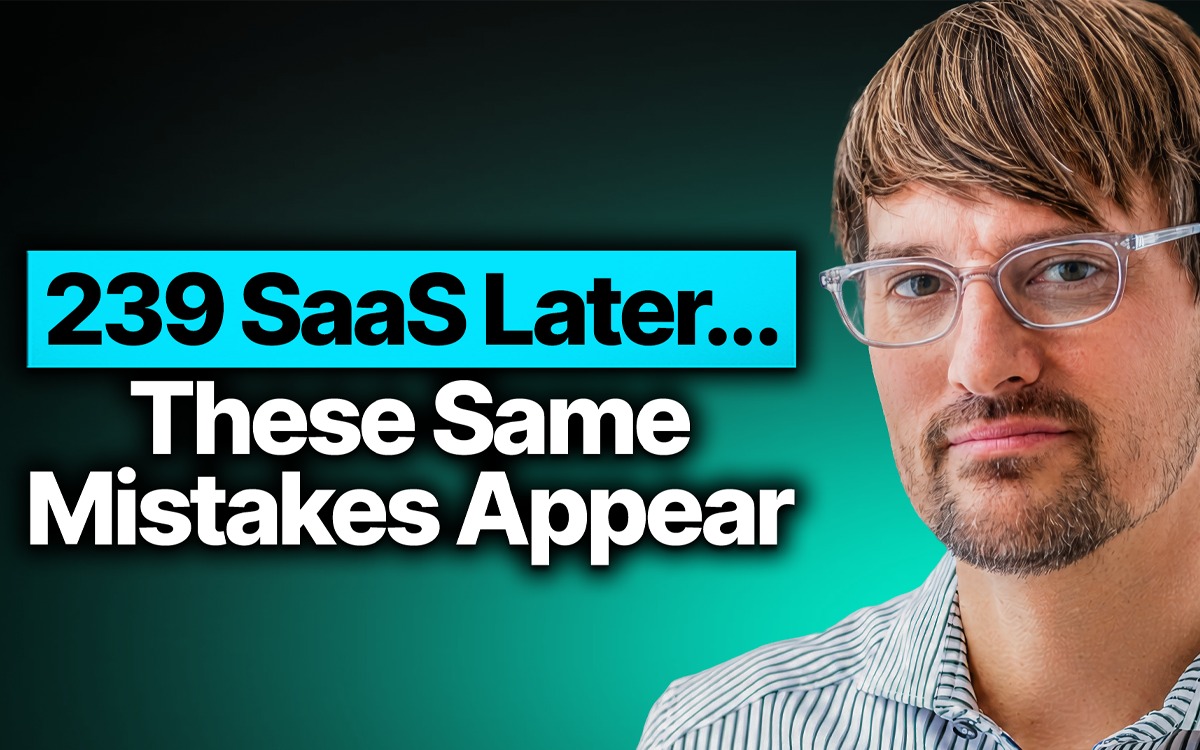
In a recent episode of the Niche Pursuits podcast, host Rob Walling sat down to break down the realities of building, scaling, and exiting Software-as-a-Service (SaaS) businesses. Walling brings a quarter-century of software experience to the table, boasting a portfolio that includes founding and selling multiple companies, mentoring hundreds of entrepreneurs, and investing in 239 SaaS businesses through his accelerator, TinySeed.
The conversation directly targets solo operators and bootstrapped founders, offering a tactical blueprint for overcoming common startup hurdles—specifically optimizing pricing models, reducing customer churn, and identifying high-value target markets. Central to Walling’s thesis is that software businesses should be engineered to grant their creators autonomy and ultimate financial freedom, rather than chaining them to endless operational stress.
Chronology: From Electrician to Software Maven
Rob Walling’s entrepreneurial journey did not begin in a high-tech incubator or a venture-backed Silicon Valley garage. Instead, his career roots lie in blue-collar labor. Following in the footsteps of his father and brother, Walling initially worked as a construction worker and electrician.
However, realizing that the trade did not align with his long-term goals, Walling pivoted. Having taught himself how to code as a child on an Apple IIe computer, he began spending his nights and weekends at the local library studying modern programming languages. His self-taught determination eventually landed him a professional job as a software developer.
While employment in the tech sector offered stability, Walling quickly grew disillusioned with spending his career building someone else’s vision. This realization sparked a moonlighting habit: building software products on nights and weekends.
Operating in the early 2000s—long before concepts like "customer development" and "lean startup methodology" became industry standard lexicon—Walling watched many of his early micro-products fail to gain traction. Undeterred, he kept building. Over time, he pieced together a portfolio of small, sustainable software products.
Remarkably, this collection of tiny products generated enough income to comfortably sustain a lifestyle in the United States while requiring only about 12 hours of work per week. This hyper-efficient lifestyle model mirrors the modern dream of many digital entrepreneurs today. Eventually, however, comfort gave way to ambition. Seeking a new challenge, Walling transitioned into acquiring existing SaaS companies, building more complex software, executing successful exits, and shifting into his current role as an advisor, mentor, and investor.
Supporting Data and the TinySeed Funding Gap
A significant portion of the podcast discussion centered around the creation and philosophy of TinySeed, the early-stage B2B SaaS accelerator Walling co-founded. Out of the six companies Walling has launched, five were entirely bootstrapped. TinySeed remains the only enterprise for which he has raised external capital, securing $59 million from outside investors.
Walling created TinySeed to bridge a notorious funding gap in the startup ecosystem: the chasm between traditional bootstrapping and venture capital. According to Walling, the traditional VC model is fundamentally misaligned with the vast majority of software companies. Venture funds typically require a "unicorn" outcome—a billion-dollar or multi-billion-dollar valuation—to generate the returns their limited partners expect.
This creates a structural mismatch for founders whose businesses are thriving, highly profitable, but ultimately scaled for a modest exit. A $20 million or $30 million acquisition can be profoundly life-changing for a solo founder or small team, yet it barely registers as a rounding error for large venture capital firms.
To illustrate the viability of smaller exits, Walling shared a case study from the TinySeed portfolio: a bootstrapped, two-founder company that recently achieved a $20 million exit. Because TinySeed owned a 10% equity stake, the accelerator netted a $2 million return, while the founders walked away with a staggering $18 million. This dynamic proves that founders do not need to chase a billion-dollar valuation to achieve generational wealth.
When evaluating B2B SaaS applications for investment, TinySeed relies on a stringent set of core metrics to separate viable businesses from stalled projects:
- Growth Momentum: Because momentum is notoriously difficult to fake, stagnant companies lingering between $1,000 and $50,000 in Monthly Recurring Revenue (MRR) often signal deeper operational or product-market fit issues.
- Customer Churn: Described by Walling as "the death of SaaS," churn measures how quickly revenue leaks out of the business as dissatisfied or indifferent customers cancel subscriptions.
- Average Revenue Per Account (ARPA): A company charging $30 a month requires a vastly different marketing, support, and sales infrastructure than one commanding $500 or $1,000 monthly.
Official Insights: Pricing Psychology and Market Segmentation
One of the most profound takeaways from the discussion was Walling’s identification of the single most common mistake SaaS founders make: underpricing their software.
Makers routinely undervalue their creations. Because founders write the code themselves, they tend to calculate price based on the time and effort it took to develop the product, rather than the immense value it delivers to the user. Walling stressed that customers do not care how many hours went into coding; they pay for distinct business outcomes, such as:
- Saving significant manual labor hours
- Streamlining complex compliance workflows
- Generating direct top-line revenue
- Mitigating costly operational risks
As an example, Walling highlighted Senior Place, a TinySeed portfolio company providing CRM software specifically tailored for senior placement agents. Because the software targets a hyper-specific niche and solves a high-stakes business problem, it easily commands pricing in the hundreds of dollars per month. While high price points can induce imposter syndrome in first-time founders, they ultimately attract better clients, provide superior support economics, and drastically lower churn.
Navigating Market Categories
Walling also categorized software markets into three distinct types:
- Horizontal SaaS: Products applicable to almost any business, such as scheduling software like Calendly.
- Vertical SaaS: Products built exclusively for a single industry, such as CRM tools for jewelers or senior care placement agents.
- Orthogonal SaaS: Products that serve a specific job title or department across a wide variety of industries (e.g., applicant tracking systems utilized by human resources personnel regardless of the company’s sector).
Data across TinySeed’s portfolio indicates that deeply focused products often experience smoother growth curves because their messaging, feature sets, and pricing validations are clear-cut.
Implications: Founder Psychology, Execution Speed, and Marketing Realities
Success in the SaaS ecosystem, according to Walling, is a cocktail of founder execution, market demand, product utility, and a dash of unpredictable luck. While luck remains outside human control, execution speed is entirely within the founder’s hands.
Walling warns that many promising companies stall not because of bad markets, but due to slow, indecisive leadership. The most successful founders share specific behavioral traits:
- High Decision Velocity: Top-tier founders test marketing theories rapidly. If a founder spends six months agonizing over perfect copy, design, and infrastructure for a single test, momentum dies. Walling advocates for a fast-testing mindset where being right 60% of the time is more than enough, provided the team learns and iterates quickly.
- Radical Self-Awareness: When founders claim a marketing channel "doesn’t work anymore," Walling often diagnoses a different underlying problem: poor execution rather than channel exhaustion.
Rethinking SaaS Marketing
Pushing back against the modern gospel of social media audience-building, Walling argued that accumulating social followers is rarely a complete go-to-market strategy. While an audience helps in the nascent stages, companies frequently plateau at $5,000 to $15,000 in MRR if they rely solely on content creation.
Instead, founders must build a network and master reliable acquisition channels tailored to their specific audience, including:
- Strategic Partnerships and Integrations: Building native integrations with complementary software products allows for mutual cross-promotion. Walling noted that during his time scaling Drip, his team launched roughly 35 integrations in 18 months, unlocking exponential distribution loops.
- Podcast and YouTube Tours: Appearing where target buyers already consume media.
- Targeted In-Person Industry Events: Engaging high-value enterprise clients face-to-face.
Understanding SaaS Exits and Founder Involvement
When a SaaS company reaches maturity, its exit valuation typically depends on scale. Smaller operations generating roughly $1.5 million to $2 million in Annual Recurring Revenue (ARR) are generally valued as a multiple of net profit, EBITDA, or Seller’s Discretionary Earnings (SDE). Conversely, larger firms exceeding $2 million in ARR attract private equity firms or strategic acquirers, commanding valuations based on revenue multiples.
However, the degree of founder involvement directly dictates the terms of the deal. If a founder is the linchpin holding the product, engineering, and customer relationships together, acquiring companies will almost universally require a multi-year transition period (often one to three years) to ensure continuity. Founders must anticipate this operational handover long before testing the waters of the M&A market.
Ultimately, Walling’s overarching message cuts through the noise of modern tech hype: building a successful SaaS company requires treating it as a mature, holistic business from day one. By prioritizing rigorous pricing models, minimizing churn, maintaining relentless execution speed, and targeting clear market needs, solo operators and bootstrapped founders can successfully engineer businesses that deliver lasting financial freedom and operational autonomy.