
By Global Business Insights
Published: Early 2026
Main Facts: The Current State of AI in Marketing
For the past three years, marketing departments worldwide have engaged in a massive, high-stakes experiment with generative artificial intelligence. For some organizations, this period has yielded genuine operational efficiencies, streamlined research phases, and accelerated content production pipelines. However, for a far greater number of companies, the generative AI boom has translated into little more than a mounting pile of software subscriptions, escalating overhead costs, and profound employee frustration.
A stark disconnect continues to separate the theoretical promises of AI from its practical, bottom-line value. While executives chase vague "AI best practices" that lack traceable real-world outcomes, organic traffic and search engine clicks are experiencing a steep, unprecedented decline. Platforms are discovering that simply flooding the digital ecosystem with machine-generated text does not equate to audience engagement or revenue generation.
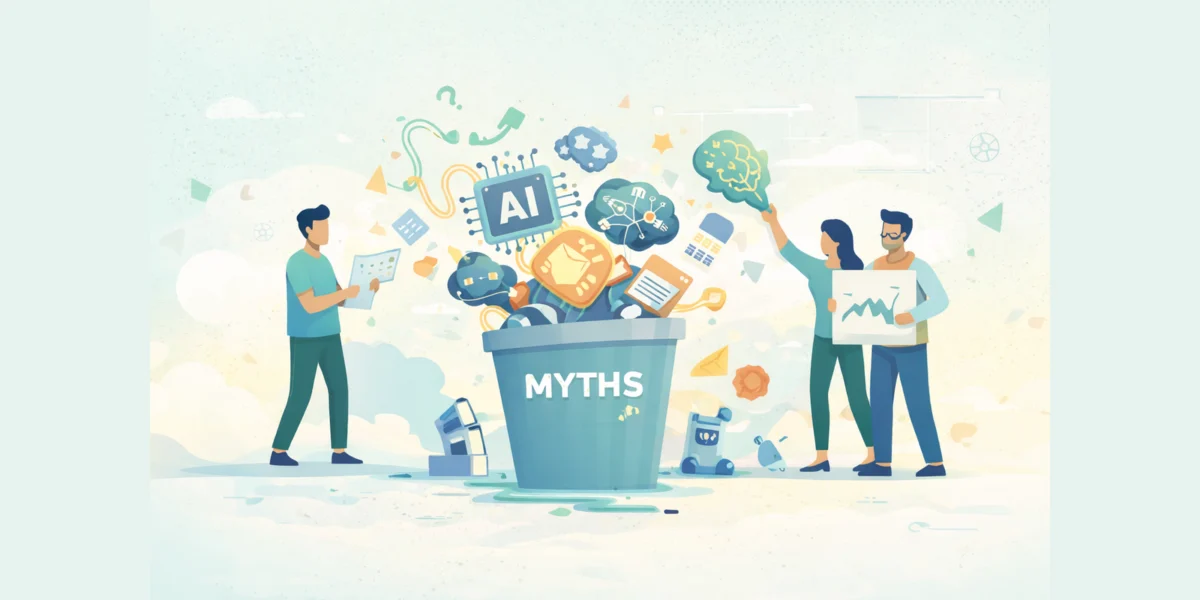
As the industry matures past the initial shockwave of generative tools, marketing leaders are being forced to confront uncomfortable truths. The prevailing wisdom surrounding AI content programs has been heavily distorted by two extremes: hyper-enthusiasts promising miraculous transformations with zero effort, and skeptics dismissing the technology as a temporary fad. Neither perspective serves the modern marketing director tasked with driving measurable ROI. Consequently, industry experts are calling for a definitive reset—urging brands to dismantle five persistent myths that have derailed content operations through 2025 and into 2026.
Chronology: Three Years of Experimentation, Frustration, and Reality Checks
To understand how the content marketing industry arrived at its current crossroads, it is necessary to examine the rapid evolution of generative AI tools over the past thirty-six months.
Phase 1: The Gold Rush (2023)
When consumer-facing generative AI tools first exploded onto the mainstream market, the immediate reaction across corporate marketing departments was panic and urgency. Driven by intense fear of missing out (FOMO), executive teams mandated the rapid adoption of any available AI writing assistant. The primary metric of success during this initial phase was sheer volume. Teams celebrated their ability to produce five, ten, or even twenty times more blog posts, social media updates, and email campaigns than they had managed manually in the past. Little attention was paid to strategic alignment, brand voice, or downstream conversion metrics.
Phase 2: Tool Saturation and Diminishing Returns (2024)
By the second year, the cracks in the volume-first strategy began to show. Companies had accumulated sprawling tech stacks featuring dozens of disconnected point solutions for copywriting, image generation, keyword research, and optimization. Instead of saving time, marketing professionals spent hours jumping between disparate platforms, copying and pasting prompts, and heavily editing generic, repetitive outputs. Concurrently, search engines and digital platforms began adjusting to the deluge of synthetic text, raising the bar for what qualified as valuable, authoritative content. Organic traffic metrics flatlined or plummeted for brands relying entirely on unedited AI copy.
Phase 3: The Pivot to Discipline and Integration (2025–2026)
Entering 2026, the corporate consensus on generative AI has shifted dramatically from unbridled optimism to pragmatic discipline. Organizations are realizing that technology alone cannot compensate for foundational weaknesses in strategy, brand differentiation, or editorial oversight. The current focus centers on integrated workflows—embedding AI directly into existing Content Management Systems (CMS), editorial calendars, and creative briefs—while prioritizing human expertise, rigorous fact-checking, and audience trust.
Supporting Data: The Metrics Driving the Shift
The pushback against uncritical AI adoption is not merely anecdotal; it is heavily backed by recent industry research and shifting digital consumption patterns.
- The Click-Through Crisis: Recent data highlights a dramatic transformation in how users discover information online. According to comprehensive research released by Ahrefs, the introduction of AI-powered search features—such as AI Overviews—has reduced outbound clicks to traditional top-ranking web pages by roughly 34.5%. This structural shift proves that high search engine rankings no longer guarantee visibility or traffic.
- The Proliferation Problem: Enterprise content teams using generative tools without strict oversight have generated an unprecedented surplus of digital content. However, internal analytics across multiple sectors reveal that while publishing volume has surged by hundreds of percentage points, downstream conversion rates have largely stalled.
- The Integration Paradox: Industry benchmarks indicate that companies utilizing connected, workflow-embedded AI tools report twice the productivity gains compared to organizations that simply layer standalone AI subscriptions onto traditional, manual processes.
Official Responses and Industry Perspectives
Thought leaders and digital platforms are increasingly vocal about the need for a recalibrated approach to artificial intelligence in content creation.
Industry analysts emphasize that while AI remains a powerful "force multiplier" for high-performing teams, it must be treated as a collaborative partner rather than an autonomous replacement for human creativity. Organizations like Contently have consistently advocated for an operational model that bridges the gap between machine efficiency and strict editorial governance.
"Used thoughtfully, AI can streamline research, tighten workflows, and help people ship higher-quality content faster," industry experts note. "But we also recognize that there are persistent myths about what AI can realistically do. Hype merchants promise transformation without effort, while skeptics dismiss everything as a fad. Neither helps the marketing director trying to figure out what actually works."
Compliance and regulatory bodies are also weighing in. In specialized sectors—such as finance, healthcare, and legal services—enterprises face stringent oversight regarding data privacy, accuracy, and brand safety. Consequently, industry demand has surged for verified human subject-matter experts—such as Chartered Financial Analysts (CFAs), Medical Doctors (MDs), Juris Doctors (JDs), and FINRA-registered reviewers—to oversee and validate AI-assisted content before it reaches the public.
Implications: Dismantling the Five Myths of AI Content Marketing
To thrive in the current digital landscape, marketing leaders must systematically deconstruct and abandon five foundational misconceptions that continue to misguide content programs.
Myth 1: More AI Tools Automatically Mean More Efficiency
- The Illusion: On paper, adding more software licenses, specialized plugins, and autonomous agents should logically compound a team’s productivity and output.
- The Reality: In practice, layering standalone AI tools on top of one another often creates severe operational friction. Instead of eliminating manual steps, team members waste valuable hours moving data between incompatible platforms, managing multiple subscriptions, and managing conflicting tool outputs.
- What Works: True efficiency stems from connected workflows rather than tool accumulation. Before introducing new technology, organizations must map their end-to-end content processes, eliminate genuine bottlenecks, and consolidate platforms. Investing in comprehensive team training and establishing clear operational guardrails yields far greater productivity dividends than chasing every emerging software feature.
Myth 2: AI Content Performs Just as Well on Its On
- The Illusion: Modern language models generate grammatically flawless, highly coherent prose in seconds, leading many teams to publish raw AI output directly to their blogs and resource centers.
- The Reality: Left to its own devices, artificial intelligence naturally defaults to the safest, most statistically probable version of an idea—resulting in generic, forgettable copy that blends into the digital noise. Furthermore, both search engines and modern readers actively look for signals of authentic human expertise, lived experience, and original perspective. Grammatically correct copy is not synonymous with a compelling, persuasive narrative.
- What Works: High-performing content teams treat generative AI as a collaborative assistant suitable for rapid research, structured outlining, and initial drafting passes. Human editors must subsequently inject proprietary customer examples, clarify nuanced claims, sharpen rhetorical arguments, conduct rigorous fact-checking, and ensure alignment with overarching business goals.
Myth 3: AI Will Solve Bad Strategy
- The Illusion: If a content program is struggling with stagnant traffic or low engagement, injecting AI-driven speed and volume will somehow reverse those negative trends.
- The Reality: Artificial intelligence is an optimization engine; it accelerates execution, but it cannot fix fundamentally flawed positioning, muddy messaging, or misaligned business goals. Speed merely amplifies the direction in which an organization is already heading—meaning a poorly targeted strategy will simply fail faster and at a much larger scale. While traffic numbers might superficially rise, conversion rates will stall if the content fails to address genuine buyer pain points.
- What Works: Marketing leaders must establish crystal-clear messaging, define precise audience segments, and map out unambiguous conversion paths before scaling content production. Once a sound strategy is established, AI can be deployed to execute that vision efficiently.
Myth 4: Everyone Needs to Adopt AI for Everything Immediately
- The Illusion: The intense fear of falling behind competitors forces executive boards to mandate immediate, enterprise-wide adoption of generative tools across every department, regardless of internal readiness.
- The Reality: Decisions driven by FOMO frequently backfire, resulting in expensive, mismatched technology deployments that breed employee confusion, operational friction, and deep skepticism. Teams that lack foundational content workflows or clear governance frameworks often discover that scaling AI production merely multiplies their brand, legal, and data-privacy risks.
- What Works: The most successful AI adopters move deliberately rather than hastily. They begin by identifying a single, high-impact use case where artificial intelligence can genuinely remove friction or reduce operational costs. By running a contained pilot, documenting specific improvements, and establishing rigorous data governance, organizations can safely scale their AI integration over time.
Myth 5: AI Search Is Basically the Same as SEO
- The Illusion: Because traditional marketers understand visibility through the lens of search engine rankings and keyword optimization, it is easy to assume that AI-powered answer engines operate as a simple extension of legacy algorithms.
- The Reality: AI search functions fundamentally differently than traditional web indexing. Instead of simply ranking discrete web pages, large language models compress, synthesize, and rewrite information drawn from multiple sources simultaneously. As a result, securing a top-ten organic ranking no longer guarantees visibility or referral traffic.
- What Works: While foundational SEO practices—such as site performance, topical authority, and technical optimization—remain essential, marketers must adopt specialized strategies designed for generative engine visibility. This includes implementing robust schema markup, establishing clear entity definitions, and structuring content in direct, question-driven formats that language models can easily parse and cite.
Conclusion
The initial years of generative AI experimentation were defined by rapid discovery, boundless enthusiasm, and inevitable missteps. As the industry transitions into 2026, the mandate for marketing leaders is clear: trade breathless predictions for operational discipline. By discarding outmoded myths, integrating tools directly into unified workflows, and balancing machine efficiency with uncompromising human oversight, organizations can finally realize the true, practical potential of artificial intelligence—proving definitively that the work is working.
Frequently Asked Questions (FAQs)
How do I know if my team is genuinely ready for advanced AI adoption?
Assess your current content operations before purchasing new tools. If your team already operates with documented workflows, consistent publishing schedules, and clear brand guidelines, you are well-positioned to pilot AI solutions. If your baseline operations remain disorganized or ad-hoc, you must strengthen those fundamental processes before introducing the complexity of artificial intelligence.
What is the minimum investment required to see measurable results from AI content tools?
Many organizations can begin utilizing AI features built directly into their existing enterprise content platforms at no additional software cost. The primary investment required is time: expect to dedicate two to four weeks to staff training, prompt engineering education, and editing workflow development before achieving consistent productivity gains.
How should marketing leaders balance traditional search engine optimization with AI Search optimization?
Treat them as complementary pillars of a modern digital strategy. Continue building deep topical authority, improving technical site performance, and earning high-quality backlinks, as these traditional fundamentals remain critical. Simultaneously, layer on AI-specific best practices, including structured data markup, explicit entity definitions, and concise, question-driven content formats designed to win citations in generative search engines.