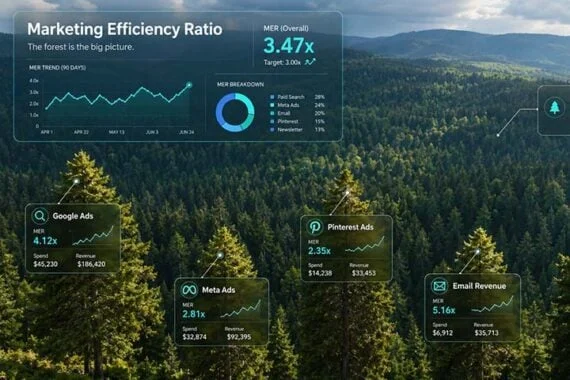
In the modern digital landscape, ecommerce marketers are drowning in data but often starving for clarity. Despite the proliferation of sophisticated, AI-driven tracking tools and granular attribution models, the quest for a "perfect" view of advertising performance remains elusive. Every platform—from Google Ads and Meta to email service providers and affiliate networks—offers its own dashboard, each claiming credit for the same dollar of revenue.
The result is a fragmented reality where merchants spend more time debating attribution methodologies than analyzing business growth. While individual channel metrics like Return on Ad Spend (ROAS) and Cost Per Acquisition (CPA) are essential for tactical optimization, they often obscure the "forest for the trees." To navigate this complexity, forward-thinking ecommerce teams are increasingly turning to a holistic, high-level metric: the Marketing Efficiency Ratio (MER).
The Fragmentation Crisis: Why Attribution is Broken
The core challenge facing digital marketers today is the "attribution mess." Platforms like Meta, TikTok, and Google use proprietary tracking pixels and API integrations to report performance. However, these reports are inherently biased. A Google Shopping campaign might claim a sale because it was the last click, while a Facebook ad might claim the same sale because the user viewed it three days prior.
This competition for credit creates a "silo effect." If an ecommerce manager relies solely on platform-reported ROAS, they may inadvertently kill off top-of-funnel awareness campaigns that don’t drive immediate clicks but are vital for brand discovery. Conversely, they may double down on bottom-of-funnel retargeting, unaware that those conversions are cannibalizing organic traffic.
The "tree" represents the specific campaign performance, while the "forest" represents the bottom-line health of the business. Relying only on the trees leads to distorted decision-making.
Defining MER: The "Blended" Solution
The Marketing Efficiency Ratio (MER) is a simple, yet powerful, financial indicator that compares total revenue to total marketing spend. Unlike platform-specific metrics, MER is platform-agnostic. It does not care where the traffic came from or which algorithm took the credit. It only cares about the relationship between total output (revenue) and total input (investment).
The Formula
The calculation is straightforward:
MER = Total Revenue ÷ Total Marketing Spend
For example, if an ecommerce brand generates $1,000,000 in monthly revenue and spends $250,000 across all marketing channels—including ad spend, agency retainers, software subscriptions, and influencer fees—the MER is 4.0. This means for every dollar invested, the company generates $4.00 in revenue.
Why It’s Called "Blended ROAS"
Many marketers refer to MER as "Blended ROAS." While traditional ROAS is a vertical metric (looking deep into one channel), MER is a horizontal metric (looking across the entire business). It serves as the ultimate "sanity check" for the marketing department.
Chronology of a Metric: From Granular to Holistic
The evolution of digital marketing metrics has moved in waves. In the early 2010s, "Last Click" attribution was the industry standard. As data privacy laws tightened—most notably with Apple’s iOS 14.5 update—the efficacy of granular tracking plummeted.
- The Era of Precision (2010–2018): Marketers were obsessed with tracking every single user journey. Advanced multi-touch attribution (MTA) models promised to assign the perfect weight to every touchpoint.
- The Privacy Pivot (2018–2022): GDPR, CCPA, and Intelligent Tracking Prevention (ITP) decimated the ability to track users across sites. The "perfect" data became statistically insignificant.
- The Era of Holistic Profitability (2022–Present): With the death of hyper-precise tracking, savvy ecommerce teams pivoted back to first principles. MER emerged as the preferred metric for businesses looking to scale sustainably without being tethered to the volatile reporting of third-party platforms.
Supporting Data: Why MER Trumps Channel Attribution
The utility of MER lies in its ability to bypass the "attribution argument." Consider a standard customer journey: A shopper discovers a product via an Instagram Reel, signs up for an email newsletter to get a discount, searches for the brand on Google after a few days, and finally completes the purchase via a direct link in an email.
In this scenario, four different tools might claim the sale. Marketing teams often waste countless hours trying to "reconcile" these numbers. MER ignores this entirely. It treats the marketing budget as a single, unified investment designed to drive the top line.

Guardrails for Growth
MER acts as a financial guardrail. By establishing a "break-even MER," leadership can define the boundaries of acceptable spend:
- Target MER: The level at which the business is highly profitable.
- Minimum Viable MER: The level at which the business covers its overhead without losing cash.
- Scale MER: A lower, but still profitable, ratio that allows for aggressive expansion into new markets or channels.
If a company operates at a 4.0 MER, a drop to 3.0 provides an immediate, indisputable signal that the current marketing mix—or the product pricing—is failing to deliver the expected returns.
Official Responses and Industry Consensus
Financial analysts and ecommerce consultants widely endorse the move toward MER, particularly in the current economic climate where capital efficiency is prioritized over "growth at all costs."
"The goal of marketing isn’t just to generate clicks; it’s to generate sustainable growth," says Sarah Jenkins, a lead consultant for a prominent ecommerce advisory firm. "When we work with high-growth brands, we stop looking at Meta ROAS as the holy grail. We look at MER to see if the overall investment is moving the needle on revenue. If the platform ROAS is high but the business-wide MER is stagnant, you aren’t growing; you’re just moving money around."
Conversely, critics of MER argue that it is too simple. By ignoring channel performance, one might continue to fund a failing channel (like a low-performing influencer campaign) because the total revenue is still high. However, proponents argue that MER is a complementary metric, not a replacement. One should use MER to understand the big picture and then drill down into ROAS to optimize specific tactics.
Implications for Modern Ecommerce Teams
Adopting MER forces a shift in how marketing teams are structured and how they communicate with the C-suite.
1. Unified Budgeting
When MER is the primary KPI, marketing budgets are no longer split into silos. Instead of having a "Facebook budget" and an "Email budget," the team manages a "Growth budget." This allows for more agility; if the email channel is underperforming, funds can be shifted to search without the political friction of "stealing" from another channel’s budget.
2. Improved Agency Relationships
Agencies often fight for attribution. By focusing on MER, the brand and the agency are aligned on a single goal: increasing the total revenue of the business. This encourages agencies to focus on tactics that actually drive growth rather than tactics that just look good on a platform report.
3. Focus on Profitability
MER naturally encourages a focus on margin. If a company has a 30% gross margin, they know they cannot afford a low MER. This reality check forces marketers to look at Average Order Value (AOV) and Customer Lifetime Value (LTV). If they can increase AOV, they can maintain the same MER even if the cost per click rises.
The Big Picture: A Balanced Approach
There is no "perfect" MER. A high-margin luxury brand might thrive on a lower MER because they have more room to spend on customer acquisition, while a low-margin commodity retailer needs a high MER to survive.
The danger of MER is that it can mask inefficiency if the business is not careful. A company might have a healthy MER, but it could be coming from one highly profitable channel while others are hemorrhaging cash. Therefore, the best ecommerce strategy involves a dual-layer approach:
- The Macro View (MER): To assess overall marketing health and profitability.
- The Micro View (ROAS/CAC/LTV): To optimize individual tactics and ensure that the "trees" are healthy enough to support the "forest."
As the digital ecosystem continues to become more opaque and privacy-focused, the brands that win will be those that stop chasing the illusion of perfect attribution and start measuring what truly matters: the health of the entire business. MER provides the clarity required to move beyond the noise and build a sustainable, scalable, and profitable brand in an increasingly complex digital world.