By the emailexpert Security Desk
Published: September 2026
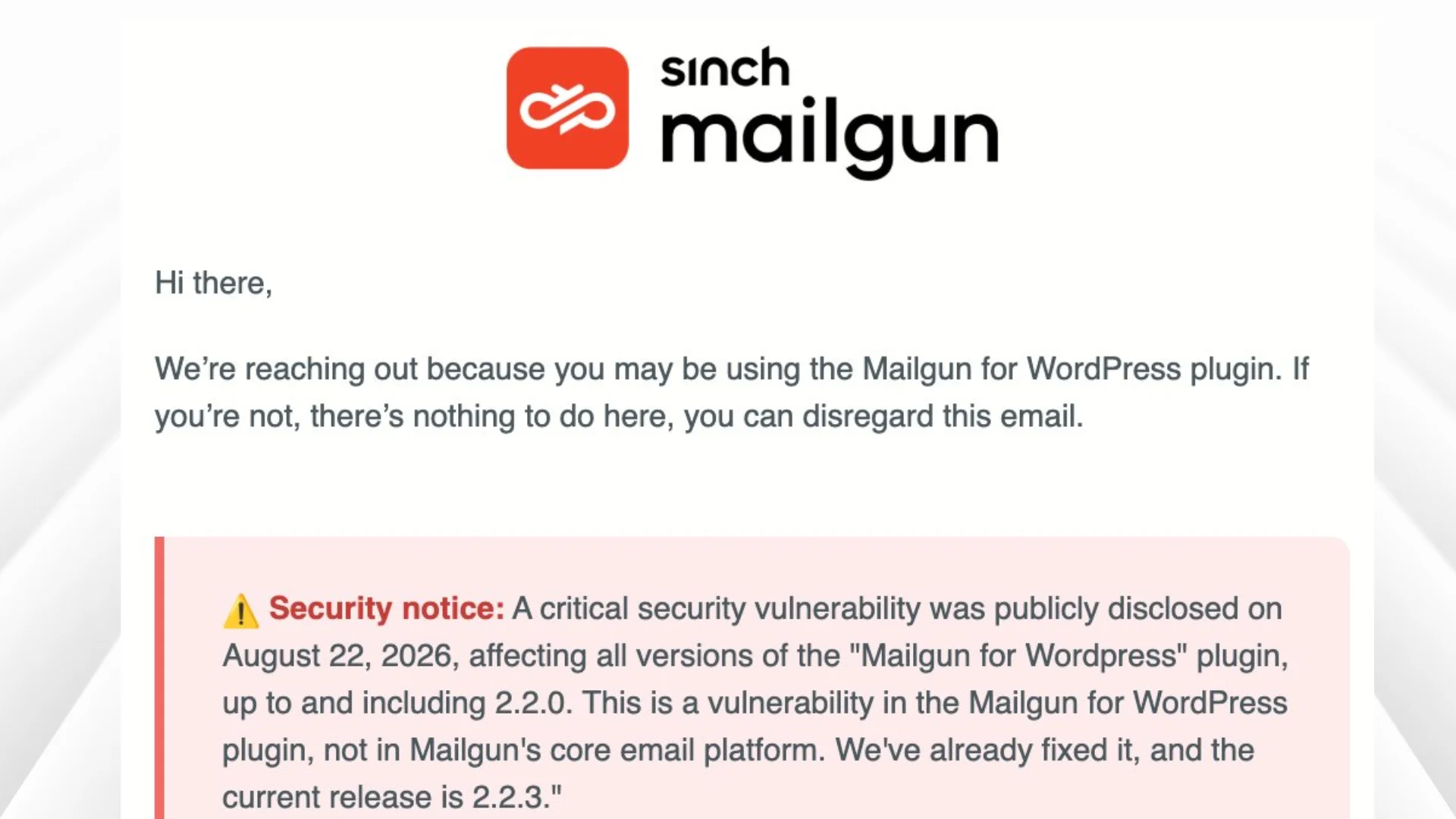
Website administrators running the popular Mailgun for WordPress plugin are being urged to update their installations immediately following the disclosure of a critical security flaw. Tracked as CVE-2026-78003, the vulnerability carries a near-maximum Common Vulnerability Scoring System (CVSS) rating of 9.8 out of 10.
The flaw allows unauthenticated, remote attackers to exploit the plugin’s API handling, potentially granting malicious actors total control over inbound email routes, facilitating account takeovers, and weaponizing compromised websites. With more than 80,000 active installations worldwide, the window for remediation is narrow, and security researchers warn that automated scanning and exploitation scripts may already be targeting vulnerable instances.
Main Facts: Anatomy of a Critical Flaw
At the heart of the issue is how the Mailgun for WordPress plugin manages communications with the broader Mailgun API. The vulnerability, classified by security firm Wordfence as a Server-Side Request Forgery (SSRF), stems from inadequate input sanitization within the plugin’s list subscription functionality.
Specifically, the add_list() function—responsible for handling mailing list sign-ups—utilized WordPress’s built-in sanitize_text_field() function to clean visitor-supplied array keys. While this function strips out standard HTML and undesirable characters, it fails to account for path traversal sequences. By crafting a malicious, specially formatted key, an unauthenticated attacker can manipulate the plugin into redirecting requests to arbitrary endpoints within the Mailgun API.
Because the request is signed with the target website’s stored Mailgun API key, the API treats the malicious instruction as an authorized command.
The Vector for Account Takeover
The most immediate and dangerous consequence of this SSRF vulnerability involves inbound email routing. An attacker exploiting CVE-2026-78003 can programmatically reconfigure a site’s inbound mail routes to forward all incoming correspondence—including password reset links for administrative accounts—directly to an attacker-controlled destination.
Once an attacker intercepts a password reset token for a WordPress administrator account, they can seamlessly compromise the host website, inject malware, create backdoor accounts, or deploy malicious redirects. Because the attack requires zero user interaction, no prior authentication, and can be completely automated, it represents a systemic threat to any WordPress installation running unpatched versions of the software.
Chronology of Disclosures and Patches
The timeline surrounding the discovery, patching, and public disclosure of CVE-2026-78003 highlights ongoing communication challenges in the open-source software ecosystem, particularly regarding vague changelogs and delayed transparency.
July 9: The Silent Patch
Mailgun quietly shipped Version 2.2.1 of the WordPress plugin on July 9. This update was designed to close two security holes. The first was CVE-2026-14834, a lesser vulnerability scoring 6.5 that allowed unauthorized users to add email addresses to a site’s mailing lists. The second fix addressed the underlying path-traversal logic that ultimately enabled the 9.8-severity SSRF vulnerability.
However, the public changelog accompanying the July 9 release was remarkably opaque. It merely mentioned preventing "unauthenticated arbitrary list subscription." There was no mention of API key manipulation, server-side request forgery, or the severe risk of account takeover. Website administrators who reviewed the changelog in July could easily have misinterpreted the update as a minor anti-spam measure that could be safely deferred.
August 22: Public Vulnerability Disclosure
Six weeks after the silent patch was deployed, the full nature of the SSRF vulnerability was officially published, cataloged under CVE-2026-78003. This public revelation connected the dots between the patched code and the severe risk it posed to API keys and administrative security.
Late August: Conflicting Reports on Active Exploitation
As news of the vulnerability spread across security channels, threat intelligence firms began monitoring for signs of weaponization:

- August 28: Threat intelligence provider VulnCheck reported observing active exploitation attempts targeting CVE-2026-78003 in the wild.
- CISA Assessments: Conversely, assessments from the Cybersecurity and Infrastructure Security Agency (CISA), published just days prior, indicated no widespread exploitation at the time of their review.
As of publication, emailexpert has not independently confirmed widespread active campaigns, but given the automated nature of modern vulnerability scanning, exploitation attempts are expected to surge.
Supporting Data and Technical Scope
Understanding the scope of CVE-2026-78003 requires a closer look at affected versions and the nature of the API keys utilized by WordPress plugins.
Version Matrix
- Affected Versions: All versions of the Mailgun for WordPress plugin up to and including 2.2.0.
- Active Installations: Over 80,000 live websites at the time of discovery.
- Current Release: Version 2.2.3 (which includes further stability and security hardening).
The Dilemma of API Key Privileges
A critical nuance in evaluating the risk of this vulnerability involves the type of Mailgun API key stored within the WordPress plugin settings:
- Primary Account Keys: These master keys possess full administrative control across every sending domain associated with the Mailgun account. If a site utilizes a primary account key within the WordPress plugin, an attacker leveraging CVE-2026-78003 gains absolute power over the entire Mailgun account, potentially impacting multiple distinct web properties and domains.
- Domain-Specific Sending Keys: These keys are restricted in scope and can only transmit mail for a single, designated domain. While a compromised sending key limits an attacker’s reach—preventing them from creating arbitrary global routing rules—it still permits them to send spoofed emails originating from that specific domain.
The Operational Catch: Many WordPress sites rely on the plugin’s native list sign-up and management features, which require elevated privileges beyond basic sending rights. Consequently, administrators cannot simply downgrade their API keys to domain-only sending keys without breaking core website functionality. The same architectural risk applies broadly across many Email Service Provider (ESP) integrations in the WordPress ecosystem: whatever administrative permissions the stored API key holds, an exploiting attacker inherits instantly.
Official Responses and Industry Guidance
Security researchers, infrastructure providers, and plugin maintainers have scrambled to provide clarity and guidance to the WordPress community.
Wordfence analysts emphasized the severe nature of the bug in their threat intelligence briefing, noting that the combination of unauthenticated access and SSRF makes this one of the most dangerous plugin-level vulnerabilities seen in recent months. They reiterated that automated attack scripts can query thousands of WordPress sites per hour, testing for outdated plugin signatures.
Mainstream vulnerability databases, including the Common Vulnerabilities and Exposures (CVE) registry and OpenCVE, have updated their records to reflect the 9.8 CVSS score, cementing its status as a critical emergency item for security operations teams.
Mailgun’s development team has urged all users to bypass manual changelog analysis and immediately ensure their environments are running the latest software iteration.
Implications and What Administrators Must Do Now
The disclosure of CVE-2026-78003 serves as a stark reminder of the fragile dependency chains inherent in modern content management systems. A single mismanaged input field in a marketing or email delivery plugin can cascade into a complete infrastructure compromise, endangering both the host website and external cloud-based email services.
Action Plan for Website Owners and IT Managers
-
Verify and Update Immediately:
Check your WordPress plugins dashboard right away. If you are running Mailgun for WordPress version 2.2.0 or lower, update to version 2.2.3 (or the latest available release) immediately.- Sites with automated updates enabled may already be protected.
- Sites whose administrators delayed updates due to vague July changelogs must be inspected and updated manually at once.
-
Audit Mailgun API Keys:
If your WordPress site was running an unpatched version of the plugin during the vulnerable window, assume that your stored Mailgun API key may have been exposed or queried.- Log into your Mailgun dashboard.
- Revoke the compromised API key immediately.
- Generate a fresh API key and update your WordPress plugin settings accordingly.
-
Check Inbound Routes and Account Logs:
Review your Mailgun account settings for any unauthorized changes to inbound routing rules, forwarding destinations, or webhook configurations. Check your WordPress user database for rogue administrator accounts created during the exposed timeframe. -
Review ESP Plugin Hygiene:
This incident underscores the principle of least privilege. Whenever possible, restrict third-party plugin API keys to the narrowest possible operational scope, and maintain a strict schedule for monitoring security advisories across all installed WordPress components.